Version History
Bugfix for missing
thermo_updateinput found by gcc 16.2.
Bugfix for some combinations of negative drmultlo (p 325). Contributed by Riley Thai.
Add logo.
Add output of
NBURNand JMZ toprogvers(shown on startup and using theverscommand).
Fix for QSE transition from BURN: eliminate negative (or zero) values.
Add variables to
strfiles, update version to .
Add variables to
strfiles, update version to .
Add variables to
strfiles, update version to .
Bugfix in
ttycommforapproxcommand.
Rename parameter
timetotimesec.
Bugfix in
ttycommfor optional parameter definition check.
Bugfix for
sum*commands.
Bugfix for
timecommand.
Bugfix in
sdotq: ion name iseb0notebthin time step determination.
Bugfix in
kappa: ppn(l+3) ispt1noth2.
Bugfix in index/bound error in
dezone.
Bugfix in
wweak(write to invalid memory).
Bugfix restore old data if mixcycl (p 433)
2is used. May cause issues only together with killburn.
Bugfix neutrino rates not called (since ).
Bugfix non-fatal dimension error for
signun.
Bugfix to single-particle neutrino rates (bug of ).
Bugfix
index in BURN network.
Bugfix :code”pst command due to typo.
Bugfix in
coulcorto avoid NaN a low density.
Bugfix in
notedef.
Bugfix in refactored Coulomb corrections.
Minor refactor in Coulomb Corrections.
Add new edit quantities.
Add
abarderivatives to Coulomb corrections.
Update Coulomb corrections (Stan Woosley 20241128 PST)
Fix
xnemcinsubroutine es.
Fix
oparameter (re-)definitions.
Fix
calcnecall for edit variables fromes.
Add exponential cutoff for Coulomb Corrections at
10000.K (Stan Woosley 20241120).
Fix regression from core rotation addition in
convectl.
Fix regression from refactor for
oparmdefinition output.
Fix regression from refactor for module
cmd.
Fix regression from refactor for module
oparm.
Fix regression from refactor for module
mold.
Coulomb corrections bugfix (Stan Woosley 20241116).
Add new Coulomb corrections approach (Stan Woosley 20241115).
Changes:
iold
Set to value other than 0 to use old physics - mostly fix that energy generation in APPROX did not include neutrino losses and mass excess but only considered differences in binding energy. These are used as flags.
name
number
type
default
unit
iold
388
integer
0
-
value
result
0Use current physics.
1(bit 0) No nu loss in H burning and BE instead of ME and old nu loss routines (old1/old2, < 1997) this should not affect lburn (p 434) as that was only implemented later, i.e., here was no bug to be fixed - where lburn (p 434) is used, iold (p 388)
has no effect.
2(bit 1) Use old nu loss (old3)
4(bit 2) Use old (1997) nu loss and ME estimates (bad)
8(bit 3) Use old (1975) Iben electron conductivity. The revised version fixes a factor
2
16(bit 4) Double counting of
,
and reverse. This bug may have been introduced by Alex when adding Langanke
-induced spallation.
32(bit 5) Do not use fix in
64(bit 6) FFN weak rates are used for nu loss in BURN even if rates are zeroed because of being outside temperature/density range.
128(bit 7) QSE does not consider mass defect from weak rates.
256(bit 8) Do not use crude fix for coulomb corrections. rates.
512(bit 9) Do not use new coulomb corrections. rates.
Added In Version 15.15.
Changed In Version 17.0.5: Added
2.Changed In Version 17.0.8: Added
4.Changed In Version 17.0.11: Added
8.Changed In Version 17.6.5: Added
16.Changed In Version 17.9.1: Added
32.Changed In Version 18.10.3: Added
64.Changed In Version 18.29: Added
128.Changed In Version 18.30: Added
256.Changed In Version 18.46: Added
512.Original entry:
Physics Parameters


Write data file sha256 to dumps.
Additions:
datafile
Print datafile hashes to tty.
name
parameters
datafiledatafileAdded In Version 18.45.
Original entry:
Link Input Cards
Write data file sha256 to log file.
Parameter ioldfree (p 632) allows to free “old” saved memory when unused (at expense of cost to re-allocate).
Allow to mode source code saving.
Additions:
ioldfree
Free memory of old variable storage after convergence. May make code use slightly less memory at the expense of overhead for re-allocation of memory at the next cycle.
name
number
type
default
unit
ioldfree
632
integer
0
-
value
result
0do not free memory
1free memory
Added In Version 18.44.
Original entry:
Backup Control Parameters
Changes:
ittyv
Verbosity of
ttyoutput.
name
number
type
default
unit
ittyv
538
integer
-1
-Be quiet if set to
0.By default, all outputs are enabled.
value
result
bit
0enable echo for parameter changes
bit
1enable echo for command execution
bit
2enable echo for burn zone mapping
bit
2enable echo for load/save of source code
Added In Version 16.89.
Changed In Version 18.37: Disable echos for parameter change and command execution.
Changed In Version 18.42.1: Disable echos for BURN abundance mapping.
Changed In Version 18.44: Disable echos for source code load/save.
Original entry:
General Edit Control Parameters
Module
moldnow fully encapsulates saving and restoring code for saved “old” data and uses dynamical allocation. Allows another increase of data size (mostlyppnb) by about 40%.
Some old values moved from
varscommon block tomoldmodule. This allows about 40% larger data size (moslyppnb) before hitting the compiler size limit for common block ingfortran.
Fix for derivative of Coulomb correction switch.
Revised version of EOS routine (
es) to fully implement all abundance derivatives.
Source code in dumps and KEPLER is now compressed archive.
New
oparmmodule for optional parameters that full absracts internal representation. The module interface is stillint32, consistent with the rest of KEPLER. Integer optional parameters are now stored (again) as 64 bit integer, both internally as well as on disk. Internally, optional parameters are now allocatable arrays and inside theoparmmodule.iotypeis now internally 64 bit as well, but stored to disk asint8(wasint32). Theoparmmodule also supports logical and character types.
Changes:
Arithmetic Expressions
In arithmetic expressions integer and float numbers can be used. Arithmetic operations permitted are +, -, * , / , % (modulo), ** (power), and brackets, ( and ), however, the operands must be of same type (integer or float).
Additionally, the abs, log (logarithm base 10), ln (logarithm base
), exp, sqrt, sin, cos, tan, asin, acos, atan, sinh, cosh, tanh, asinh, acosh, atanh, erf, erfc, and erfcs (erfc_scaled), function have been defined.
The type conversion functions aint (truncate to integer - returns float), int (truncate to integer - returns integer), nint (nearest integer - returns integer), floor (nearest integer below - returns integer), ceil (nearest integer above - returns integer), and dble (returns float), and real (returns float) are defined as well.
The min and max functions return the lower or larger of the two arguments, separated by , or ;. Both arguments need to have same type, which is also type returned.
Changed In Version 17.0.12.
Changed In Version 18.7.4: Removed ^ (now used for xor).
Changed In Version 18.7.5: Add min and max functions.
Changed In Version 18.43: Add dble function.
Change cutoff in
etafor coulomb corrections to(Woosley 20241022).
Some (major) internal refactor of I/O units.
Allow disabling of BURN abundance mapping messages, ittyv (p 538) Bit
2.
Changes:
ittyv
Verbosity of
ttyoutput.
name
number
type
default
unit
ittyv
538
integer
-1
-Be quiet if set to
0.By default, all outputs are enabled.
value
result
bit
0enable echo for parameter changes
bit
1enable echo for command execution
bit
2enable echo for burn zone mapping
bit
2enable echo for load/save of source code
Added In Version 16.89.
Changed In Version 18.37: Disable echos for parameter change and command execution.
Changed In Version 18.42.1: Disable echos for BURN abundance mapping.
Changed In Version 18.44: Disable echos for source code load/save.
Original entry:
General Edit Control Parameters
Add angular velocities at photosphere. Later, this may be useful for observable rotation rates as well as critical factor for mass loss.
Additions:
angweff
Angular velocity at effective radius.
name
number
type
unit
angweff
172
float
rad/secAdded In Version 18.42.
Original entry:
Evolution-Related Parameters
angweffx
Angular velocity in
-direction at effective radius.
name
number
type
unit
angweffx
173
float
rad/secAdded In Version 18.42.
Original entry:
Evolution-Related Parameters
angweffy
Angular velocity in
-direction at effective radius.
name
number
type
unit
angweffy
174
float
rad/secAdded In Version 18.42.
Original entry:
Evolution-Related Parameters
angweffz
Angular velocity in
-direction at effective radius.
name
number
type
unit
angweffz
175
float
rad/secAdded In Version 18.42.
Original entry:
Evolution-Related Parameters
Add write command.
Add photosphere velocity veff (q 171).
Additions:
write
Write provided data to text file.
name
parameters
write( * FILENAME ) | ( FILENAME [DATA`[:ck:::vs:`FMT ]] [DATA`[:ck:::vs:`FMT]] [ … ] )
Write data to file.
*
The * form deletes the file, for a fresh start.
FILENAME
Name of output file. May be up to
132characters.DATA
Literal data item to be written. Default formattings are
(I10),(E25.17), and(A8)for strings up to8characters and(A)otherwise.FMT, …
A simple Fortran format specifier. For float types,
1Pis prepended.This may be particularly useful within command files.
write * xxx.txt
write xxx.txt {jm} {zm(jm}} hi
write xxx.txt {jm}:I5 {zm(jm}}:E12.5 hi:A6

write lc.txt {ncyc}:I6 {xlumeff}:E12.5 {teff}:E12.5 {veff}:E12.5 {xlum}:E12.5
Added In Version 18.41.
Original entry:
Link Input Cards
veff
Velocity at effective radius.
name
number
type
unit
veff
171
float
cm/secAdded In Version 18.41.
Original entry:
Evolution-Related Parameters
Additions:
//f
The following lines will be appended to the file FILENAME until
\\command or end of file.
name
parameters
//fFILENAME
//f adapnet.cfg
version  10000
adapnet configuration file for rath00_10.1.bdat_burn
MINNET
17
Z N_MIN N_MAX
  0     1     1
  1     0     2
...
\\
Added In Version 18.40.
Original entry:
Optional Cards
//f*
Same as //f, but delete any existing FILENAME file.
name
parameters
//f*FILENAME
Added In Version 18.40.
Original entry:
Optional Cards
Small fix on ETA calculation in interactive mode.
Updates to
Makefileto automatically generate default links.
Changes:
Note
If you’d like to adjust the standard values of BURN isotopes,
nburnand or the maximum zone number,jmz, you can specify those values using the variable namesNBURNandJMZ, respectively. These can be specified statically in theMakefile, e.g.,SOURCE = $(HOME)/kepler/source SYSTEM = gfortran VERSION = O64 NBURN = 500 JMZ = 32767 include $(SOURCE)/Makefile.makeor, alternatively, add the definitions to the
makecommand line, e.g.,make JMZ=1983 NBURN=4096Whereas any changes in this file should propagate to all paces where these definitions are needed, it is not clear, however, whether this is the case consistently. It is therefore recommended, for the time of this writing, to perform a
make cleanbefore recompiling the code using
make.Warning
JMZneeds to be an odd number andNBURNneeds to be an even number.NBURNshould be at least 500.To switch the plot routine used, use the
PLOTvariable. Current plot interfaces are
value
result
mongotraditional X11 mongo interface (default)
nilno plot for cases where no plot interface can be linked or is desired
pyPython interface for Python module
PLOT = nilDepending on whether to compile for a standalone executable or for the Python interface, one can select the set of interface utility subroutines to include using the
UTILSvariable.
value
result
futilities for standalone Fortran executable (default)
pyutilities for Python interface
UTILS = fWarning
Usually, this should not be change manually, leave at default.
For compilation on older system where the FORTRAN 2003 intrinsic
ieee_arithmeticis not defined, we may chose an alternate version to use, with its corresponding compile flagsIEEEVALS = ieeevals_gcc4.f90 IEEEFLAGS := -fno-range-checkFor development to disable
xflag, we may chose an alternate version to usePROGDBG = progdbg_devel.f90To disable compilation for native architecture use in
ARCH = nonein
Makefile.For
gfortranthere is now also the option to overwrite the compilers and linker using the variableFOR90,CCOMP, andlinker. You may set extra compiler flags usingFLAGSXto all three parts (Fortran, C, linker) or useFFLAGSXfor options use for Fortran and C,CFLAGSXfor additional compiler options for C, andLFLAGSXfor extra linker options.To add a note to the program that is printed on startup, use the
NOTEoption.NOTE = Hello World!When KEPLER is compiled while not on a clean
gitcommit, the source files are included in the KEPLER executable. These are also saved to each dump file. These include all the make files, Python scripts,.cand.f90files. By default, theMakefilein the build directory is always included as well.One can set compiler executable using
CandFORTRANto set the executable name andCOMPDIRto set a common executable directory, if needed.Note
compdirneeds to include the trailing path separator/.For example, to overwrite the use of gnu C compiler on Apple, you may use
C = gcc-14The
MakefilevariableSAVESOURCEcontrols what source files are included
value
result
0never save any source
1save all source if not on git always save Makefile (default)
-1save all source if not on git do not save Makefile when on git
SAVESOURCE = -1Changed In Version 17.2.1: Added
JMZandNBURNvariables toMakefile.Changed In Version 17.3.2: Added
FULDATvariable toMakefile.Changed In Version 18.2.3: Added variables
IEEEVALSandIEEEFLAGStoMakefile.Changed In Version 18.3: Added variables
PROGDBGandARCHtoMakefile.Changed In Version 18.7.11: Variable
FULDATreplaced by variableFULDEF.Changed In Version 18.7.16: Variable
FULDATdeprecated. Use proper link to desiredfuldatversion instead.Changed In Version 18.15.3: Added Makefile capability to overwrite default compile flags for
gfortran.Changed In Version 18.39: Added variables
NOTEandSAVESOURCEtoMakefile.Changed In Version 18.39.5: Added variables
CandFORTRANtoMakefile.
Rename
nsedat0tonsedat-125andnsedat1tonsedat-129. Make nsedat-129 the new default when callingmake links
Fix to
Makefilefor compile note module creation and wrong dependency ofkepler.f90.
Do not show message of writing source code if only the
Makefileis written there.
Bugfix for including quotation marks in included source code.
Add source SHA1 to dumps and run history. Add source code to binary and dumps if executable is not on git.
This is good for cases when code is not on git branch to identify whether two binaries are identical.
Add compile note
NOTEtoMakefile.Add run notes through note command.
Additions:
src
Print or store the executable source code (if included).
name
parameters
src[ DIRECTORY ]
Print to screen if no DIRECTORY is provided.
src oldAdded In Version 18.39.
Original entry:
Other Terminal Edit Commands
dumpsrc
Print or store the dump source code (if included).
name
parameters
dumpsrc[ DIRECTORY ]
Print to screen if no DIRECTORY is provided.
dumpsrc oldAdded In Version 18.39.
Original entry:
Other Terminal Edit Commands
note
Add, show, or delete current run notes.
name
parameters
note[ [ INDEX ] NOTE | del | delete | ck:- ] | [ del | ck:delete | - [ INDEX ] ] | [ clear ]
Print to screen if no DIRECTORY is provided.
note 'this is a test run only'
note 'we use C12(a,g) = 1.0'
node 1 'A headline'
note
note del 2
note clear
Note
This should also mostly work without the quotation marks.
INDEX
Index in list of notes where to insert new note, to delete, or to show.
NOTE
String to add as note
-, del, delete
Delete note at that index, or last note if no index is provided.
clear
Delete all notes.
KEPLER will print out the lines it delete, just in case of change of mind of the user, so it can be added back if need be.
Added In Version 18.39.
Original entry:
Other Terminal Edit Commands
Changes:
Note
If you’d like to adjust the standard values of BURN isotopes,
nburnand or the maximum zone number,jmz, you can specify those values using the variable namesNBURNandJMZ, respectively. These can be specified statically in theMakefile, e.g.,SOURCE = $(HOME)/kepler/source SYSTEM = gfortran VERSION = O64 NBURN = 500 JMZ = 32767 include $(SOURCE)/Makefile.makeor, alternatively, add the definitions to the
makecommand line, e.g.,make JMZ=1983 NBURN=4096Whereas any changes in this file should propagate to all paces where these definitions are needed, it is not clear, however, whether this is the case consistently. It is therefore recommended, for the time of this writing, to perform a
make cleanbefore recompiling the code using
make.Warning
JMZneeds to be an odd number andNBURNneeds to be an even number.NBURNshould be at least 500.To switch the plot routine used, use the
PLOTvariable. Current plot interfaces are
value
result
mongotraditional X11 mongo interface (default)
nilno plot for cases where no plot interface can be linked or is desired
pyPython interface for Python module
PLOT = nilDepending on whether to compile for a standalone executable or for the Python interface, one can select the set of interface utility subroutines to include using the
UTILSvariable.
value
result
futilities for standalone Fortran executable (default)
pyutilities for Python interface
UTILS = fWarning
Usually, this should not be change manually, leave at default.
For compilation on older system where the FORTRAN 2003 intrinsic
ieee_arithmeticis not defined, we may chose an alternate version to use, with its corresponding compile flagsIEEEVALS = ieeevals_gcc4.f90 IEEEFLAGS := -fno-range-checkFor development to disable
xflag, we may chose an alternate version to usePROGDBG = progdbg_devel.f90To disable compilation for native architecture use in
ARCH = nonein
Makefile.For
gfortranthere is now also the option to overwrite the compilers and linker using the variableFOR90,CCOMP, andlinker. You may set extra compiler flags usingFLAGSXto all three parts (Fortran, C, linker) or useFFLAGSXfor options use for Fortran and C,CFLAGSXfor additional compiler options for C, andLFLAGSXfor extra linker options.To add a note to the program that is printed on startup, use the
NOTEoption.NOTE = Hello World!When KEPLER is compiled while not on a clean
gitcommit, the source files are included in the KEPLER executable. These are also saved to each dump file. These include all the make files, Python scripts,.cand.f90files. By default, theMakefilein the build directory is always included as well.One can set compiler executable using
CandFORTRANto set the executable name andCOMPDIRto set a common executable directory, if needed.Note
compdirneeds to include the trailing path separator/.For example, to overwrite the use of gnu C compiler on Apple, you may use
C = gcc-14The
MakefilevariableSAVESOURCEcontrols what source files are included
value
result
0never save any source
1save all source if not on git always save Makefile (default)
-1save all source if not on git do not save Makefile when on git
SAVESOURCE = -1Changed In Version 17.2.1: Added
JMZandNBURNvariables toMakefile.Changed In Version 17.3.2: Added
FULDATvariable toMakefile.Changed In Version 18.2.3: Added variables
IEEEVALSandIEEEFLAGStoMakefile.Changed In Version 18.3: Added variables
PROGDBGandARCHtoMakefile.Changed In Version 18.7.11: Variable
FULDATreplaced by variableFULDEF.Changed In Version 18.7.16: Variable
FULDATdeprecated. Use proper link to desiredfuldatversion instead.Changed In Version 18.15.3: Added Makefile capability to overwrite default compile flags for
gfortran.Changed In Version 18.39: Added variables
NOTEandSAVESOURCEtoMakefile.Changed In Version 18.39.5: Added variables
CandFORTRANtoMakefile.
Add source SHA1 to binary. This is good for cases when code is not on git branch to identify whether two binaries are identical.
Additions:
source
The source hash of the current KEPLER binary.
name
parameters
sourcesourceAdded In Version 18.38.6.
Original entry:
Other Terminal Edit Commands
Adjust Coulomb correction cutoff (requested by Stan).
Change zone range interpretation to be more in line with Python. In particular,
0does no longer correspond to the surface zone, but now-1is.
Changes:
sumb
Display an edit of the mass fraction of BURN species.
name
parameters
sumb[ ( ISOSYM+ [ ZONE [ ZONE ] ] ) | ( ZONE [ ZONE ] [ISOSYM+] ) ]
sumb
sumb 1 10
sumb -1. 0 c13
sumb 1 9999
sumb c12
sumb 1 c12
sumb c12 c13
sumb c12 1 1.d33
sumb c12 c13 1 1.d33
sumb 0 -10 c12 c13
ZONE [ ZONE ]
Zone or zone range (inclusive) over which to sum. Similar to <j> command zone numbers out side the usual range of zones from
1to jm (q 2) are transformed. Zone numbers less than1are counted “outward in” from the surface, with-1corresponding to the surface zone, i.e., jm (q 2)is added to the specified number. After this, zone numbers
jm (q 2) are truncated to jm (q 2) and zone numbers (now still) less than
1are truncated to1. Finally, if the first resulting number is larger then the second, the numbers are swapped.If ZONE is a float, KEPLER will try to translate it to a zone number. First, if the magnitude of the value is less than
1.e+10it is assumed the number is in solar masses. Next, values less than0.are, as above, counted from the surface, i.e., the total mass of the star, zmjm (q 2)
is added. KEPLER then finds the mass shell with lower boundary mass as close as possible to the provided mass coordinate.
If there is an overflow at the upper mass limit (ZONE
ISOSYM
BURN species symbol. If supplied, only those species are edited.
If ISOSYM is not supplied, all species with abundances larger than abunlimb (p 272) are printed.
Changed In Version 17.7.5: Adjusted zone range treatment.
Changed In Version 18.38.4: Now
-1is the surface zone and not0Original entry:
Normal Program Managment Commands
Add KEPLER version and compile info to log file.
Refactor subroutine
es.
Bugfix for light curve output. Fix
Makefile.
Add
toffsetto light curve output file (.lc) and store version info. Add cadence of light curve output.
Additions:
nlcout
Write out slight curve data file
nameprob.lc every nlcout (p 630) time steps.
name
number
type
default
unit
nlcout
630
integer
0
-No data is written if nlcout (p 630)

0.Added In Version 18.38.
Original entry:
Light Curve Binary Files
nlcvers
Version of the current lightcurve output file.
name
number
type
default
unit
nlcvers
631
integer
most_recent_version
-This is to allow compatibility of newer KEPLER versions with older runs - do not change the data file version during the run. Usually you would not want to change the value of this parameter by hand unless you really know what your are doing.
Purpose: When starting an old run with a newer version of KEPLER, it will continue to append data in the old output format.
Similar to nconvers (p 493) and nifcvers (p 627).
Added In Version 18.38.
Original entry:
Light Curve Binary Files
Changes:
lcout
Number of outer layers to be written in light curve output file, .lc.
name
number
type
default
unit
lcout
437
integer
10
-No file is written if the value is
0.Added In Version 16.25.
Changed In Version 18.38: Default value now is
10. Use nlcout (p 630) to disable output of light curve file.Original entry:
Light Curve Binary Files
Another bugfix for revised Coulomb corrections found by Stan.
A bugfix for revised Coulomb corrections found by Stan.
Store more compile info in Kepler. Add vers command to show current KEPLER version.
Bugfix for old Coulomb corrections.
Additions:
vers
Type out information about the current KEPLER version and compile info.
name
parameters
versversthe output looks like this
[KEPDEF]  Version 18.38.02
[COMPILER_VERSION] GCC version 14.2.1 20240912 (Red Hat 14.2.1-3)
[COMPILER_OPTIONS] -I /home/alex/kepler/gfortran -mtune=generic -march=x86-64 -O3 -ff2c -finit-local-zero -fno-strict-overflow -fpre-include=/usr/include/finclude/math-vector-fortran.h
[COMPILE_HOST]             w.2sn.net
[COMPILE_PROCESSOR]
[COMPILE_PLATFORM]         Linux-6.10.6-200.fc40.x86_64-x86_64-with-glibc2.39
[COMPILE_PLATFORM_VERSION] #1 SMP PREEMPT_DYNAMIC Mon Aug 19 14:09:30 UTC 2024
Added In Version 18.37.5.
Original entry:
Other Terminal Edit Commands
Bugfix. Change cutoff for coulomb corrections to use
etaafter it has bee defined in current call toes. Add derivatives.
Bugfix of tty echo from command files.
Change
ecommand line parameter to enable overwrite of ittyv (p 538) by command files.Add
% ittyvcommand file directive.Add
**special startup section.
Additions:
The xsave flag enables saving of command file before each command execution. This is to prevent loss of changes to command file in case KEPLER terminates during execution, e.g., for a end command.
% ittyv NUMAdded In Version 18.37.2.
Add
ecommand line parameter to enable suppression of echo of command file execution inttycom.
Changes:
(optional) is a set of one or more space delimited words in arbitrary order chosen from among the following possibilities:
Option
Meaning
s
To suspend the code after starting.
k
do not load BURN data and kill burning, similar to the killburn command.
d
To destroy the ASCII output files after sending them to the microfiche printer (not currently implemented – see also the discussion of parameter iautoout (p 159).
h
To automatically make a paper copy of the ASCII output files (not currently implemented).
c
write out stored command file (overwrite existing).
a
append stored command file.
p
make plot on start-up.
n
suppress graphical output, e.g., for batch mode.
x
DEBUG mode. Allow running without proper git hash.
X
Extended DEBUG mode. Could be used to enable internal debugging code. Adds
2to internalidebugvariable.e
Allow experts to overwrite of ittyv (p 538) by command files. This is for the
% ittyvcommand file directive.Changed In Version >15: Added k option.
Changed In Version 17.1: Added c and a options.
Changed In Version 17.6: Added x option.
Changed In Version 17.11.7: Added p and n options.
Changed In Version 18.0.1: Added X option.
Changed In Version 18.37.1: Added e option.
Use ittyv (p 538) to disable echo for parameter change and command execution.
Changes:
ittyv
Verbosity of
ttyoutput.
name
number
type
default
unit
ittyv
538
integer
-1
-Be quiet if set to
0.By default, all outputs are enabled.
value
result
bit
0enable echo for parameter changes
bit
1enable echo for command execution
bit
2enable echo for burn zone mapping
bit
2enable echo for load/save of source code
Added In Version 16.89.
Changed In Version 18.37: Disable echos for parameter change and command execution.
Changed In Version 18.42.1: Disable echos for BURN abundance mapping.
Changed In Version 18.44: Disable echos for source code load/save.
Original entry:
General Edit Control Parameters
Bugfix to write out correct
cnvfile version number in Version 1.7.0.
Minor refactors.
Clean up definition and use of iflgabar (p 160).
Changes:
iflgabar
The mean atomic weight,
, calculated in subroutine
sdotis implicitly coupled to the ion equation of state provided iflgabar (p 160) bit0(value1) is set and the ISE or NSE network is being used; or iflgabar (p 160) bit1is set and the APPROX network is being used.
name
number
type
default
unit
iflgabar
160
integer
0
-
value
result
flag
0coupling disabled
flag
1couple
flag
2couple
flag
3couple
value
result
bit
0couple
bit
1couple
Warning
This may be an obsolescent parameter and the coding should be carefully rechecked if it is set

0).Warning
Check coding for the case of using BURN network.
Changed In Version 18.36: Added bit
0caseOriginal entry:
Nuclear Reaction Parameters
A small fix, forgot to remove
stopstatement incalcnefrom debugging.
A regression in
calcnefrom refactor.
Update structure output format
strto include toffset (p 315).
Set default value for generation of new problems for cnebmax (p 624) to
0.01.
Improve output verbosity. Update parameter change echos to indicate when a parameter values did not change.
Another in subroutine
esfor skipped call tocalcne. Add initialisation ofxnei.
Bugfix in subroutine
esfor skipped call tocalcne.
Fix output in optional parameter redefinition. Add
redefcommand and option.
Changes:
o
Obtain/set/define/delete optional user-defined (‘O’) parameters.
name
parameters
o[ NAME [ VALUE [ OPERATION ] | ( VALUE [ def | dev | redef | @ | & | ^ ) | ( del | # ) ] ( OPERATION | @ | & | ^) VALUE ] | VALUE list ]
o i 1 def
o i 1 +
o i
o
o i del
NAME
is the name of the parameter to be specified. By default no parameters are initilazed by KEPLER.
OPERATION
add | mul | div | sub | mod | * | - | + | / | % | ^ | **
These can be used in commad files or to specify other quantities that are useful to analysis later.
The plain form o without any other parameters will list all currently defined parameters.
The form with only NAME specified will return the value of the parameter.
The form with NAME and VALUE will set the parameter to the new value. The VALUE should observe the type of the parameter.
The form with NAME, VALUE, and OPERATION will perfom the operation on the parameter and set it to the resulting value. The operand VALUE should observe the type of the parameter.
The form with NAME, VALUE, and def or @ will define the new parameter and set its value to VALUE. The variable type is inferred from the type of the initial value. An error results if the variable NAME already exists.
The form with NAME, VALUE, and dev or & will define a new parameter and set its value to VALUE if NAME does not yes exits, otherwise NAME remains unchanged. An error results if the variable NAME already exists and has a different type than VALUE.
The form with NAME, VALUE, and redef or ^ will define a new parameter and set its value to VALUE if NAME does not yes exits, otherwise will assign the new value to NAME. An error results if the variable NAME already exists and has a different type than VALUE.
The form with NAME, ( OPERATION or dev or & ) VALUE is also allowed with the purposes as above, just last two arguments switched.
The form NAME VALUE list prints all parameters with that value.
The form with NAME and del or # will delete the optional parameter.
Note
In contrast to p and q parameters the o parameters cannot be addressed by number. This limitation was imposed as the parameters can be added and removed randomly.
parmetercard ::= "o" ( listspec | setspec | defspec | delspec )
listspec     ::= [ parameter ]
setspec      ::= parameter ( value [ operation ] | operation value )
defspec      ::= parameter ( value ( "def" | "dev" | "redef" | "@" | "&" | "^" ) ) | ( "@" | "&" | "^" ) value )
delspec      ::= parameter ( "del" | "#" )
parameter    ::= name
name         ::= string
number       ::= integer
value        ::= float | integer
operation    ::= "add" | "mul" | "div" | "sub" | "mod" | "*" | "-" | "+" | "/" | "%" | "^" | "**"
Added In Version 17.0.2.
Changed In Version 18.1.3: Add “@”, “#”, “^”, “**”, and pow.
Changed In Version 18.2: Parameters no longer need to be defined but instead the first assignment will be used as implicit definition if impoparm (p 587) is
1.Changed In Version 18.7.7: Added dev.
Changed In Version 18.7.20: Add & and option for reverse order of definition operators.
Changed In Version 18.35.4: Add redef and ^ for redefinition without error.
Original entry:
Normal Program Managment Commands
Fix initialisation of
xneiinaccrete.
Add cmdfile to print current cmd file name to screen.
Add cmd to print current cmd file to screen.
Add mrun (p 628) to allow better termination control.
Add dtmin (p 629) to limit minimum time step. Backups will terminate of that limit is reached.
Additions:
mrun
Flags for run termination.
name
number
type
default
unit
mrun
628
integer
0
-
value
result
Bit
0(value1)Do not call terminate on
stopevents such aspresn.Bit
1(value2)Try exact time matching for tstop (p 15).
A useful choice may be
3to use tstop (p 15) to run to a specific time and then go into interactive mode.Added In Version 18.35.
Original entry:
Problem Termination Parameters
dtmin
Minimum time step for run.
name
number
type
default
unit
dtmin
629
float
0.
-Backups will terminate if reached.
Added In Version 18.35.
Original entry:
Timestep Control Parameters
Add physical stop times for s card to allow stopping or running for specified times.
Changes:
?
Evaluate expression.
name
parameters
?EXPRESSION
? p 2 * 2.
? dn(3) * rn(3)**3
EXPRESSION
legal expression that can be evaluated in command files
If no expression is supplied, print current run status, similar to
s ?Added In Version 17.0.12.
Changed In Version 18.34.8: Added blank ? option.
Original entry:
Normal Program Managment Commands
s
Suspend execution, or step cycle if suspended.
name
parameters
s[ N | T | - | ? ]
s 3N
Number of cycle to run problem before suspending again. If negative, run until that absolute cycle number.
T
Time (time (p 0)) to run problem before suspending again. If negative, run until that absolute time.
-
Same as r.
?
Print current run status.
Changed In Version 18.3.5: Added - option.
Changed In Version 18.34.8: Added ? and F options.
Original entry:
Normal Program Managment Commands
Ensure
calcneis only called for APPROX, not QSE / NSE.
Refactor/accelerate
calne/newguess.
Add zoning for
xnei.
Some bugfix in es for
calcnecalls.
Refactor. Eliminate some implicit type conversion and real*4 constants.
Limit nsaveb (p 270) warning to cases when it has actually changed.
Explicitly zero unsaved zonal arrays from old runs.
Set fixed full nsavez (p 269) to ensure binary restart of QSE and NSE.
Deprececations:
nsavez
Total number of non-BURN zonal arrays to save in restart dumps.
name
number
type
default
unit
nsavez
269
integer
43
-These arrays are listed in
kepcoms, starting withymand numberingnzonei+nzonecin total. nsavez (p 269) must be at least14and no greater thannzonei+nzonec. Saving more than the minimum number of arrays needed to restart the problem is often useful for edit purposes.Now obsolete. Needs to be
nzonei+nzonecto ensure binary restart. Kept as parameter for backward compatibility and restart of old dumps.Deprecated Since Version 18.34.
Original entry:
Restart-Dump Control Parameters
Set fixed full nsaveb (p 270) to ensure binary restart of BURN.
Deprececations:
nsaveb
Total number of BURN zonal arrays to save in restart dumps.
name
number
type
default
unit
nsaveb
270
integer
12
-These arrays are listed in
kepcoms, starting withnetnumband numberingnzonebin total. nsaveb (p 270) must be at least6and no greater thannzoneb.Note
You probably should leave this value alone.
Now obsolete. Needs to be
nzonebto ensure binary restart. Kept as parameter for backward compatibility and restart of old dumps.Deprecated Since Version 18.33.
Original entry:
Restart-Dump Control Parameters
Update
.cnvfiles to Version 10700 to include toffset (p 315) for better reconstruction of time coordinate in case ofzerotimecalls.
Add output for values at a given radius interface (
.ifcfiles).
Additions:
nifcout
Write out interface data to file
nameprob.ifc every nifcout (p 625) cycles. Off when0.
name
number
type
default
unit
nifcout
625
integer
1
-Added In Version 18.32.
Original entry:
Interface Files
rifcout
Write out interface data for radius rifcout (p 626). Off when

0.
name
number
type
default
unit
rifcout
626
float
0.
-Added In Version 18.32.
Original entry:
Interface Files
nifcvers
Version of the current interface output file.
name
number
type
default
unit
nifcvers
627
integer
most_recent_version
-This is to allow compatibility of newer KEPLER versions with older runs - do not change the data file version during the run. Usually you would not want to change the value of this parameter by hand unless you really know what your are doing.
Purpose: When starting an old run with a newer version of KEPLER, it will continue to append data in the old output format.
Similar to nconvers (p 493).
Added In Version 18.32.
Original entry:
Interface Files
Bugfix for ionisation (Woosley).
Additions:
cnebmax
Ionisation parameter above which full ionisation is assumed.
name
number
type
default
unit
cnebmax
624
float
0.03
-Assume that ionization is complete when
cnebmax (p 624). For cnebmax (p 624)
0.03this corresponds to about
1.e+8K.Added In Version 18.31.
Original entry:
Equation-Of-State Parameters
Bugfix for coulomb corrections in
mes(Woosley).
Changes:
iold
Set to value other than 0 to use old physics - mostly fix that energy generation in APPROX did not include neutrino losses and mass excess but only considered differences in binding energy. These are used as flags.
name
number
type
default
unit
iold
388
integer
0
-
value
result
0Use current physics.
1(bit 0) No nu loss in H burning and BE instead of ME and old nu loss routines (old1/old2, < 1997) this should not affect lburn (p 434) as that was only implemented later, i.e., here was no bug to be fixed - where lburn (p 434) is used, iold (p 388)
2(bit 1) Use old nu loss (old3)
4(bit 2) Use old (1997) nu loss and ME estimates (bad)
8(bit 3) Use old (1975) Iben electron conductivity. The revised version fixes a factor
2
16(bit 4) Double counting of
32(bit 5) Do not use fix in
64(bit 6) FFN weak rates are used for nu loss in BURN even if rates are zeroed because of being outside temperature/density range.
128(bit 7) QSE does not consider mass defect from weak rates.
256(bit 8) Do not use crude fix for coulomb corrections. rates.
512(bit 9) Do not use new coulomb corrections. rates.
Added In Version 15.15.
Changed In Version 17.0.5: Added
2.Changed In Version 17.0.8: Added
4.Changed In Version 17.0.11: Added
8.Changed In Version 17.6.5: Added
16.Changed In Version 17.9.1: Added
32.Changed In Version 18.10.3: Added
64.Changed In Version 18.29: Added
128.Changed In Version 18.30: Added
256.Changed In Version 18.46: Added
512.Original entry:
Physics Parameters
Bugfix for missing ME-BE difference for weak rates in QSE
sdot.
Changes:
iold
Set to value other than 0 to use old physics - mostly fix that energy generation in APPROX did not include neutrino losses and mass excess but only considered differences in binding energy. These are used as flags.
name
number
type
default
unit
iold
388
integer
0
-
value
result
0Use current physics.
1(bit 0) No nu loss in H burning and BE instead of ME and old nu loss routines (old1/old2, < 1997) this should not affect lburn (p 434) as that was only implemented later, i.e., here was no bug to be fixed - where lburn (p 434) is used, iold (p 388)
2(bit 1) Use old nu loss (old3)
4(bit 2) Use old (1997) nu loss and ME estimates (bad)
8(bit 3) Use old (1975) Iben electron conductivity. The revised version fixes a factor
2
16(bit 4) Double counting of
32(bit 5) Do not use fix in
64(bit 6) FFN weak rates are used for nu loss in BURN even if rates are zeroed because of being outside temperature/density range.
128(bit 7) QSE does not consider mass defect from weak rates.
256(bit 8) Do not use crude fix for coulomb corrections. rates.
512(bit 9) Do not use new coulomb corrections. rates.
Added In Version 15.15.
Changed In Version 17.0.5: Added
2.Changed In Version 17.0.8: Added
4.Changed In Version 17.0.11: Added
8.Changed In Version 17.6.5: Added
16.Changed In Version 17.9.1: Added
32.Changed In Version 18.10.3: Added
64.Changed In Version 18.29: Added
128.Changed In Version 18.30: Added
256.Changed In Version 18.46: Added
512.Original entry:
Physics Parameters
Bugfix for sumi command. Adds mass coordinates to output.
Add mixcycx (q 170) to track when mixing was done. Useful in together with mixcycle to switch between value of mixcycl (p 433). This avoids having to _zero_ the diffusion coefficients in some circumstances.
Additions:
mixcycx
Track cycle when mixing was last done.
name
number
type
unit
mixcycx
170
integer
-Used to avoid double mixing. Use in conjunction of mixcycl (p 433) and mixcycle.
Added In Version 18.28.
Original entry:
Time Step-Related Parameters
Changes:
mixcycle
Perform mixing/diffusion operation using current coefficients.
name
parameters
mixcycle[ INEW ]
mixcyle 1INEW
If provided, set mixcycl (p 433) to this new value. If INEW is
0then mixing is applied if it has not already been done.If mixcycl is
1the new time step dtnew (p 1) is used, otherwise the old time step is used.Note
If mixcycl (p 433) was
0the mixing operation was already performed at the end of the cycle and the routine returns with an error message.Typical use cases are to switch from mixcycl (p 433)
2to mixcycl (p 433)0mixcycle 0or to switch from mixcycl (p 433)
0to mixcycl (p 433)2mixcycle 2or to just do mixing for the sake of plots / edits
mixcycleAdded In Version >16.
Changed In Version 18.16.2: Flipped Options
0and1but kept default behaviour. Added Option2.Changed In Version 18.28: Introduce internal use of mixcycx (q 170) to track mixing. mixcycle is now used as a convenience function to switch mixcycl (p 433) modes.
Original entry:
Special Purpose Commands
Add Arnett model fit parameter for entrainment mixing.
Additions:
eentrain
Exponent for convective entrainment.
name
number
type
default
unit
eentrain
623
float
1.
-Exponent is named
nin Arnett’s description.Added In Version 18.27.
Original entry:
Semiconvection And Overshoot Parameters
Zero convective velocity output in non-convective zones.
Add improvement to flame model in
cbf(Woosley).
Add new overshoot model for entrainment mixing to
update.
Additions:
aentrain
Efficiency factor for convective entrainment.
name
number
type
default
unit
aentrain
622
float
0.
-If set to zero, no convective entrainment is considered. A value of 1/6 seems a good physical choice (for eentrain (p 623)
1).Added In Version 18.26.
Original entry:
Semiconvection And Overshoot Parameters
Minor bugfix to geff in multi-zone overshoot edit.
Minor bugfix to surface opacity limits.
Critical bugfix to surface opacity limits.
Add limits to opacity used in atmosphere model.
Bug fixes to
gbuoyandn2edit quantity.
Limit
Zincond06to table limit of60.
Fix centering of
hpedit quantity.
Add
n2edit quantity.
Another bugfix to
decay.dat.
Bugfix to
decay.dat.
Add grid convergence parameter for setup of fine grids.
Additions:
gridconv
Grid generation convergence limit.
name
number
type
default
unit
gridconv
619
float
1.e-10
-High-resolution grid setups may require a larger values, such as
1.e-9.Added In Version 18.24.
Original entry:
Grid generation Parameters
Add
M1-O2Makefile option. Fixintent(OUT)tointent(INOUT)forflagdzindezone.
Add core temperature (temp0 (p 618)) for inner boundary condition.
Another fix for plot irtype (p 132) numbers
31.
Fixes for plot irtype (p 132) numbers
31and32.
Add plot irtype (p 132) numbers
31and32.
Changes:
irtype
name
number
type
default
unit
irtype
132
integer
3
-
value
result
1log radius (
cm)
2interior mass fraction
(fraction of total mass)
3interior mass in
Msun(including summ0 (p 61))
4radius (
cm)
5log interior mass in
Msun(including summ0 (p 61))
6zone number
7log interior mass (
Msun) using jp0 (p 119) and jp1 (p 120)
8interior mass (
Msun) using jp0 (p 119) and jp1 (p 120)
9log exterior mass (
Msun) using jp0 (p 119) and jp1 (p 120)
10exterior mass (
Msun) using jp0 (p 119) and jp1 (p 120)
11log column density (
g/cm**2) using jp0 (p 119) and jp1 (p 120)
12column density (
g/cm**2) using jp0 (p 119) and jp1 (p 120)
13pressure (
erg/cc) using jp0 (p 119) and jp1 (p 120)
14log pressure (
erg/cc) using jp0 (p 119) and jp1 (p 120)
15(non-relativistic) gravitational potential (
cm**2/sec**2) using jp0 (p 119) and jp1 (p 120)
16log (non-relativistic) gravitational potential (
cm**2/sec**2) using jp0 (p 119) and jp1 (p 120)
17normalized (non-relativistic) gravitational potential (
c**2) using jp0 (p 119) and jp1 (p 120)
18log normalized (non-relativistic) gravitational potential (
c**2) using jp0 (p 119) and jp1 (p 120)
19gravitational redshift using jp0 (p 119) and jp1 (p 120)
20log gravitational redshift using jp0 (p 119) and jp1 (p 120)
21enclosed volume (
cc) using jp0 (p 119) and jp1 (p 120)
22log enclosed volume (
cc) using jp0 (p 119) and jp1 (p 120)
23enclosed volume (
Rsun**3) using jp0 (p 119) and jp1 (p 120)
24log enclosed volume (
Rsun**3) using jp0 (p 119) and jp1 (p 120)
25optical depth using jp0 (p 119) and jp1 (p 120)
26log optical depth using jp0 (p 119) and jp1 (p 120)
27moment of inertia coordinate (
g*cm**2)
28log moment of inertia coordinate (
g*cm**2)
29moment of inertia coordinate (
Msun*Rsun**2)
30log moment of inertia coordinate (
Msun*Rsun**2)
31log radius (
Rsun)
32radius (
Rsun)Note
For
2and3the diffusion coefficients in Plot Types7and8are shown in mass units, as it is most useful for investigating mixing of chemical species, for1and4they are radius mass units, and for5they are given in moment of inertia coordinates, as it is most useful if transport of angular momentum is considered. For Plot Types :9
12the surface of the star is to the left.Changed In Version <15: Added new plot types.
Changed In Version >15: Added new plot types.
Changed In Version 17.0.13: Added plot types
25and26.Changed In Version 17.7.1: Moved plot type
5to29. Added new plot5and plots27,28, and30.Changed In Version 18.22.2: Added plot types
31and32.Original entry:
Radial Coordinate-Control Graphics Parameters
Fixes for Python interactive mode.
Additions:
gam1
Weighed adiabatic index (gamma1) of star.
name
number
type
unit
gam1
169
float
-Added In Version 18.22.
Original entry:
Evolution-Related Parameters
Minor fix to
flowboutput.
Change rloss (p 409) to allow remove of outer zone if its outer boundary is larger than rloss (p 409) if no surface boundary pressure is set by pbound (p 69) or isurf (p 523).
Change
betafor bypassing :code`iclacne` fron0.1to0.03. Change default for yemax (p 323) from0.498to0.5. (Stan Woosley).
Changes:
yemax
Maximum value of
allowed when initializing a new ISE zone.
name
number
type
default
unit
yemax
323
float
0.5
mol/gThis simulates the small amount of neutronization that usually occurs before the end of oxygen burning.
Added In Version 9.
Changed In Version 18.21.7: Default changed from
0.498to0.5.Original entry:
ISE Network Physics Parameters
Further bugfix for QSE transition when using iburnye (p 357).
Bugfix for QSE transition when using iburnye (p 357). Thanks to Stan Woosley.
Bugfix for tqsemin (p 105), regression to past refactor. Thanks to Stan Woosley.
Minor refactor of
sleqs.
Minor refactor for noqsecon (p 210) and its documentation.
Add limited time output on command prompt.
Add initial 3D angular momentum record, rename
angdec,angdecx,angdecy,angdeczto angldec (q 162), angldecx (q 163), angldecy (q 164), angldecz (q 165).Further updates on zero - should be mostly complete now.
Additions:
anglintx
X-component of initial total angular momentum.
name
number
type
unit
anglintx
166
float
erg*secAdded In Version 18.21.
Original entry:
Rotation-Related Parameters
anglinty
Y-component of initial total angular momentum.
name
number
type
unit
anglinty
167
float
erg*secAdded In Version 18.21.
Original entry:
Rotation-Related Parameters
anglintz
Z-component of initial total angular momentum.
name
number
type
unit
anglintz
168
float
erg*secAdded In Version 18.21.
Original entry:
Rotation-Related Parameters
Changes:
zero
Reset all relevant parameter as if stating a fresh run.
name
parameters
zeroThis is to be used after, e.g., some initial relaxation step.
zeroh1init (q 101), q:he4init, zinit (q 134), and totm0 (p 222) are intentionally not reset to retain initial properties.
Added In Version 17.7.3.
Changed In Version 18.20.1: Add some more resets.
Changed In Version 18.21: Should be mostly complete now.
Original entry:
Link Input Cards
angldec
Angular momentum decretion.
name
number
type
unit
angldec
162
float
erg*secAdded In Version 18.15.
Changed In Version 18.21: Renamed from
angdecOriginal entry:
Decretion-Related Parameters
angldecx
X-angular momentum decretion.
name
number
type
unit
angldecx
163
float
erg*secAdded In Version 18.15.
Changed In Version 18.21: Renamed from
angdecxOriginal entry:
Decretion-Related Parameters
angldecy
Y-angular momentum decretion.
name
number
type
unit
angldecy
164
float
erg*secAdded In Version 18.15.
Changed In Version 18.21: Renamed from
angdecyOriginal entry:
Decretion-Related Parameters
angldecz
Z-angular momentum decretion.
name
number
type
unit
angldecz
165
float
erg*secAdded In Version 18.15.
Changed In Version 18.21: Renamed from
angdeczOriginal entry:
Decretion-Related Parameters
Fix
zerocommand, rewriteexecutesubroutine, addresetusecommand to reset record of used time.
Additions:
resetuse
Reset used times to zero.
name
parameters
resetuseThis is to be used after, e.g., some initial relaxation step.
resetuseAdded In Version 18.20.1.
Original entry:
Link Input Cards
Changes:
zero
Reset all relevant parameter as if stating a fresh run.
name
parameters
zeroThis is to be used after, e.g., some initial relaxation step.
zeroh1init (q 101), q:he4init, zinit (q 134), and totm0 (p 222) are intentionally not reset to retain initial properties.
Added In Version 17.7.3.
Changed In Version 18.20.1: Add some more resets.
Changed In Version 18.21: Should be mostly complete now.
Original entry:
Link Input Cards
Update mass loss, record last positive mass loss rate as reference. Record only wind mass loss not including binary if needed.
Additions:
xmlossr0
Mass loss bass for limiting relative change in mass loss rates.
name
number
type
default
unit
xmlossr0
617
float
0.
Msun/yrWhen
0.then mass loss rate may change arbitrary, otherwise limited to relative change as described in xmlossrf (p 592). This is updated at the end of the cycle to the current rate, xmlossr (q 82) when, and only when, positive. If xmlossrf (p 592)
0.then set xmlossr0 (p 617) to only wind mass loss.Added In Version 18.20.
Original entry:
Mass Loss Parameters
Small updates on mass loss treatment suggested by Stan. In particular, change limits for Yoon (2018) WR mass loss truncation at low metallicity.
Changes:
xmlossrf
Maximum allowed relative change in mass loss rate.
name
number
type
default
unit
xmlossrf
592
float
-0.2
-If set to negative value, only limit wind mass loss not binary (by absolute value).
Set to
0.to disable.Added In Version 18.6.
Changed In Version 18.19.1: Disable by setting to
0..Original entry:
Mass Loss Parameters
Changes:
noiland
Prevent separated islands of zones employing a new network from developing by not letting zone
jgo to the new network unless zonej-1has already done so.
name
number
type
default
unit
noiland
290
integer
3
-The following flags are currently implemented
value
result
1Do not transition APPROX zones to ISE
2Do not transition ISE zones to NSE
Changed In Version 18.19: Added noiland (p 290) flag
2. Default changed from1to3.Original entry:
ISE Network Transition Parameters
Additions:
mlosswr
WR mass loss rate formula to use.
name
number
type
default
unit
mlosswr
616
integer
3
-
value
result
0no WR mass loss
1Langer(1995), mass-dependent mass loss rate, no metallicity dependence, see xlanger1 (p 355)
2Braun (1999), only the Fe and Ni abundance is considered for zfakexp (p 379)
3Yoon (2018), varied but hard-coded metallicity dependence
Added In Version 18.18.
Original entry:
Mass Loss Parameters
Changes:
xlanger1
Langer mass loss rate parameter 1.
name
number
type
default
unit
xlanger1
355
float
0.
?Enabled for mlosswr (p 616)
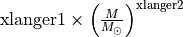
1.Mass loss rate is
See also xlanger2 (p 356).
Added In Version 14.
Changed In Version 18.18: Now only used if mlosswr (p 616)
1.Original entry:
Mass Loss Parameters
xmlossw
Multiplier on WR mass loss rates.
name
number
type
default
unit
xmlossw
387
float
0.
-Added In Version 15.13.
Changed In Version 18.18: Now also applies to Langer (1995) WR mass loss rate.
Original entry:
Mass Loss Parameters
Further regression for QSE initiation from BURN.
Regression for QSE initiation from BURN.
Add updated version of iytsflag (p 67).
Regression for QSE initiation from BURN.
Changes:
iytsflag
Consider only specific changes in
ye,yq,yf,o16and other select species in ISE zones when computing the timestep.
name
number
type
default
unit
iytsflag
67
integer
5
-It recognises the following bit flags
value
result
0enable
1use ISE/NSE initial values rather than values from
ppnthat have been subject to mixing
2use
ysi
3use
y56
4use
pn1
5use
nt1
6use
eb0.Note
A flags
.
For example,
5stands for Flags 0 and 2 being set.Changed In Version 18.16.5: Use of
ys32was disabled.Changed In Version 18.17: Add flags for species selection and allow the use of initial ISE/NSE values for time step control.
Original entry:
Timestep Control Parameters
Revise initialisation of QSE when iburnye (p 357)
1(Stan Woosley). Remove QSE timestep control for.
Changes:
iytsflag
Consider only specific changes in
ye,yq,yf,o16and other select species in ISE zones when computing the timestep.
name
number
type
default
unit
iytsflag
67
integer
5
-It recognises the following bit flags
value
result
0enable
1use ISE/NSE initial values rather than values from
ppnthat have been subject to mixing
2use
ysi
3use
y56
4use
pn1
5use
nt1
6use
eb0.Note
A flags
For example,
5stands for Flags 0 and 2 being set.Changed In Version 18.16.5: Use of
ys32was disabled.Changed In Version 18.17: Add flags for species selection and allow the use of initial ISE/NSE values for time step control.
Original entry:
Timestep Control Parameters
Add updated initialisation of QSE when lburn (p 434)
1(Stan Woosley).
Update solar abundances to Lodders 2020.
Changes:
mixcycle
Perform mixing/diffusion operation using current coefficients.
name
parameters
mixcycle[ INEW ]
mixcyle 1INEW
If provided, set mixcycl (p 433) to this new value. If INEW is
0then mixing is applied if it has not already been done.If mixcycl is
1the new time step dtnew (p 1) is used, otherwise the old time step is used.Note
If mixcycl (p 433) was
0the mixing operation was already performed at the end of the cycle and the routine returns with an error message.Typical use cases are to switch from mixcycl (p 433)
2to mixcycl (p 433)0mixcycle 0or to switch from mixcycl (p 433)
0to mixcycl (p 433)2mixcycle 2or to just do mixing for the sake of plots / edits
mixcycleAdded In Version >16.
Changed In Version 18.16.2: Flipped Options
0and1but kept default behaviour. Added Option2.Changed In Version 18.28: Introduce internal use of mixcycx (q 170) to track mixing. mixcycle is now used as a convenience function to switch mixcycl (p 433) modes.
Original entry:
Special Purpose Commands
Regression to
deltat.
Add extra sensitivity to Zone
1.
Additions:
dtcrc
First zone multiplier on change in radius per step.
name
number
type
default
unit
dtcrc
611
float
1.
-Added In Version 18.16.
Original entry:
Timestep Control Parameters
dtctc
First zone multiplier on change in temp per step.
name
number
type
default
unit
dtctc
612
float
1.
-Added In Version 18.16.
Original entry:
Timestep Control Parameters
dtclc
First zone multiplier on change in lumin per step.
name
number
type
default
unit
dtclc
613
float
1.
-Added In Version 18.16.
Original entry:
Timestep Control Parameters
dtcdc
First zone multiplier on change in density per step.
name
number
type
default
unit
dtcdc
614
float
1.
-Added In Version 18.16.
Original entry:
Timestep Control Parameters
dtcqc
First zone multiplier on linear contraction per step.
name
number
type
default
unit
dtcqc
615
float
1.
-Added In Version 18.16.
Original entry:
Timestep Control Parameters
icnet
Switch on CNET.
name
number
type
default
unit
icnet
600
integer
0
-Development work in progress.
Added In Version 18.16.
Original entry:
CNET Network parameters
cnet1
For future CNET use.
name
number
type
default
unit
cnet1
601
string
Placeholder
-Added In Version 18.16.
Original entry:
CNET Network parameters
cnet2
For future CNET use.
name
number
type
default
unit
cnet2
602
string
Placeholder
-Added In Version 18.16.
Original entry:
CNET Network parameters
cnet3
For future CNET use.
name
number
type
default
unit
cnet3
603
string
Placeholder
-Added In Version 18.16.
Original entry:
CNET Network parameters
cnet4
For future CNET use.
name
number
type
default
unit
cnet4
604
string
Placeholder
-Added In Version 18.16.
Original entry:
CNET Network parameters
cnet5
For future CNET use.
name
number
type
default
unit
cnet5
605
string
Placeholder
-Added In Version 18.16.
Original entry:
CNET Network parameters
cnet6
For future CNET use.
name
number
type
default
unit
cnet6
606
string
Placeholder
-Added In Version 18.16.
Original entry:
CNET Network parameters
cnet7
For future CNET use.
name
number
type
default
unit
cnet7
607
string
Placeholder
-Added In Version 18.16.
Original entry:
CNET Network parameters
cnet8
For future CNET use.
name
number
type
default
unit
cnet8
608
string
Placeholder
-Added In Version 18.16.
Original entry:
CNET Network parameters
cnet9
For future CNET use.
name
number
type
default
unit
cnet9
609
string
Placeholder
-Added In Version 18.16.
Original entry:
CNET Network parameters
cnet0
For future CNET use.
name
number
type
default
unit
cnet0
610
string
Placeholder
-Added In Version 18.16.
Original entry:
CNET Network parameters
Change default egamp (p 342) to
0.(Stan Woosley).
Changes:
egamp
Dimensionless correction factor used in calculating the escape of gamma rays from the radioactive decay of Ni56 and
, as controlled by timex0 (p 38).
name
number
type
default
unit
egamp
342
float
0.
-See subroutine
sdotfor details.Note
From Stan Woosley: I’ve been working on the radiation transport a fair bit lately. You might want to make the default for egamp (p 342)
0., not0.6, but leave xkapgam (p 341)0.054(or0.6, it’s not that accurate)Actually xkapgam (p 341) varies with how centrally concentrated the
is and might be bigger if it is not at the center.
The local opacity for gamma-rays is
0.03cm**2/g, many people agree, but the effective kappa in our trapping scheme which looks at the radial optical depth to the surface should use a larger value because, except at the center, gamma rays typically have a longer path than what they see at180degrees. Maybe drawing a figure would help. If all the0.03might be a better value.Added In Version 12.
Changed In Version 18.15.13: Updated default value from
0.6to0..Original entry:
Supernova Parameters
Bugfix to zero WR mass loss rate when not used (used to retain last value when mass loss rate was not zero).
Formatting update for
flowboutput.
Bugfix for iterative adaptive network in Python interface.
Regression for code:`ibdatov=1 - used to disable all special rates. Now only disables those for which there is a replacement in BDAT.
Update
strout.
Additions:
etot
Specific binding energy of zone.
name
type
unit
centering
storage
etot
float
erg/g
center
loadbufAdded In Version 18.15.6.
Original entry:
Miscellaneous
Regression for BURN timestep control.
Regression for re-write of
bwrit.
Changes:
Note
If you’d like to adjust the standard values of BURN isotopes,
nburnand or the maximum zone number,jmz, you can specify those values using the variable namesNBURNandJMZ, respectively. These can be specified statically in theMakefile, e.g.,SOURCE = $(HOME)/kepler/source SYSTEM = gfortran VERSION = O64 NBURN = 500 JMZ = 32767 include $(SOURCE)/Makefile.makeor, alternatively, add the definitions to the
makecommand line, e.g.,make JMZ=1983 NBURN=4096Whereas any changes in this file should propagate to all paces where these definitions are needed, it is not clear, however, whether this is the case consistently. It is therefore recommended, for the time of this writing, to perform a
make cleanbefore recompiling the code using
make.Warning
JMZneeds to be an odd number andNBURNneeds to be an even number.NBURNshould be at least 500.To switch the plot routine used, use the
PLOTvariable. Current plot interfaces are
value
result
mongotraditional X11 mongo interface (default)
nilno plot for cases where no plot interface can be linked or is desired
pyPython interface for Python module
PLOT = nilDepending on whether to compile for a standalone executable or for the Python interface, one can select the set of interface utility subroutines to include using the
UTILSvariable.
value
result
futilities for standalone Fortran executable (default)
pyutilities for Python interface
UTILS = fWarning
Usually, this should not be change manually, leave at default.
For compilation on older system where the FORTRAN 2003 intrinsic
ieee_arithmeticis not defined, we may chose an alternate version to use, with its corresponding compile flagsIEEEVALS = ieeevals_gcc4.f90 IEEEFLAGS := -fno-range-checkFor development to disable
xflag, we may chose an alternate version to usePROGDBG = progdbg_devel.f90To disable compilation for native architecture use in
ARCH = nonein
Makefile.For
gfortranthere is now also the option to overwrite the compilers and linker using the variableFOR90,CCOMP, andlinker. You may set extra compiler flags usingFLAGSXto all three parts (Fortran, C, linker) or useFFLAGSXfor options use for Fortran and C,CFLAGSXfor additional compiler options for C, andLFLAGSXfor extra linker options.To add a note to the program that is printed on startup, use the
NOTEoption.NOTE = Hello World!When KEPLER is compiled while not on a clean
gitcommit, the source files are included in the KEPLER executable. These are also saved to each dump file. These include all the make files, Python scripts,.cand.f90files. By default, theMakefilein the build directory is always included as well.One can set compiler executable using
CandFORTRANto set the executable name andCOMPDIRto set a common executable directory, if needed.Note
compdirneeds to include the trailing path separator/.For example, to overwrite the use of gnu C compiler on Apple, you may use
C = gcc-14The
MakefilevariableSAVESOURCEcontrols what source files are included
value
result
0never save any source
1save all source if not on git always save Makefile (default)
-1save all source if not on git do not save Makefile when on git
SAVESOURCE = -1Changed In Version 17.2.1: Added
JMZandNBURNvariables toMakefile.Changed In Version 17.3.2: Added
FULDATvariable toMakefile.Changed In Version 18.2.3: Added variables
IEEEVALSandIEEEFLAGStoMakefile.Changed In Version 18.3: Added variables
PROGDBGandARCHtoMakefile.Changed In Version 18.7.11: Variable
FULDATreplaced by variableFULDEF.Changed In Version 18.7.16: Variable
FULDATdeprecated. Use proper link to desiredfuldatversion instead.Changed In Version 18.15.3: Added Makefile capability to overwrite default compile flags for
gfortran.Changed In Version 18.39: Added variables
NOTEandSAVESOURCEtoMakefile.Changed In Version 18.39.5: Added variables
CandFORTRANtoMakefile.
A major regression to mass loss mapping.
Add angular momentum decretion recording.
Additions:
angldec
Angular momentum decretion.
name
number
type
unit
angldec
162
float
erg*secAdded In Version 18.15.
Changed In Version 18.21: Renamed from
angdecOriginal entry:
Decretion-Related Parameters
angldecx
X-angular momentum decretion.
name
number
type
unit
angldecx
163
float
erg*secAdded In Version 18.15.
Changed In Version 18.21: Renamed from
angdecxOriginal entry:
Decretion-Related Parameters
angldecy
Y-angular momentum decretion.
name
number
type
unit
angldecy
164
float
erg*secAdded In Version 18.15.
Changed In Version 18.21: Renamed from
angdecyOriginal entry:
Decretion-Related Parameters
angldecz
Z-angular momentum decretion.
name
number
type
unit
angldecz
165
float
erg*secAdded In Version 18.15.
Changed In Version 18.21: Renamed from
angdeczOriginal entry:
Decretion-Related Parameters
Changes:
Kepler Variables
A selection of KEPLER variables can also be used, including p and q parameters (by name or number), and user-defined optional o parameters. Also allowed are any zonal variables accessible through
loadbufwhere zone number or mass coordinate can be used similar to the z interactive command.This includes a small set of KEPLER physical and mathematical constants, pie, c, k, me, a, sigt, gee, n0, solmass, solrad, year, h, ev, mev, amu, and rgas.
Changed In Version 18.15: Added h, ev, mev, and amu.
One can also use a small selection of array functions named after the FORTRAN functions on loadbuf quantities and specify ranges using the : (colon) syntax where omitted first and last indices stand for
1and jm (q 2) respectively.
function
type
description
sum
float
sum up values
maxval
float
maximum value
minval
float
minimum value
maxloc
integer
index of maximum
minloc
integer
index of minimum
To obtain location of variable values in
loadbufarrays, the following functions can be used. You may use , or ; to separate arguments, or omit brackets where the expression remains unique, but you must retain “,” or “;”.
function
type
description
locl
integer
lower zone number
loc
integer
closest zone number
loch
integer
higher zone number
locx
float
linear interpolated floating zone number
mocl
integer
lower zone number (test outside-in)
moc
integer
closest zone number (test outside-in)
moch
integer
higher zone number (test outside-in)
mocx
float
linear interpolated floating zone number (test outside-in)
@ loc(rn,1.d12) > 1000
@ loc rn(:1200),1.d12  > 1000
Changed In Version 17.11.7: Added “;” as allowed separator. Allow range specification. Require separator. Add “m” functions.
To test where condition is fulfilled anywhere for
loadbufarrays, the following functions can be used. You may omit brackets for call syntax where the expression remains unique. You can use the FORTRAN operators <, <=, ==, =, >=, >, /=, and !=.
function
type
description
any
logical
condition fulfilled for any array value
all
logical
condition fulfilled for all array values
@ all(rn < 1.d12)
@ any convect == 4
Added In Version 17.11.7.
Changed In Version 18.7.2: Added = and !=.
Note
Dissection of the expression fails with variable names that contain operators, e.g., for some reaction rates. In this case, square brackets, [ and ] can be used to keep these together.
@ [o16+o16](1) > 1.d10
d #oign
Changed In Version 17.0.13.
Further small regression to accretion mapping.
Update mapping algorithm to reduce numerical round-off. Some historic fix maybe as well.
Update mass loss to use
xlumeffand not causeNaNwhen negative.
Fix: ncycb (q 49) now the same as ncyc (q 4), as per documentation and for messages from
zbcycle.Fix
wdatffnupper temperaure bound from
11.to30.. (Regression from Dec 21, 2000 update)Negative values in tweakmin (p 479) and dweakmin (p 584) use lower values from respective gird in
wdat.
Add QSE/NSE isotope recording for plotting. This avoids extra calls ro
qseeditfor solely this purpose. When nserec (p 599) is changed, the commandupdateqmay be use to re-compute or discard NSE/QSE isotope data.For nserec (p 599)
1the unburntis added to the NSE/QSE abundances.
For nserec (p 599)
0the NSE/QSE abundances of non-unburnt,
are added to the
entry of the NSE/QSE plots.
Additions:
updateq
Update or discard NSE/QSE isotopic data after changing nserec (p 599).
name
parameters
updatequpdateqAdded In Version 18.14.
Original entry:
Abundance and Production Factor Plots
nserec
Record and plot NSE/QSE isotope abundances.
name
number
type
default
unit
nserec
599
integer
1
-Note
The command updateq can be used to update or discard NSE/QSE data after changing this parameter. Otherwise, it takes effect after next cycle.
For nserec (p 599)
1the unburntFor nserec (p 599)
0the NSE/QSE abundances of non-unburntAdded In Version 18.14.
Original entry:
Abundance Plot Parameters
QSE/NSE data from alternate
nsedatfiles may be used. Currently there is the originalnsedat0with125isotopes and a revisednsedat1with129isotopes, adding,
,
, and
.
QSE/NSE data is now read from file
nsedat.
Add QSE edit to
test.
Changes:
test
Gives a terminal edit of quantity TESTVAR for the materials in zone ZONE, but at the temperature T in
Kand density D ing/ccspecified.
name
parameters
testTESTVAR ZONE T D
test p 1 3.E+9 2.E+7TESTVAR
A variable symbol which may be anyone of the following:
value
result
k
Opacity (
cm**2/g)s
(specific) Energy Production Rate (
erg/g/sec)p
Pressure (
erg/cc)e
(specific) Energy (
erg/g)d
degeneracy parameter
q
make QSE edit (various quantities)
ZONE
Zone from which to take composition. Processing of zone specification is done similar to the <j> command.
T
temperature T in
KD
density in
g/ccChanged In Version >16: added d to print degeneracy
Changed In Version 18.13.5: added q to print QSE edit
Original entry:
Other Terminal Edit Commands

Regression from version to
qsedit. Contributed by SEW.
Prehistoric bug fix,
c12(c12,n)andc12(c12,p)reverse rates had extra factor2.
Bugfix decay code.
Bugfix: add factor
rhoto constant low-T reverse rate ofNe22(a,n).
Allow to set fraction of neutrino energy in electron, electron-anti, and mu+tau neutrinos using fnue (p 597) and fnueb (p 598).
Allow to set instantaneous constant (total) neutrino luminosity as enu53 (p 287) when taunu (p 286)
0.Add initdata to allow manual reset of variable external data files.
Add new formula
30to BDAT to allow direct use of log-equidistant-spaced tabulated rates.
Additions:
initdata
Reset initialisation status of variable external data files.
name
parameters
initdataAdded In Version 18.13.
Original entry:
Special Purpose Commands
fnue
Fraction of neutrino energy in electron neutrinos.
name
number
type
default
unit
fnue
597
float
0.167
-Fraction of mu and tau neutrinos is 1 - fnue (p 597) - fnueb (p 598).
Added In Version 18.13.
Original entry:
BURN Physics Parameters
fnueb
Fraction of neutrino energy in electron anti-neutrinos.
name
number
type
default
unit
fnueb
598
float
0.167
-For details see also fnue (p 597).
Added In Version 18.13.
Original entry:
BURN Physics Parameters
Changes:
taunu
Time scale for the neutrino pulse considered by the BURN coprocessor in calculating neutrino-induced nucleosynthesis after core collapse.
name
number
type
default
unit
taunu
286
float
0.
secIf set
0.then enu53 (p 287) is interpreted as (constant) neutrino luminosity.Changed In Version 18.13: Added case
0..Original entry:
BURN Physics Parameters
enu53
Total energy for the neutrino pulse considered by the BURN coprocessor in calculating neutrino- induced nucleosynthesis after core collapse.
name
number
type
default
unit
enu53
287
float
3.
1.e+53 ergIf taunu (p 286)
1.e+53erg/sec.Changed In Version 18.13: Added interpretation as luminosity if taunu (p 286)
0..Original entry:
BURN Physics Parameters
Update to
specl1to use NACRE rate forna23(a,n)26al_tand add statistical weights. Fix for low-temperature22ne(a,g)26mgrate to be density-dependent.
Minor regression for mongo plot symbols.
Some refactor for more isomer support and formatting.
Add BDAT formulae
44-47. Same as formulae14-17but allow overwriting to hard-coded rates if ibdatov (p 542) is0.
Adjust edit output format.
Bugfix for BURN nucleus determining time step.
Bugfix
o18(a,n)ne21NACRE99 rate was missing thermal correction factor.Regression for Iliadis rates (
bdatFormulae21and22):t9m23g=t913g*t913greplaced byt9m23g=t9m13g**2. from of 23 April 2017.
Regression from F90 refactor:
cnvfiles were wrongly written with version number set to when actually writing . When exceptionException: File <name>.cnv is corrupt.is encountered, you may trynvers=10600for the Python read script.
Bugfix in wind output, was flagging records as version
20100despite writing version20200.Bugfix set wind loss parameters to
0.if there is not mass loss, e.g., when :q`jloss`:math:<=0(xmlossr (q 82), delmass (q 128), dvloss (q 136)).
Add luminosity at affective radius (xlumeff (q 161)). Effective temperature teff (q 48) is now using this luminosity instead of xlum (q 46) at the outermost zone. Effective opacity capeff (q 87) is now just the value of the zone in which radius (q 47) lies, previously-used interpolation was incorrect.
Additions:
xlumeff
Luminosity at effective radius.
name
number
type
unit
xlumeff
161
float
erg/secAdded In Version 18.12.
Original entry:
Evolution-Related Parameters
Changes:
teff
Effective surface temperature at radius (q 47).
name
number
type
unit
teff
48
float
KChanged In Version 18.12: now use xlumeff (q 161) instead of xlum (q 46).
Original entry:
Evolution-Related Parameters
capeff
Opacity at effective radius.
name
number
type
unit
capeff
87
float
cm**2/gChanged In Version 18.12: Replaces (incorrect) interpolation by zone value of radius (q 47).
Original entry:
Other Surfarce Properties
Bugfix for high-T branch of NACRE
o17(p,g)f18rate.
Add literature weights to
C12agrate from NACRE tospecl0. A few rates inspecl1have had constants promoted to double precision.
Bugfix for NACRE rates - used to limit
T9beyond scope ofspecl1inworkdef.
Bugfix to screening to
(n,p)in subroutinebwrit.
Minor bugfix to ADAPNET diagnostic output.
Add sorted zonal BURN edit
Band APPROX editI.
Changes:
<j>
Make a current edit for zone <j> on the terminal.
name
parameters
<j>[ (i [ IONSYM ] ) | ( ( b | b ) [ ISOSYM ] ) | q ]
12
.5 i
1.d33 i c12
-5 b c13
0 b
<j>
zone number or mass
IONSYM
symbol of ion from APPROX / NSE / QSE network
ISOSYM
symbol of species from BURN network
The usual range of zones is from
1to jm (q 2). Zone numbers less than1are counted “outward in” from the surface, with-1corresponding to the surface zone, i.e., jm (q 2)1are truncated to1.If <j> is a float, KEPLER will try to translate it to a zone number. First, if the magnitude of the value is less than
1.e+10it is assumed the number is in solar masses. Next, values less than0.are, as above, counted from the surface, i.e., the total mass of the star, totm (q 17)summ0 (p 61) is added. KEPLER then finds the mass shell with lower boundary mass as close as possible to the provided mass coordinate.
i
make APPROX / NSE / ISE ion edit of all ions with abundances larger than abunlim (p 128)
I
same as i but sort by decreasing mass fraction
i ISOSYM
make APPROX / NSE / ISE ion edit of the specified ion
b
make BURN species edit of all species with abundances larger than abunlimb (p 272)
B
same as b but sort by decreasing mass fraction
b ISOSYM
make BURN species edit of the specified species
q
Make a NSE / ISE edit on the terminal
Changed In Version 18.11.6: Added B and I.
Original entry:
Normal Program Managment Commands
Update lburndtc (p 596) now consistently also enables BURN abundances for abundance backups in
sdot.[SDOT]abundance change backup vales are now mass fractions and no longer parts per nucleon.
Update ipnuc (p 525) and ipnu (p 526).
Changes:
ipnuc
Do nuclear burning/energy generation.
name
number
type
default
unit
ipnuc
525
integer
1
-Same use of jshell0 (p 93) and jshell1 (p 94) as ipup (p 28).
Added In Version 16.85.
Changed In Version 18.11.4: add bmasslow (p 419)
Original entry:
Nuclear Reaction Parameters
ipnu
Do neutrino losses.
name
number
type
default
unit
ipnu
526
integer
1
-Same use of jshell0 (p 93) and jshell1 (p 94) as ipup (p 28).
Added In Version 16.85.
Changed In Version 18.11.4: add bmasslow (p 419)
Original entry:
Nuclear Reaction Parameters
Re-adjust convectively-bound flame code.
Fix iplotb (p 443)
2for LBURN.
Convectively bound flame speed switched to smooth curve.
Update convective bound flame temperature scaling to be continuous.
Make zones below flame non-convective for cbfkapm (p 594)
0..Add ncbfmult (p 595) for number of zones to be modified.
Add lburndtc (p 596) to enable tracking BURN isotopes for time step (default for new runs).
Additions:
ncbfmult
name
number
type
default
unit
ncbfmult
595
integer
15
-Number of zones to be modified by flame using cbfkapm (p 594).
Added In Version 18.11.
Original entry:
Flame Model
lburndtc
If set to
1track BURN species for time step rather than APPROX species.
name
number
type
default
unit
lburndtc
596
integer
1
-Added In Version 18.11.
Original entry:
BURN full Processing
Add neutrino loss for
decay.
Big fix for cbflame in
kappa.
Historic bug fix for use of Fuller weak rate nu loss even if not computed because of being outside range. Outside range, neutrino energy losses for those rates, hence, were not included. This would affect runs using BURN network for energy generation (lburn (p 434)
1.).
Changes:
iold
Set to value other than 0 to use old physics - mostly fix that energy generation in APPROX did not include neutrino losses and mass excess but only considered differences in binding energy. These are used as flags.
name
number
type
default
unit
iold
388
integer
0
-
value
result
0Use current physics.
1(bit 0) No nu loss in H burning and BE instead of ME and old nu loss routines (old1/old2, < 1997) this should not affect lburn (p 434) as that was only implemented later, i.e., here was no bug to be fixed - where lburn (p 434) is used, iold (p 388)
2(bit 1) Use old nu loss (old3)
4(bit 2) Use old (1997) nu loss and ME estimates (bad)
8(bit 3) Use old (1975) Iben electron conductivity. The revised version fixes a factor
2
16(bit 4) Double counting of
32(bit 5) Do not use fix in
64(bit 6) FFN weak rates are used for nu loss in BURN even if rates are zeroed because of being outside temperature/density range.
128(bit 7) QSE does not consider mass defect from weak rates.
256(bit 8) Do not use crude fix for coulomb corrections. rates.
512(bit 9) Do not use new coulomb corrections. rates.
Added In Version 15.15.
Changed In Version 17.0.5: Added
2.Changed In Version 17.0.8: Added
4.Changed In Version 17.0.11: Added
8.Changed In Version 17.6.5: Added
16.Changed In Version 17.9.1: Added
32.Changed In Version 18.10.3: Added
64.Changed In Version 18.29: Added
128.Changed In Version 18.30: Added
256.Changed In Version 18.46: Added
512.Original entry:
Physics Parameters
Regression for
cbflame.
Regression for
cbflame1.
Add parameter for convectively bound flame effective opacity. Regression for
cbflame1.
Additions:
cbfkapm
name
number
type
default
unit
cbfkapm
594
float
0.
-Multiplier used to generate artificially thickened flame for inward propagation of off center oxygen and silicon burning that generates an abar inversion
Note
Thermohaline convection (alpth (p 425)) should be turned off when using this flame model.
Added In Version 18.10.
Original entry:
Flame Model
Dissolve
kepozandkepoumodules, fixkepdeffur current numpy, rearrangeMakefile.make.
Add update convective flame model that modifies opacity.
Add
limebfor isomers (that was overlooked before.) More clean-up of modules and Makefile.
Complete conversion to modules. Had to resort to use submodule (Fortran2008) feature to allow recursive dependence of
ttycom/executewithcmd. A few minor interface inconsistencies that could potentially have led to crashes or data corruption were removed.
Bugfix for Python integration (regression from conversion of
stacklib/stackl90to a module).
Historical bugfix for
na23(p,g)mg24inspecl0for.
Some numerical updates for hstatym (p 386).
Minor bugfix in
mapb2a(undefined variables). Fix type mismatch ininvert. Bugfix ininvertcall tominv.
Enable cf88
C12agrate as ivrate (p 422)0inspecl0to actually use cf188. This rate includes e1mltc12 (p 227) and e1mltc12 (p 227).
Changes:
ivrate
Version of the APPROX network rate subroutine to use.
name
number
type
default
unit
ivrate
422
integer
1
-Currently:
value
result
0WW95 rate set
1use the rath00 rate set including the
,
) rate form Buchmann et al. (2000) and Buchmann, priv. comm. (Jul 2000).
2uses the NACRE c12ag rate.
3use the rath00 rate set and the adopted values of Kunz et al.(2002, ApJ).
4use the rath00 rate set and the low values of Kunz et al.(2002, ApJ).
5use the rath00 rate set and the high values of Kunz et al.(2002, ApJ).
6use the rath00 rate set and the REACLIB implementation of Kunz et al.(2002, ApJ).
On restart of older programs a value of
0is initialized.ivrate (p 422) values of
3,4, and5also selects these rates in the rath00 rate set BURN co-processing “special” subroutinespecl0(seespecl.fandspecl0.f.)Added In Version 16.10.
Changed In Version 17.1.3: Added Option
6.Changed In Version 18.8.6: Now Option
1_actually_ uses NACRE c12ag rate, and Iotion0_actually_ uses the cf88 c12ag rate.Original entry:
BURN Physics Parameters
Historic bugfix for
li7(h3,2n)2areverse rate inspecl0.
(isomer regress) Bugfix for subroutine
compressfor array over-run.
Numerical refinement for flame thickness in convectively-bound flame model. (cancelled)
(isomer regress) Bugfix for adapnet isotope tracking.
(isomer regress) Bugfix for subroutine
restartfor loading dumps.
Add isomers, mostly internal use for now, update binary file, no reactions for them yet available.
Isomers are coded using energy level
for the generic isotope (thermally excited),
for the ground state (
g),for the first excited state (
m),for the second excited state (
m2), and so forth.
Small bugfix to BDAT formula
.
Add optional parameter default operator &. Add reversed operators for optional parameter definition, @ and &.
o x &= 3.
Changes:
o
Obtain/set/define/delete optional user-defined (‘O’) parameters.
name
parameters
o[ NAME [ VALUE [ OPERATION ] | ( VALUE [ def | dev | redef | @ | & | ^ ) | ( del | # ) ] ( OPERATION | @ | & | ^) VALUE ] | VALUE list ]
o i 1 def
o i 1 +
o i
o
o i del
NAME
is the name of the parameter to be specified. By default no parameters are initilazed by KEPLER.
OPERATION
add | mul | div | sub | mod | * | - | + | / | % | ^ | **
These can be used in commad files or to specify other quantities that are useful to analysis later.
The plain form o without any other parameters will list all currently defined parameters.
The form with only NAME specified will return the value of the parameter.
The form with NAME and VALUE will set the parameter to the new value. The VALUE should observe the type of the parameter.
The form with NAME, VALUE, and OPERATION will perfom the operation on the parameter and set it to the resulting value. The operand VALUE should observe the type of the parameter.
The form with NAME, VALUE, and def or @ will define the new parameter and set its value to VALUE. The variable type is inferred from the type of the initial value. An error results if the variable NAME already exists.
The form with NAME, VALUE, and dev or & will define a new parameter and set its value to VALUE if NAME does not yes exits, otherwise NAME remains unchanged. An error results if the variable NAME already exists and has a different type than VALUE.
The form with NAME, VALUE, and redef or ^ will define a new parameter and set its value to VALUE if NAME does not yes exits, otherwise will assign the new value to NAME. An error results if the variable NAME already exists and has a different type than VALUE.
The form with NAME, ( OPERATION or dev or & ) VALUE is also allowed with the purposes as above, just last two arguments switched.
The form NAME VALUE list prints all parameters with that value.
The form with NAME and del or # will delete the optional parameter.
Note
In contrast to p and q parameters the o parameters cannot be addressed by number. This limitation was imposed as the parameters can be added and removed randomly.
parmetercard ::= "o" ( listspec | setspec | defspec | delspec )
listspec     ::= [ parameter ]
setspec      ::= parameter ( value [ operation ] | operation value )
defspec      ::= parameter ( value ( "def" | "dev" | "redef" | "@" | "&" | "^" ) ) | ( "@" | "&" | "^" ) value )
delspec      ::= parameter ( "del" | "#" )
parameter    ::= name
name         ::= string
number       ::= integer
value        ::= float | integer
operation    ::= "add" | "mul" | "div" | "sub" | "mod" | "*" | "-" | "+" | "/" | "%" | "^" | "**"
Added In Version 17.0.2.
Changed In Version 18.1.3: Add “@”, “#”, “^”, “**”, and pow.
Changed In Version 18.2: Parameters no longer need to be defined but instead the first assignment will be used as implicit definition if impoparm (p 587) is
1.Changed In Version 18.7.7: Added dev.
Changed In Version 18.7.20: Add & and option for reverse order of definition operators.
Changed In Version 18.35.4: Add redef and ^ for redefinition without error.
Original entry:
Normal Program Managment Commands
Disallow duplicate parameter names (
p,q, ando), checked in subroutinecheckpq.
Changes:
Special Variables
Special variables are cputime, which returns the CPU time used since start of the current execution, and timeused, which returns the CPU time since start of the problem, both as float and in
sec.Changed In Version 18.7.19: Renamed cpu_time to cputime.
Bugfix for nested brackets in mathematical expressions in
cmdfiles.
Bugfix for definition of and assignment to optional parameters on input cards.
Replace
fuldef?.f90variants byfuldef.f90that reads data from data filefuldat. Original data has been copied to data filesfuldef?. Themake linksnow makes a symbolic link to the default data set infuldat1. Ordering ofvalues and
nfulnothave been adjusted/fixed. Data from files provides higher accuracy. The link optionsfuldeforfuldatare now obsolete.
Changes:
Note
If you’d like to adjust the standard values of BURN isotopes,
nburnand or the maximum zone number,jmz, you can specify those values using the variable namesNBURNandJMZ, respectively. These can be specified statically in theMakefile, e.g.,SOURCE = $(HOME)/kepler/source SYSTEM = gfortran VERSION = O64 NBURN = 500 JMZ = 32767 include $(SOURCE)/Makefile.makeor, alternatively, add the definitions to the
makecommand line, e.g.,make JMZ=1983 NBURN=4096Whereas any changes in this file should propagate to all paces where these definitions are needed, it is not clear, however, whether this is the case consistently. It is therefore recommended, for the time of this writing, to perform a
make cleanbefore recompiling the code using
make.Warning
JMZneeds to be an odd number andNBURNneeds to be an even number.NBURNshould be at least 500.To switch the plot routine used, use the
PLOTvariable. Current plot interfaces are
value
result
mongotraditional X11 mongo interface (default)
nilno plot for cases where no plot interface can be linked or is desired
pyPython interface for Python module
PLOT = nilDepending on whether to compile for a standalone executable or for the Python interface, one can select the set of interface utility subroutines to include using the
UTILSvariable.
value
result
futilities for standalone Fortran executable (default)
pyutilities for Python interface
UTILS = fWarning
Usually, this should not be change manually, leave at default.
For compilation on older system where the FORTRAN 2003 intrinsic
ieee_arithmeticis not defined, we may chose an alternate version to use, with its corresponding compile flagsIEEEVALS = ieeevals_gcc4.f90 IEEEFLAGS := -fno-range-checkFor development to disable
xflag, we may chose an alternate version to usePROGDBG = progdbg_devel.f90To disable compilation for native architecture use in
ARCH = nonein
Makefile.For
gfortranthere is now also the option to overwrite the compilers and linker using the variableFOR90,CCOMP, andlinker. You may set extra compiler flags usingFLAGSXto all three parts (Fortran, C, linker) or useFFLAGSXfor options use for Fortran and C,CFLAGSXfor additional compiler options for C, andLFLAGSXfor extra linker options.To add a note to the program that is printed on startup, use the
NOTEoption.NOTE = Hello World!When KEPLER is compiled while not on a clean
gitcommit, the source files are included in the KEPLER executable. These are also saved to each dump file. These include all the make files, Python scripts,.cand.f90files. By default, theMakefilein the build directory is always included as well.One can set compiler executable using
CandFORTRANto set the executable name andCOMPDIRto set a common executable directory, if needed.Note
compdirneeds to include the trailing path separator/.For example, to overwrite the use of gnu C compiler on Apple, you may use
C = gcc-14The
MakefilevariableSAVESOURCEcontrols what source files are included
value
result
0never save any source
1save all source if not on git always save Makefile (default)
-1save all source if not on git do not save Makefile when on git
SAVESOURCE = -1Changed In Version 17.2.1: Added
JMZandNBURNvariables toMakefile.Changed In Version 17.3.2: Added
FULDATvariable toMakefile.Changed In Version 18.2.3: Added variables
IEEEVALSandIEEEFLAGStoMakefile.Changed In Version 18.3: Added variables
PROGDBGandARCHtoMakefile.Changed In Version 18.7.11: Variable
FULDATreplaced by variableFULDEF.Changed In Version 18.7.16: Variable
FULDATdeprecated. Use proper link to desiredfuldatversion instead.Changed In Version 18.15.3: Added Makefile capability to overwrite default compile flags for
gfortran.Changed In Version 18.39: Added variables
NOTEandSAVESOURCEtoMakefile.Changed In Version 18.39.5: Added variables
CandFORTRANtoMakefile.
Python: extract
kepcomfromkepdef.f90by script instead.
Tweaked version separating our
kepcomagain to work Python interface.
Now all KEPLER code is
F90.
Bugfix for
p(ng)2dinrate2.f90(NACRE rates).
Transition from common block with include files to FORTRAN modules requires now python code. Python code to be updates to deal with f90 modules.
Changes:
Note
If you’d like to adjust the standard values of BURN isotopes,
nburnand or the maximum zone number,jmz, you can specify those values using the variable namesNBURNandJMZ, respectively. These can be specified statically in theMakefile, e.g.,SOURCE = $(HOME)/kepler/source SYSTEM = gfortran VERSION = O64 NBURN = 500 JMZ = 32767 include $(SOURCE)/Makefile.makeor, alternatively, add the definitions to the
makecommand line, e.g.,make JMZ=1983 NBURN=4096Whereas any changes in this file should propagate to all paces where these definitions are needed, it is not clear, however, whether this is the case consistently. It is therefore recommended, for the time of this writing, to perform a
make cleanbefore recompiling the code using
make.Warning
JMZneeds to be an odd number andNBURNneeds to be an even number.NBURNshould be at least 500.To switch the plot routine used, use the
PLOTvariable. Current plot interfaces are
value
result
mongotraditional X11 mongo interface (default)
nilno plot for cases where no plot interface can be linked or is desired
pyPython interface for Python module
PLOT = nilDepending on whether to compile for a standalone executable or for the Python interface, one can select the set of interface utility subroutines to include using the
UTILSvariable.
value
result
futilities for standalone Fortran executable (default)
pyutilities for Python interface
UTILS = fWarning
Usually, this should not be change manually, leave at default.
For compilation on older system where the FORTRAN 2003 intrinsic
ieee_arithmeticis not defined, we may chose an alternate version to use, with its corresponding compile flagsIEEEVALS = ieeevals_gcc4.f90 IEEEFLAGS := -fno-range-checkFor development to disable
xflag, we may chose an alternate version to usePROGDBG = progdbg_devel.f90To disable compilation for native architecture use in
ARCH = nonein
Makefile.For
gfortranthere is now also the option to overwrite the compilers and linker using the variableFOR90,CCOMP, andlinker. You may set extra compiler flags usingFLAGSXto all three parts (Fortran, C, linker) or useFFLAGSXfor options use for Fortran and C,CFLAGSXfor additional compiler options for C, andLFLAGSXfor extra linker options.To add a note to the program that is printed on startup, use the
NOTEoption.NOTE = Hello World!When KEPLER is compiled while not on a clean
gitcommit, the source files are included in the KEPLER executable. These are also saved to each dump file. These include all the make files, Python scripts,.cand.f90files. By default, theMakefilein the build directory is always included as well.One can set compiler executable using
CandFORTRANto set the executable name andCOMPDIRto set a common executable directory, if needed.Note
compdirneeds to include the trailing path separator/.For example, to overwrite the use of gnu C compiler on Apple, you may use
C = gcc-14The
MakefilevariableSAVESOURCEcontrols what source files are included
value
result
0never save any source
1save all source if not on git always save Makefile (default)
-1save all source if not on git do not save Makefile when on git
SAVESOURCE = -1Changed In Version 17.2.1: Added
JMZandNBURNvariables toMakefile.Changed In Version 17.3.2: Added
FULDATvariable toMakefile.Changed In Version 18.2.3: Added variables
IEEEVALSandIEEEFLAGStoMakefile.Changed In Version 18.3: Added variables
PROGDBGandARCHtoMakefile.Changed In Version 18.7.11: Variable
FULDATreplaced by variableFULDEF.Changed In Version 18.7.16: Variable
FULDATdeprecated. Use proper link to desiredfuldatversion instead.Changed In Version 18.15.3: Added Makefile capability to overwrite default compile flags for
gfortran.Changed In Version 18.39: Added variables
NOTEandSAVESOURCEtoMakefile.Changed In Version 18.39.5: Added variables
CandFORTRANtoMakefile.
A regression from refactoring, weak rates in
xnuwtot,xnuwbm,xnuwbp,xnuwec, andxnuwpcwere not properly linked.
devecho fixed.
Bugfix for swapped
def/devfor optional parameters.
Additions:
The simpleq flag switches to simple, single-level “if” statement evaluation (default).
% simpleqAdded In Version 18.7.7.
The nestedq flag switches to simple, single-level “if” statement evaluation.
% nestedqAdded In Version 18.7.7.
? [ EXPRESSION ]
If EXPRESSION evaluates evaluates to
.TRUE., then the commands following up to the next ? or ?? command are executed (ifstatement) and if it evaluates to.FALSE.they are skipped. Removal is independent of whether they are executed or skipped, but is only governed whether on is in a @ or : section. If EXPRESSION is not provided, this serves as a marker for the end of theifstatement (endif).In simpleq mode, any new ? ends the previous section and starts a new one, code after a ? without an EXPRESSION is executed unconditionally.
In nestedq mode, any new ? with an EXPRESSION introduces a new level that is only ended by a final ? without an EXPRESSION.
% simpleq

*
:
dev xl 0.
xl = 1.e8
? (xmlossr > 1.e20)
xl = 5.e7
? (xmlossr > 1.e21)
x = 2.e7
? (xmlossr > 1.e22)
xl = 1.e7
? (xl < 0.99 * xmlossr) | (xl > 1.01 * xmlossr)
dtmax = {xl}
Added In Version 18.7.7.
?? [ EXPRESSION ]
If EXPRESSION evaluates evaluates to
.TRUE.or is missing and the previous section was not executed, then the commands following up to the next ? or ?? command are executed (elseif/elsestatements) and otherwise they are skipped. Removal is independent of whether they are executed or skipped, but is only governed whether on is in a @ or : section.% nestedq * : dev xl {pie} ? (xmlossr > 1.e22) xl = 1.e7 ?? (xmlossr > 1.e21) x = 2.e7 ?? (xmlossr > 1.e20) xl = 5.e7 ?? xl = 1.e8 ? ? (xl < 0.99 * xmlossr) | (xl > 1.01 * xmlossr) dtmax = {xl}Added In Version 18.7.7.
dev
Default value for optional user-defined (‘O’) parameters.
name
parameters
devNAME VALUE
dev i 1
o i 1 +
o i
o
del i
NAME
is the name of the parameter for which to set default value.
Set default value for the optional parameter NAME. See o for details.
Added In Version 18.7.7.
Original entry:
Normal Program Managment Commands
Changes:
o
Obtain/set/define/delete optional user-defined (‘O’) parameters.
name
parameters
o[ NAME [ VALUE [ OPERATION ] | ( VALUE [ def | dev | redef | @ | & | ^ ) | ( del | # ) ] ( OPERATION | @ | & | ^) VALUE ] | VALUE list ]
o i 1 def
o i 1 +
o i
o
o i del
NAME
is the name of the parameter to be specified. By default no parameters are initilazed by KEPLER.
OPERATION
add | mul | div | sub | mod | * | - | + | / | % | ^ | **
These can be used in commad files or to specify other quantities that are useful to analysis later.
The plain form o without any other parameters will list all currently defined parameters.
The form with only NAME specified will return the value of the parameter.
The form with NAME and VALUE will set the parameter to the new value. The VALUE should observe the type of the parameter.
The form with NAME, VALUE, and OPERATION will perfom the operation on the parameter and set it to the resulting value. The operand VALUE should observe the type of the parameter.
The form with NAME, VALUE, and def or @ will define the new parameter and set its value to VALUE. The variable type is inferred from the type of the initial value. An error results if the variable NAME already exists.
The form with NAME, VALUE, and dev or & will define a new parameter and set its value to VALUE if NAME does not yes exits, otherwise NAME remains unchanged. An error results if the variable NAME already exists and has a different type than VALUE.
The form with NAME, VALUE, and redef or ^ will define a new parameter and set its value to VALUE if NAME does not yes exits, otherwise will assign the new value to NAME. An error results if the variable NAME already exists and has a different type than VALUE.
The form with NAME, ( OPERATION or dev or & ) VALUE is also allowed with the purposes as above, just last two arguments switched.
The form NAME VALUE list prints all parameters with that value.
The form with NAME and del or # will delete the optional parameter.
Note
In contrast to p and q parameters the o parameters cannot be addressed by number. This limitation was imposed as the parameters can be added and removed randomly.
parmetercard ::= "o" ( listspec | setspec | defspec | delspec )
listspec     ::= [ parameter ]
setspec      ::= parameter ( value [ operation ] | operation value )
defspec      ::= parameter ( value ( "def" | "dev" | "redef" | "@" | "&" | "^" ) ) | ( "@" | "&" | "^" ) value )
delspec      ::= parameter ( "del" | "#" )
parameter    ::= name
name         ::= string
number       ::= integer
value        ::= float | integer
operation    ::= "add" | "mul" | "div" | "sub" | "mod" | "*" | "-" | "+" | "/" | "%" | "^" | "**"
Added In Version 17.0.2.
Changed In Version 18.1.3: Add “@”, “#”, “^”, “**”, and pow.
Changed In Version 18.2: Parameters no longer need to be defined but instead the first assignment will be used as implicit definition if impoparm (p 587) is
1.Changed In Version 18.7.7: Added dev.
Changed In Version 18.7.20: Add & and option for reverse order of definition operators.
Changed In Version 18.35.4: Add redef and ^ for redefinition without error.
Original entry:
Normal Program Managment Commands
Revise flame model to allow flame to propagate to centre.
Add min and max functions.
Changes:
Arithmetic Expressions
In arithmetic expressions integer and float numbers can be used. Arithmetic operations permitted are +, -, * , / , % (modulo), ** (power), and brackets, ( and ), however, the operands must be of same type (integer or float).
Additionally, the abs, log (logarithm base 10), ln (logarithm base
The type conversion functions aint (truncate to integer - returns float), int (truncate to integer - returns integer), nint (nearest integer - returns integer), floor (nearest integer below - returns integer), ceil (nearest integer above - returns integer), and dble (returns float), and real (returns float) are defined as well.
The min and max functions return the lower or larger of the two arguments, separated by , or ;. Both arguments need to have same type, which is also type returned.
Changed In Version 17.0.12.
Changed In Version 18.7.4: Removed ^ (now used for xor).
Changed In Version 18.7.5: Add min and max functions.
Changed In Version 18.43: Add dble function.
Change ^ from arithmetic power operator to logical
xoroperator. Some bug fixes in precedence.
Changes:
Arithmetic Expressions
In arithmetic expressions integer and float numbers can be used. Arithmetic operations permitted are +, -, * , / , % (modulo), ** (power), and brackets, ( and ), however, the operands must be of same type (integer or float).
Additionally, the abs, log (logarithm base 10), ln (logarithm base
The type conversion functions aint (truncate to integer - returns float), int (truncate to integer - returns integer), nint (nearest integer - returns integer), floor (nearest integer below - returns integer), ceil (nearest integer above - returns integer), and dble (returns float), and real (returns float) are defined as well.
The min and max functions return the lower or larger of the two arguments, separated by , or ;. Both arguments need to have same type, which is also type returned.
Changed In Version 17.0.12.
Changed In Version 18.7.4: Removed ^ (now used for xor).
Changed In Version 18.7.5: Add min and max functions.
Changed In Version 18.43: Add dble function.
Command Expressions
Command expressions consist of a logical expression that use the comparison operators >, <, >=, <=, ==, = (same as ==), /=, and != (same as /=) to compare arithmetic expressions. More complex expression can be composed using and brackets, ( and ), ~ (not), & (and), or ^ (xor), and | (or), in that order of precedence. You may use logical values .TRUE., .True., .true., T, .FALSE., .False., .false., or F in or as logical expressions. Use cases may be limited.
Changed In Version 17.11.7: Added logical values and logical not (~).
Changed In Version 18.7.2: Added /= and !=.
Changed In Version 18.7.4: Added ^ for xor (removed as allowed symbol for power).
Special Variables
Special variables are cputime, which returns the CPU time used since start of the current execution, and timeused, which returns the CPU time since start of the problem, both as float and in
sec.Changed In Version 18.7.19: Renamed cpu_time to cputime.
Kepler Variables
A selection of KEPLER variables can also be used, including p and q parameters (by name or number), and user-defined optional o parameters. Also allowed are any zonal variables accessible through
loadbufwhere zone number or mass coordinate can be used similar to the z interactive command.This includes a small set of KEPLER physical and mathematical constants, pie, c, k, me, a, sigt, gee, n0, solmass, solrad, year, h, ev, mev, amu, and rgas.
Changed In Version 18.15: Added h, ev, mev, and amu.
One can also use a small selection of array functions named after the FORTRAN functions on loadbuf quantities and specify ranges using the : (colon) syntax where omitted first and last indices stand for
1and jm (q 2) respectively.
function
type
description
sum
float
sum up values
maxval
float
maximum value
minval
float
minimum value
maxloc
integer
index of maximum
minloc
integer
index of minimum
To obtain location of variable values in
loadbufarrays, the following functions can be used. You may use , or ; to separate arguments, or omit brackets where the expression remains unique, but you must retain “,” or “;”.
function
type
description
locl
integer
lower zone number
loc
integer
closest zone number
loch
integer
higher zone number
locx
float
linear interpolated floating zone number
mocl
integer
lower zone number (test outside-in)
moc
integer
closest zone number (test outside-in)
moch
integer
higher zone number (test outside-in)
mocx
float
linear interpolated floating zone number (test outside-in)
@ loc(rn,1.d12) > 1000
@ loc rn(:1200),1.d12  > 1000
Changed In Version 17.11.7: Added “;” as allowed separator. Allow range specification. Require separator. Add “m” functions.
To test where condition is fulfilled anywhere for
loadbufarrays, the following functions can be used. You may omit brackets for call syntax where the expression remains unique. You can use the FORTRAN operators <, <=, ==, =, >=, >, /=, and !=.
function
type
description
any
logical
condition fulfilled for any array value
all
logical
condition fulfilled for all array values
@ all(rn < 1.d12)
@ any convect == 4
Added In Version 17.11.7.
Changed In Version 18.7.2: Added = and !=.
Note
Dissection of the expression fails with variable names that contain operators, e.g., for some reaction rates. In this case, square brackets, [ and ] can be used to keep these together.
@ [o16+o16](1) > 1.d10
d #oign
Changed In Version 17.0.13.
Allow convectively bound flame (cbfmult (p 593)) in QSE regions.
Changes:
Command Expressions
Command expressions consist of a logical expression that use the comparison operators >, <, >=, <=, ==, = (same as ==), /=, and != (same as /=) to compare arithmetic expressions. More complex expression can be composed using and brackets, ( and ), ~ (not), & (and), or ^ (xor), and | (or), in that order of precedence. You may use logical values .TRUE., .True., .true., T, .FALSE., .False., .false., or F in or as logical expressions. Use cases may be limited.
Changed In Version 17.11.7: Added logical values and logical not (~).
Changed In Version 18.7.2: Added /= and !=.
Changed In Version 18.7.4: Added ^ for xor (removed as allowed symbol for power).
Special Variables
Special variables are cputime, which returns the CPU time used since start of the current execution, and timeused, which returns the CPU time since start of the problem, both as float and in
sec.Changed In Version 18.7.19: Renamed cpu_time to cputime.
Kepler Variables
A selection of KEPLER variables can also be used, including p and q parameters (by name or number), and user-defined optional o parameters. Also allowed are any zonal variables accessible through
loadbufwhere zone number or mass coordinate can be used similar to the z interactive command.This includes a small set of KEPLER physical and mathematical constants, pie, c, k, me, a, sigt, gee, n0, solmass, solrad, year, h, ev, mev, amu, and rgas.
Changed In Version 18.15: Added h, ev, mev, and amu.
One can also use a small selection of array functions named after the FORTRAN functions on loadbuf quantities and specify ranges using the : (colon) syntax where omitted first and last indices stand for
1and jm (q 2) respectively.
function
type
description
sum
float
sum up values
maxval
float
maximum value
minval
float
minimum value
maxloc
integer
index of maximum
minloc
integer
index of minimum
To obtain location of variable values in
loadbufarrays, the following functions can be used. You may use , or ; to separate arguments, or omit brackets where the expression remains unique, but you must retain “,” or “;”.
function
type
description
locl
integer
lower zone number
loc
integer
closest zone number
loch
integer
higher zone number
locx
float
linear interpolated floating zone number
mocl
integer
lower zone number (test outside-in)
moc
integer
closest zone number (test outside-in)
moch
integer
higher zone number (test outside-in)
mocx
float
linear interpolated floating zone number (test outside-in)
@ loc(rn,1.d12) > 1000
@ loc rn(:1200),1.d12  > 1000
Changed In Version 17.11.7: Added “;” as allowed separator. Allow range specification. Require separator. Add “m” functions.
To test where condition is fulfilled anywhere for
loadbufarrays, the following functions can be used. You may omit brackets for call syntax where the expression remains unique. You can use the FORTRAN operators <, <=, ==, =, >=, >, /=, and !=.
function
type
description
any
logical
condition fulfilled for any array value
all
logical
condition fulfilled for all array values
@ all(rn < 1.d12)
@ any convect == 4
Added In Version 17.11.7.
Changed In Version 18.7.2: Added = and !=.
Note
Dissection of the expression fails with variable names that contain operators, e.g., for some reaction rates. In this case, square brackets, [ and ] can be used to keep these together.
@ [o16+o16](1) > 1.d10
d #oign
Changed In Version 17.0.13.
Kepler Variables
A selection of KEPLER variables can also be used, including p and q parameters (by name or number), and user-defined optional o parameters. Also allowed are any zonal variables accessible through
loadbufwhere zone number or mass coordinate can be used similar to the z interactive command.This includes a small set of KEPLER physical and mathematical constants, pie, c, k, me, a, sigt, gee, n0, solmass, solrad, year, h, ev, mev, amu, and rgas.
Changed In Version 18.15: Added h, ev, mev, and amu.
One can also use a small selection of array functions named after the FORTRAN functions on loadbuf quantities and specify ranges using the : (colon) syntax where omitted first and last indices stand for
1and jm (q 2) respectively.
function
type
description
sum
float
sum up values
maxval
float
maximum value
minval
float
minimum value
maxloc
integer
index of maximum
minloc
integer
index of minimum
To obtain location of variable values in
loadbufarrays, the following functions can be used. You may use , or ; to separate arguments, or omit brackets where the expression remains unique, but you must retain “,” or “;”.
function
type
description
locl
integer
lower zone number
loc
integer
closest zone number
loch
integer
higher zone number
locx
float
linear interpolated floating zone number
mocl
integer
lower zone number (test outside-in)
moc
integer
closest zone number (test outside-in)
moch
integer
higher zone number (test outside-in)
mocx
float
linear interpolated floating zone number (test outside-in)
@ loc(rn,1.d12) > 1000
@ loc rn(:1200),1.d12  > 1000
Changed In Version 17.11.7: Added “;” as allowed separator. Allow range specification. Require separator. Add “m” functions.
To test where condition is fulfilled anywhere for
loadbufarrays, the following functions can be used. You may omit brackets for call syntax where the expression remains unique. You can use the FORTRAN operators <, <=, ==, =, >=, >, /=, and !=.
function
type
description
any
logical
condition fulfilled for any array value
all
logical
condition fulfilled for all array values
@ all(rn < 1.d12)
@ any convect == 4
Added In Version 17.11.7.
Changed In Version 18.7.2: Added = and !=.
Note
Dissection of the expression fails with variable names that contain operators, e.g., for some reaction rates. In this case, square brackets, [ and ] can be used to keep these together.
@ [o16+o16](1) > 1.d10
d #oign
Changed In Version 17.0.13.
Changes:
p
Edit changable (‘P’) parameters.
name
parameters
p[ ( PARAMETER [ ( .. PARAMETER ) | ( VALUE [ OPERATION ] ) ] ) | ( LISTVALUE [ list ] ) ]
p
p 1
p 1 1.e-5
p 1 2. *
p 1 * 3.
p 1 .. 3
p 1 .0001 %
p 1 list
p 1.d-14
p *time
PARAMETER
is the name or number of the parameter to be specified. See Changable (‘P’) Parameters for a list of the changeable parameters in the code and their units and default values.
VALUE
is the value to be assigned to this parameter. Note that fixed point parameters must have fixed pointed values specified, and floating point parameters must be given floating point values (i.e.,
). If VALUE is a string, this cannot be a valid float
OPERATION
add | mul | div | sub | mod | pow | * | - | + | / | % | ^ | **
LISTVALUE
Value for parameter list by value. Integer or float.
Note
If the desired list value is also valid parameter number, then use the “list” keyword, otherwise it may be omitted.
Parameters are internally first set to their default values, but can be overwritten uisng input cards, e.g., in generators or interactively.
For editing parameters one may use either their number or name.
Current parameter values can be querried using the “p command by just specifying their numer or name. A range of parameters can be listed using “-” or “..”. The “*” wildcard can be used at the beginning or the end to list all parmeters with matching names where the usual UNIX shell-type maching is performed, “*” standing for any number of arbitrary characters. Parameters can be listed by matching numerical value using the “list” keyword. If the numeric value is of type float or integer and out of the allowed range of allowed parameter numbers, the “list” keyword may be omitted.
Parameters can be changed by specifying the new value or using one of the operations “*”, “-”, “+”, “/”, “%”, “^”, or “**” on the current value. The operators “^” and , “**” do the same things.
parmetercard ::= "p" listspec | setspec | vallistspec
listspec     ::= [ parameter [ rangeop parameter ] ] | wildspec
rangeop      ::= ".."
wildspec     ::= "*"string | string"*" | "*"string"*"
setspec      ::= parameter value [ operation ] | parameter simpleop value
vallistspec  ::= value [ "list" ]
parameter    ::= name | number
name         ::= string
number       ::= integer
value        ::= float | integer | string
operation    ::= simpleop | complexop
simpleop     ::= "*" | "-" | "+" | "/" | "%" | "^"
complexop    ::= "add" | "mul" | "div" | "sub" | "mod" | "pow"
Changed In Version >15: Added matching by wildchard and parameter range.
Changed In Version 16.85: procession of p cards by
ttycomallows the use of parameter names in generators. Prior to that, only parameter numners were allowed in generators.Changed In Version 17.0.2: List parameters by value.
Changed In Version 18.1.3: Add “^”, “**”, and pow.
Changed In Version 18.7.1: only allow .. for parameter range selection
Original entry:
Normal Program Managment Commands
q
List edit (‘Q’) parameters.
name
parameters
q[ PARAMETER [ .. PARAMETER ] ]
q
q 1
q 1 .. 3
Changed In Version 18.7.1: only allow .. for parameter range selection
Original entry:
Normal Program Managment Commands
Additions:
cbfmult
Multiplier for convectively bound flame for O burning flame.
name
number
type
default
unit
cbfmult
593
float
0.
-Note
Thermohaline convection (alpth (p 425)) should be turned off when using this flame model.
Added In Version 18.7.
Original entry:
Flame Model
Mass loss was re-organised. Parameter xmlossrf (p 592) now limits mass loss rate change. Langer mass loss now is treated the same as other mass loss rates and does not overwrite binary mass loss. Binary mass loss is now additive rather than using the maximum of binary and wind mass loss rates.
Additions:
xmlossrf
Maximum allowed relative change in mass loss rate.
name
number
type
default
unit
xmlossrf
592
float
-0.2
-If set to negative value, only limit wind mass loss not binary (by absolute value).
Set to
0.to disable.Added In Version 18.6.
Changed In Version 18.19.1: Disable by setting to
0..Original entry:
Mass Loss Parameters
Small refactor of git/uuid to use modules.
Fixed base name separation for
#and added multi-digit automaticzbackups for restart.
Bugfix in
coreedit command.
Bugfix to
angwcstedit.
Add updated binary module from Stan (ibintype (p 591))
Additions:
ibintype
Binary interaction type.
name
number
type
default
unit
ibintype
591
integer
4
-
value
result
1Mass loss in a detached binary due to wind. The separation and the period will always increase
2Conservative mass transfer. Total angular momentum and mass do no change.
3Non-conservative mass transfer with mass with the angular momentum of the secondary (e.g., for super-Eddington accretion on neutron stars)
4Non-conservative transfer with a specified fraction of accretion and angular momentum loss
Added In Version 18.5.
Original entry:
Binary Mass Loss Parameters
Changes:
rloss
Maximum radius beyond which zones are removed from star, similar to vloss (p 271).
name
number
type
default
unit
rloss
409
float
1.e+99
-Use
rnjmas reference radius.
Isotope masses are added to the “wind” arrays,
windandwindb.Added In Version 15.28.
Changed In Version 18.5: Used to use
rnjmOriginal entry:
Mass Loss Parameters
Various updates to make files for compatibility to M1/ARM64/MacOSX.
Change
ioparmtoint32for compatibility with F18 standard.
Fix
adapnet- historic bug on network decay chains.Adds updated
bdatand matching adapnet.cfg, the current variant set as default inMakefile.makeis variant “burn”, Version 10.1. This includes some “phoney” alpha decay rates for network closure (unstable things can decay) and, in particular, missing decays forand
.
adapnet.cfgnow truncates the network at.
Update mongo plot labels to use exponents.
Rename
angwnetc. toangwaetc.
Update
rotoutoutput.
Replace external C library function
uuid_comparewith built-inuuid__compareinlibgfortran.
Add r command to resume running.
Additions:
r
Suspend execution, or resume stepping of cycles if suspended.
name
parameters
r[ N | - ]
s 100
r
r
N
Same a :c:’s’. Number of cycle to run problems before suspending again.
-
Ignored.
Added In Version 18.3.5.
Original entry:
Normal Program Managment Commands
Changes:
s
Suspend execution, or step cycle if suspended.
name
parameters
s[ N | T | - | ? ]
s 3N
Number of cycle to run problem before suspending again. If negative, run until that absolute cycle number.
T
Time (time (p 0)) to run problem before suspending again. If negative, run until that absolute time.
-
Same as r.
?
Print current run status.
Changed In Version 18.3.5: Added - option.
Changed In Version 18.34.8: Added ? and F options.
Original entry:
Normal Program Managment Commands
Add
rossbytorotoutand change version number to10200.
Change error code abortion from
modetoiexecinttycom.
Additions:
rossbyf
Multiplier on Rossby reference rotation profile.
name
number
type
default
unit
rossbyf
588
float
0.
-Set to non-zero value to enable.
We use
where
,
is the Rossby number,
is the convective velocity,
is the pressure scale height
,
is the diffusion coefficient,
is the convective mixing length parameter xmlen (p 19).
The reference rotation background profile,
is then computed from by
where
the scaling pre-factor
is rossbyf (p 588),
the maximum Rossby number
is rossbym (p 589), and
the power of the scaling scaling
is rossbyp (p 590).
The reference state is integrated from the outside in and stored in
angwros.Note
A combination of rossbyf (p 588) and rossbym (p 589) allows to move the location of the break.
Added In Version 18.3.
Original entry:
Rotation Parameters
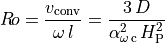

rossbym
Maximum value of gradient in Rossby reference rotation profile.
name
number
type
default
unit
rossbym
589
float
0.333333
-Original entry:
Rotation Parameters
rossbyp
Power of Rossby number (Ro) in gradient of Rossby reference rotation profile.
name
number
type
default
unit
rossbyp
590
float
0.6
-See rossbyf (p 588) for details.
Added In Version 18.3.
Original entry:
Rotation Parameters
Changes:
Note
If you’d like to adjust the standard values of BURN isotopes,
nburnand or the maximum zone number,jmz, you can specify those values using the variable namesNBURNandJMZ, respectively. These can be specified statically in theMakefile, e.g.,SOURCE = $(HOME)/kepler/source SYSTEM = gfortran VERSION = O64 NBURN = 500 JMZ = 32767 include $(SOURCE)/Makefile.makeor, alternatively, add the definitions to the
makecommand line, e.g.,make JMZ=1983 NBURN=4096Whereas any changes in this file should propagate to all paces where these definitions are needed, it is not clear, however, whether this is the case consistently. It is therefore recommended, for the time of this writing, to perform a
make cleanbefore recompiling the code using
make.Warning
JMZneeds to be an odd number andNBURNneeds to be an even number.NBURNshould be at least 500.To switch the plot routine used, use the
PLOTvariable. Current plot interfaces are
value
result
mongotraditional X11 mongo interface (default)
nilno plot for cases where no plot interface can be linked or is desired
pyPython interface for Python module
PLOT = nilDepending on whether to compile for a standalone executable or for the Python interface, one can select the set of interface utility subroutines to include using the
UTILSvariable.
value
result
futilities for standalone Fortran executable (default)
pyutilities for Python interface
UTILS = fWarning
Usually, this should not be change manually, leave at default.
For compilation on older system where the FORTRAN 2003 intrinsic
ieee_arithmeticis not defined, we may chose an alternate version to use, with its corresponding compile flagsIEEEVALS = ieeevals_gcc4.f90 IEEEFLAGS := -fno-range-checkFor development to disable
xflag, we may chose an alternate version to usePROGDBG = progdbg_devel.f90To disable compilation for native architecture use in
ARCH = nonein
Makefile.For
gfortranthere is now also the option to overwrite the compilers and linker using the variableFOR90,CCOMP, andlinker. You may set extra compiler flags usingFLAGSXto all three parts (Fortran, C, linker) or useFFLAGSXfor options use for Fortran and C,CFLAGSXfor additional compiler options for C, andLFLAGSXfor extra linker options.To add a note to the program that is printed on startup, use the
NOTEoption.NOTE = Hello World!When KEPLER is compiled while not on a clean
gitcommit, the source files are included in the KEPLER executable. These are also saved to each dump file. These include all the make files, Python scripts,.cand.f90files. By default, theMakefilein the build directory is always included as well.One can set compiler executable using
CandFORTRANto set the executable name andCOMPDIRto set a common executable directory, if needed.Note
compdirneeds to include the trailing path separator/.For example, to overwrite the use of gnu C compiler on Apple, you may use
C = gcc-14The
MakefilevariableSAVESOURCEcontrols what source files are included
value
result
0never save any source
1save all source if not on git always save Makefile (default)
-1save all source if not on git do not save Makefile when on git
SAVESOURCE = -1Changed In Version 17.2.1: Added
JMZandNBURNvariables toMakefile.Changed In Version 17.3.2: Added
FULDATvariable toMakefile.Changed In Version 18.2.3: Added variables
IEEEVALSandIEEEFLAGStoMakefile.Changed In Version 18.3: Added variables
PROGDBGandARCHtoMakefile.Changed In Version 18.7.11: Variable
FULDATreplaced by variableFULDEF.Changed In Version 18.7.16: Variable
FULDATdeprecated. Use proper link to desiredfuldatversion instead.Changed In Version 18.15.3: Added Makefile capability to overwrite default compile flags for
gfortran.Changed In Version 18.39: Added variables
NOTEandSAVESOURCEtoMakefile.Changed In Version 18.39.5: Added variables
CandFORTRANtoMakefile.
Add
IEEEVALSoption toMakefile.
Changes:
Note
If you’d like to adjust the standard values of BURN isotopes,
nburnand or the maximum zone number,jmz, you can specify those values using the variable namesNBURNandJMZ, respectively. These can be specified statically in theMakefile, e.g.,SOURCE = $(HOME)/kepler/source SYSTEM = gfortran VERSION = O64 NBURN = 500 JMZ = 32767 include $(SOURCE)/Makefile.makeor, alternatively, add the definitions to the
makecommand line, e.g.,make JMZ=1983 NBURN=4096Whereas any changes in this file should propagate to all paces where these definitions are needed, it is not clear, however, whether this is the case consistently. It is therefore recommended, for the time of this writing, to perform a
make cleanbefore recompiling the code using
make.Warning
JMZneeds to be an odd number andNBURNneeds to be an even number.NBURNshould be at least 500.To switch the plot routine used, use the
PLOTvariable. Current plot interfaces are
value
result
mongotraditional X11 mongo interface (default)
nilno plot for cases where no plot interface can be linked or is desired
pyPython interface for Python module
PLOT = nilDepending on whether to compile for a standalone executable or for the Python interface, one can select the set of interface utility subroutines to include using the
UTILSvariable.
value
result
futilities for standalone Fortran executable (default)
pyutilities for Python interface
UTILS = fWarning
Usually, this should not be change manually, leave at default.
For compilation on older system where the FORTRAN 2003 intrinsic
ieee_arithmeticis not defined, we may chose an alternate version to use, with its corresponding compile flagsIEEEVALS = ieeevals_gcc4.f90 IEEEFLAGS := -fno-range-checkFor development to disable
xflag, we may chose an alternate version to usePROGDBG = progdbg_devel.f90To disable compilation for native architecture use in
ARCH = nonein
Makefile.For
gfortranthere is now also the option to overwrite the compilers and linker using the variableFOR90,CCOMP, andlinker. You may set extra compiler flags usingFLAGSXto all three parts (Fortran, C, linker) or useFFLAGSXfor options use for Fortran and C,CFLAGSXfor additional compiler options for C, andLFLAGSXfor extra linker options.To add a note to the program that is printed on startup, use the
NOTEoption.NOTE = Hello World!When KEPLER is compiled while not on a clean
gitcommit, the source files are included in the KEPLER executable. These are also saved to each dump file. These include all the make files, Python scripts,.cand.f90files. By default, theMakefilein the build directory is always included as well.One can set compiler executable using
CandFORTRANto set the executable name andCOMPDIRto set a common executable directory, if needed.Note
compdirneeds to include the trailing path separator/.For example, to overwrite the use of gnu C compiler on Apple, you may use
C = gcc-14The
MakefilevariableSAVESOURCEcontrols what source files are included
value
result
0never save any source
1save all source if not on git always save Makefile (default)
-1save all source if not on git do not save Makefile when on git
SAVESOURCE = -1Changed In Version 17.2.1: Added
JMZandNBURNvariables toMakefile.Changed In Version 17.3.2: Added
FULDATvariable toMakefile.Changed In Version 18.2.3: Added variables
IEEEVALSandIEEEFLAGStoMakefile.Changed In Version 18.3: Added variables
PROGDBGandARCHtoMakefile.Changed In Version 18.7.11: Variable
FULDATreplaced by variableFULDEF.Changed In Version 18.7.16: Variable
FULDATdeprecated. Use proper link to desiredfuldatversion instead.Changed In Version 18.15.3: Added Makefile capability to overwrite default compile flags for
gfortran.Changed In Version 18.39: Added variables
NOTEandSAVESOURCEtoMakefile.Changed In Version 18.39.5: Added variables
CandFORTRANtoMakefile.
Fix
loadbufdrvalue.
Fix action of ipnuc (p 525).
Additions:
impoparm
When set to
1, optional parameters can be defined implicitly.
name
number
type
default
unit
impoparm
587
integer
1
-Added In Version 18.2.
Original entry:
Parameter-Change Parameters
Changes:
o
Obtain/set/define/delete optional user-defined (‘O’) parameters.
name
parameters
o[ NAME [ VALUE [ OPERATION ] | ( VALUE [ def | dev | redef | @ | & | ^ ) | ( del | # ) ] ( OPERATION | @ | & | ^) VALUE ] | VALUE list ]
o i 1 def
o i 1 +
o i
o
o i del
NAME
is the name of the parameter to be specified. By default no parameters are initilazed by KEPLER.
OPERATION
add | mul | div | sub | mod | * | - | + | / | % | ^ | **
These can be used in commad files or to specify other quantities that are useful to analysis later.
The plain form o without any other parameters will list all currently defined parameters.
The form with only NAME specified will return the value of the parameter.
The form with NAME and VALUE will set the parameter to the new value. The VALUE should observe the type of the parameter.
The form with NAME, VALUE, and OPERATION will perfom the operation on the parameter and set it to the resulting value. The operand VALUE should observe the type of the parameter.
The form with NAME, VALUE, and def or @ will define the new parameter and set its value to VALUE. The variable type is inferred from the type of the initial value. An error results if the variable NAME already exists.
The form with NAME, VALUE, and dev or & will define a new parameter and set its value to VALUE if NAME does not yes exits, otherwise NAME remains unchanged. An error results if the variable NAME already exists and has a different type than VALUE.
The form with NAME, VALUE, and redef or ^ will define a new parameter and set its value to VALUE if NAME does not yes exits, otherwise will assign the new value to NAME. An error results if the variable NAME already exists and has a different type than VALUE.
The form with NAME, ( OPERATION or dev or & ) VALUE is also allowed with the purposes as above, just last two arguments switched.
The form NAME VALUE list prints all parameters with that value.
The form with NAME and del or # will delete the optional parameter.
Note
In contrast to p and q parameters the o parameters cannot be addressed by number. This limitation was imposed as the parameters can be added and removed randomly.
parmetercard ::= "o" ( listspec | setspec | defspec | delspec )
listspec     ::= [ parameter ]
setspec      ::= parameter ( value [ operation ] | operation value )
defspec      ::= parameter ( value ( "def" | "dev" | "redef" | "@" | "&" | "^" ) ) | ( "@" | "&" | "^" ) value )
delspec      ::= parameter ( "del" | "#" )
parameter    ::= name
name         ::= string
number       ::= integer
value        ::= float | integer
operation    ::= "add" | "mul" | "div" | "sub" | "mod" | "*" | "-" | "+" | "/" | "%" | "^" | "**"
Added In Version 17.0.2.
Changed In Version 18.1.3: Add “@”, “#”, “^”, “**”, and pow.
Changed In Version 18.2: Parameters no longer need to be defined but instead the first assignment will be used as implicit definition if impoparm (p 587) is
1.Changed In Version 18.7.7: Added dev.
Changed In Version 18.7.20: Add & and option for reverse order of definition operators.
Changed In Version 18.35.4: Add redef and ^ for redefinition without error.
Original entry:
Normal Program Managment Commands
Changes:
p
Edit changable (‘P’) parameters.
name
parameters
p[ ( PARAMETER [ ( .. PARAMETER ) | ( VALUE [ OPERATION ] ) ] ) | ( LISTVALUE [ list ] ) ]
p
p 1
p 1 1.e-5
p 1 2. *
p 1 * 3.
p 1 .. 3
p 1 .0001 %
p 1 list
p 1.d-14
p *time
PARAMETER
is the name or number of the parameter to be specified. See Changable (‘P’) Parameters for a list of the changeable parameters in the code and their units and default values.
VALUE
is the value to be assigned to this parameter. Note that fixed point parameters must have fixed pointed values specified, and floating point parameters must be given floating point values (i.e.,
OPERATION
add | mul | div | sub | mod | pow | * | - | + | / | % | ^ | **
LISTVALUE
Value for parameter list by value. Integer or float.
Note
If the desired list value is also valid parameter number, then use the “list” keyword, otherwise it may be omitted.
Parameters are internally first set to their default values, but can be overwritten uisng input cards, e.g., in generators or interactively.
For editing parameters one may use either their number or name.
Current parameter values can be querried using the “p command by just specifying their numer or name. A range of parameters can be listed using “-” or “..”. The “*” wildcard can be used at the beginning or the end to list all parmeters with matching names where the usual UNIX shell-type maching is performed, “*” standing for any number of arbitrary characters. Parameters can be listed by matching numerical value using the “list” keyword. If the numeric value is of type float or integer and out of the allowed range of allowed parameter numbers, the “list” keyword may be omitted.
Parameters can be changed by specifying the new value or using one of the operations “*”, “-”, “+”, “/”, “%”, “^”, or “**” on the current value. The operators “^” and , “**” do the same things.
parmetercard ::= "p" listspec | setspec | vallistspec
listspec     ::= [ parameter [ rangeop parameter ] ] | wildspec
rangeop      ::= ".."
wildspec     ::= "*"string | string"*" | "*"string"*"
setspec      ::= parameter value [ operation ] | parameter simpleop value
vallistspec  ::= value [ "list" ]
parameter    ::= name | number
name         ::= string
number       ::= integer
value        ::= float | integer | string
operation    ::= simpleop | complexop
simpleop     ::= "*" | "-" | "+" | "/" | "%" | "^"
complexop    ::= "add" | "mul" | "div" | "sub" | "mod" | "pow"
Changed In Version >15: Added matching by wildchard and parameter range.
Changed In Version 16.85: procession of p cards by
ttycomallows the use of parameter names in generators. Prior to that, only parameter numners were allowed in generators.Changed In Version 17.0.2: List parameters by value.
Changed In Version 18.1.3: Add “^”, “**”, and pow.
Changed In Version 18.7.1: only allow .. for parameter range selection
Original entry:
Normal Program Managment Commands
o
Obtain/set/define/delete optional user-defined (‘O’) parameters.
name
parameters
o[ NAME [ VALUE [ OPERATION ] | ( VALUE [ def | dev | redef | @ | & | ^ ) | ( del | # ) ] ( OPERATION | @ | & | ^) VALUE ] | VALUE list ]
o i 1 def
o i 1 +
o i
o
o i del
NAME
is the name of the parameter to be specified. By default no parameters are initilazed by KEPLER.
OPERATION
add | mul | div | sub | mod | * | - | + | / | % | ^ | **
These can be used in commad files or to specify other quantities that are useful to analysis later.
The plain form o without any other parameters will list all currently defined parameters.
The form with only NAME specified will return the value of the parameter.
The form with NAME and VALUE will set the parameter to the new value. The VALUE should observe the type of the parameter.
The form with NAME, VALUE, and OPERATION will perfom the operation on the parameter and set it to the resulting value. The operand VALUE should observe the type of the parameter.
The form with NAME, VALUE, and def or @ will define the new parameter and set its value to VALUE. The variable type is inferred from the type of the initial value. An error results if the variable NAME already exists.
The form with NAME, VALUE, and dev or & will define a new parameter and set its value to VALUE if NAME does not yes exits, otherwise NAME remains unchanged. An error results if the variable NAME already exists and has a different type than VALUE.
The form with NAME, VALUE, and redef or ^ will define a new parameter and set its value to VALUE if NAME does not yes exits, otherwise will assign the new value to NAME. An error results if the variable NAME already exists and has a different type than VALUE.
The form with NAME, ( OPERATION or dev or & ) VALUE is also allowed with the purposes as above, just last two arguments switched.
The form NAME VALUE list prints all parameters with that value.
The form with NAME and del or # will delete the optional parameter.
Note
In contrast to p and q parameters the o parameters cannot be addressed by number. This limitation was imposed as the parameters can be added and removed randomly.
parmetercard ::= "o" ( listspec | setspec | defspec | delspec )
listspec     ::= [ parameter ]
setspec      ::= parameter ( value [ operation ] | operation value )
defspec      ::= parameter ( value ( "def" | "dev" | "redef" | "@" | "&" | "^" ) ) | ( "@" | "&" | "^" ) value )
delspec      ::= parameter ( "del" | "#" )
parameter    ::= name
name         ::= string
number       ::= integer
value        ::= float | integer
operation    ::= "add" | "mul" | "div" | "sub" | "mod" | "*" | "-" | "+" | "/" | "%" | "^" | "**"
Added In Version 17.0.2.
Changed In Version 18.1.3: Add “@”, “#”, “^”, “**”, and pow.
Changed In Version 18.2: Parameters no longer need to be defined but instead the first assignment will be used as implicit definition if impoparm (p 587) is
1.Changed In Version 18.7.7: Added dev.
Changed In Version 18.7.20: Add & and option for reverse order of definition operators.
Changed In Version 18.35.4: Add redef and ^ for redefinition without error.
Original entry:
Normal Program Managment Commands
Initialize
noparmingenerto not rely on memory being zero as well as being an advance toward Python module restarts.
Improve BURN network backups for Python tools.
Implement complex formula for 3D dynamical instability.
Additions:
angfjdyn
General efficiency multiplier for generalised dynamical instability.
name
number
type
default
unit
angfjdyn
585
float
0.
-Added In Version 18.1.
Original entry:
Rotation Parameters
angfsh
Relative weighing of Solberg-Hoiland instability contribution for generalised dynamical instability (angfjdyn (p 585)).
name
number
type
default
unit
angfsh
586
float
1.
-Added In Version 18.1.
Original entry:
Rotation Parameters
Additions:
debug
Switch on or off debugging mode.
name
parameters
debug[ VALUE ]
debug
debug 0
VALUE
switch on if
0If value is not present, print current value.
Added In Version 18.0.1.
Original entry:
Normal Program Managment Commands
Changes:
(optional) is a set of one or more space delimited words in arbitrary order chosen from among the following possibilities:
Option
Meaning
s
To suspend the code after starting.
k
do not load BURN data and kill burning, similar to the killburn command.
d
To destroy the ASCII output files after sending them to the microfiche printer (not currently implemented – see also the discussion of parameter iautoout (p 159).
h
To automatically make a paper copy of the ASCII output files (not currently implemented).
c
write out stored command file (overwrite existing).
a
append stored command file.
p
make plot on start-up.
n
suppress graphical output, e.g., for batch mode.
x
DEBUG mode. Allow running without proper git hash.
X
Extended DEBUG mode. Could be used to enable internal debugging code. Adds
2to internalidebugvariable.e
Allow experts to overwrite of ittyv (p 538) by command files. This is for the
% ittyvcommand file directive.Changed In Version >15: Added k option.
Changed In Version 17.1: Added c and a options.
Changed In Version 17.6: Added x option.
Changed In Version 17.11.7: Added p and n options.
Changed In Version 18.0.1: Added X option.
Changed In Version 18.37.1: Added e option.
cmddbg
Switch on or off debugging for command file functions.
name
parameters
cmddbg[ VALUE ]
cmddbg
cmddbg 0
VALUE
switch on if
0, switch off otherwise.If value is not present, print current value.
Added In Version 17.11.7.
Changed In Version 18.0.1: Print current value if no value is provided.
Original entry:
Normal Program Managment Commands
Official version with 3D angular momentum.
Update default doc path to
doc.Bug fix in weak rates (used undefined variable as index).
Additions:
nonormb
Do not normalise mapped BURN abundances.
name
parameters
nonormbnonormbNote
This is for debugging purposes.
Note
If BURN is not active, this card is ignored.
Added In Version 18.
Original entry:
Optional Cards
dweakmin
Minimum density for weak rates.
name
number
type
default
unit
dweakmin
584
float
100000.
g/ccFor some problems, e.g., XRB, this should be set to a lower value.
If set to
0.then use lower bound from loaded grid datawdatfile.Added In Version 18.
Original entry:
BURN Physics Parameters
Bug fix to
generfor addition of BURN file.Bug fix to Itoh08 opacities, regress from refactor.
Bug fix to add radconv (q 89) calculation to subroutine
gener.Bug fix advection energy calculation for case of combined loss and accretion.
Bug fix to neutrino losses when lburn (p 434) is used: now use updated abundances.
All common block in separate files to assure identical variable names.
Bug fix to minzone (p 444) updates relevant to decretion.
Bug fix to disable rezone across bmasslow (p 419) domain boundary.
Add
drzonal edit variable.Stop on generator errors if not in interactive mode. Experimental.
Todo
Add option to activate/deactivate this.
Add
{}expression evaluation to generator.dvacc (q 137) now stored correctly.
Set APPROX accretion composition after
mapburn.
Additions:
~
Similar to : command but always evaluates to
.FALSE.. This can be used, e.g., to store “subroutine” code sections that are retained unconditionally. Really the same as: FAdded In Version 17.11.7.
Kepler Variables
A selection of KEPLER variables can also be used, including p and q parameters (by name or number), and user-defined optional o parameters. Also allowed are any zonal variables accessible through
loadbufwhere zone number or mass coordinate can be used similar to the z interactive command.This includes a small set of KEPLER physical and mathematical constants, pie, c, k, me, a, sigt, gee, n0, solmass, solrad, year, h, ev, mev, amu, and rgas.
Changed In Version 18.15: Added h, ev, mev, and amu.
One can also use a small selection of array functions named after the FORTRAN functions on loadbuf quantities and specify ranges using the : (colon) syntax where omitted first and last indices stand for
1and jm (q 2) respectively.
function
type
description
sum
float
sum up values
maxval
float
maximum value
minval
float
minimum value
maxloc
integer
index of maximum
minloc
integer
index of minimum
To obtain location of variable values in
loadbufarrays, the following functions can be used. You may use , or ; to separate arguments, or omit brackets where the expression remains unique, but you must retain “,” or “;”.
function
type
description
locl
integer
lower zone number
loc
integer
closest zone number
loch
integer
higher zone number
locx
float
linear interpolated floating zone number
mocl
integer
lower zone number (test outside-in)
moc
integer
closest zone number (test outside-in)
moch
integer
higher zone number (test outside-in)
mocx
float
linear interpolated floating zone number (test outside-in)
@ loc(rn,1.d12) > 1000
@ loc rn(:1200),1.d12  > 1000
Changed In Version 17.11.7: Added “;” as allowed separator. Allow range specification. Require separator. Add “m” functions.
To test where condition is fulfilled anywhere for
loadbufarrays, the following functions can be used. You may omit brackets for call syntax where the expression remains unique. You can use the FORTRAN operators <, <=, ==, =, >=, >, /=, and !=.
function
type
description
any
logical
condition fulfilled for any array value
all
logical
condition fulfilled for all array values
@ all(rn < 1.d12)
@ any convect == 4
Added In Version 17.11.7.
Changed In Version 18.7.2: Added = and !=.
Note
Dissection of the expression fails with variable names that contain operators, e.g., for some reaction rates. In this case, square brackets, [ and ] can be used to keep these together.
@ [o16+o16](1) > 1.d10
d #oign
Changed In Version 17.0.13.
dr
Zone thickness.
name
type
unit
centering
storage
dr
float
cm
center
loadbufAdded In Version 17.11.7.
Original entry:
Miscellaneous
//b
The following lines will be appended to BURN generator file until
\\command or end of file.
name
parameters
//bIf genburn has not been called before, this BURN section will be ignored. This allows to just comment out the genburn command and not worrying to remove //b section.
Added In Version 17.11.7.
Original entry:
Optional Cards
//b*
Same as //b but delete old BURN generator file.
name
parameters
//b*Note
This is done only once during generation, the first time it is encountered.
Added In Version 17.11.7.
Original entry:
Optional Cards
uuid
Set UUID of generator.
name
parameters
uuidUUID
This may be used to better track connections between runs and generators used.
uuid 3f856e9e-b45b-11ea-b3f3-2cfda1c73a9cAdded In Version 17.11.7.
Original entry:
Optional Cards
sha
Set sha hash of generator.
name
parameters
shaSHA
This may be used to better track connections between runs and generators used.
sha 1ebc0705ced3e43cfbdb219314da7cdf3bc0e6f8Added In Version 17.11.7.
Original entry:
Optional Cards
cmddbg
Switch on or off debugging for command file functions.
name
parameters
cmddbg[ VALUE ]
cmddbg
cmddbg 0
VALUE
switch on if
0, switch off otherwise.If value is not present, print current value.
Added In Version 17.11.7.
Changed In Version 18.0.1: Print current value if no value is provided.
Original entry:
Normal Program Managment Commands
del
Delete optional user-defined (‘O’) parameters.
name
parameters
delNAME
o i 1 def
o i 1 +
o i
o
del i
NAME
is the name of the parameter to be deleted.
Delete the optional parameter NAME. See o for details.
Added In Version 17.11.7.
Original entry:
Normal Program Managment Commands
def
Define optional user-defined (‘O’) parameters.
name
parameters
defNAME VALUE
def i 1
o i 1 +
o i
o
del i
NAME
is the name of the parameter to be defined.
Define the optional parameter NAME. See o for details.
Added In Version 17.11.7.
Original entry:
Normal Program Managment Commands
Changes:
% OPTIONS
Options/flags/directives to the command file interpreter. The number of spaces between
%and the command may beThe debug flag allows debugging of expression interpretation.
% debugAdded In Version 17.0.2.
The nodebug flag switches debugging off (default).
% nodebugAdded In Version 17.0.12.
The simpleq flag switches to simple, single-level “if” statement evaluation (default).
% simpleqAdded In Version 18.7.7.
The nestedq flag switches to simple, single-level “if” statement evaluation.
% nestedqAdded In Version 18.7.7.
The noecho flag disables printout of expression tests to console.
% noechoAdded In Version 17.0.12.
The echo flag enables printout of expression tests to console (possibly misguided default).
% echoAdded In Version 17.0.12.
The xsave flag enables saving of command file before each command execution. This is to prevent loss of changes to command file in case KEPLER terminates during execution, e.g., for a end command.
% ittyv NUMAdded In Version 18.37.2.
Set the value of ittyv (p 538) used in command execution. Note that you requite to use the command line flag e to enable this expert feature.
% xsaveAdded In Version 17.0.13.
The noxsave flag disables saving of command file before each command execution. This save a lot of write operations, however, changes to command file may be lost in case KEPLER terminates during execution, e.g., for a end command.
% noxsaveAdded In Version 17.0.13.
The end flag end KEPLER in a save way, also saving the command file properly before termination.
% endAdded In Version 17.0.13.
The delete directive deletes the command file and terminates its execution.
% deleteAdded In Version 17.0.13.
The delsec directive deletes the current section and skips to the next section.
*
: tn(1) > 1.d8
p 1 1.
@ dn(1) > 1.d6
% delsec
Added In Version 17.0.13.
Changed In Version 17.11.7: Replace # by % to distinguish from comment lines for the off chance of an accidental collision.
Command Expressions
Command expressions consist of a logical expression that use the comparison operators >, <, >=, <=, ==, = (same as ==), /=, and != (same as /=) to compare arithmetic expressions. More complex expression can be composed using and brackets, ( and ), ~ (not), & (and), or ^ (xor), and | (or), in that order of precedence. You may use logical values .TRUE., .True., .true., T, .FALSE., .False., .false., or F in or as logical expressions. Use cases may be limited.
Changed In Version 17.11.7: Added logical values and logical not (~).
Changed In Version 18.7.2: Added /= and !=.
Changed In Version 18.7.4: Added ^ for xor (removed as allowed symbol for power).
Special Variables
Special variables are cputime, which returns the CPU time used since start of the current execution, and timeused, which returns the CPU time since start of the problem, both as float and in
sec.Changed In Version 18.7.19: Renamed cpu_time to cputime.
Kepler Variables
A selection of KEPLER variables can also be used, including p and q parameters (by name or number), and user-defined optional o parameters. Also allowed are any zonal variables accessible through
loadbufwhere zone number or mass coordinate can be used similar to the z interactive command.This includes a small set of KEPLER physical and mathematical constants, pie, c, k, me, a, sigt, gee, n0, solmass, solrad, year, h, ev, mev, amu, and rgas.
Changed In Version 18.15: Added h, ev, mev, and amu.
One can also use a small selection of array functions named after the FORTRAN functions on loadbuf quantities and specify ranges using the : (colon) syntax where omitted first and last indices stand for
1and jm (q 2) respectively.
function
type
description
sum
float
sum up values
maxval
float
maximum value
minval
float
minimum value
maxloc
integer
index of maximum
minloc
integer
index of minimum
To obtain location of variable values in
loadbufarrays, the following functions can be used. You may use , or ; to separate arguments, or omit brackets where the expression remains unique, but you must retain “,” or “;”.
function
type
description
locl
integer
lower zone number
loc
integer
closest zone number
loch
integer
higher zone number
locx
float
linear interpolated floating zone number
mocl
integer
lower zone number (test outside-in)
moc
integer
closest zone number (test outside-in)
moch
integer
higher zone number (test outside-in)
mocx
float
linear interpolated floating zone number (test outside-in)
@ loc(rn,1.d12) > 1000
@ loc rn(:1200),1.d12  > 1000
Changed In Version 17.11.7: Added “;” as allowed separator. Allow range specification. Require separator. Add “m” functions.
To test where condition is fulfilled anywhere for
loadbufarrays, the following functions can be used. You may omit brackets for call syntax where the expression remains unique. You can use the FORTRAN operators <, <=, ==, =, >=, >, /=, and !=.
function
type
description
any
logical
condition fulfilled for any array value
all
logical
condition fulfilled for all array values
@ all(rn < 1.d12)
@ any convect == 4
Added In Version 17.11.7.
Changed In Version 18.7.2: Added = and !=.
Note
Dissection of the expression fails with variable names that contain operators, e.g., for some reaction rates. In this case, square brackets, [ and ] can be used to keep these together.
@ [o16+o16](1) > 1.d10
d #oign
Changed In Version 17.0.13.
Kepler Variables
A selection of KEPLER variables can also be used, including p and q parameters (by name or number), and user-defined optional o parameters. Also allowed are any zonal variables accessible through
loadbufwhere zone number or mass coordinate can be used similar to the z interactive command.This includes a small set of KEPLER physical and mathematical constants, pie, c, k, me, a, sigt, gee, n0, solmass, solrad, year, h, ev, mev, amu, and rgas.
Changed In Version 18.15: Added h, ev, mev, and amu.
One can also use a small selection of array functions named after the FORTRAN functions on loadbuf quantities and specify ranges using the : (colon) syntax where omitted first and last indices stand for
1and jm (q 2) respectively.
function
type
description
sum
float
sum up values
maxval
float
maximum value
minval
float
minimum value
maxloc
integer
index of maximum
minloc
integer
index of minimum
To obtain location of variable values in
loadbufarrays, the following functions can be used. You may use , or ; to separate arguments, or omit brackets where the expression remains unique, but you must retain “,” or “;”.
function
type
description
locl
integer
lower zone number
loc
integer
closest zone number
loch
integer
higher zone number
locx
float
linear interpolated floating zone number
mocl
integer
lower zone number (test outside-in)
moc
integer
closest zone number (test outside-in)
moch
integer
higher zone number (test outside-in)
mocx
float
linear interpolated floating zone number (test outside-in)
@ loc(rn,1.d12) > 1000
@ loc rn(:1200),1.d12  > 1000
Changed In Version 17.11.7: Added “;” as allowed separator. Allow range specification. Require separator. Add “m” functions.
To test where condition is fulfilled anywhere for
loadbufarrays, the following functions can be used. You may omit brackets for call syntax where the expression remains unique. You can use the FORTRAN operators <, <=, ==, =, >=, >, /=, and !=.
function
type
description
any
logical
condition fulfilled for any array value
all
logical
condition fulfilled for all array values
@ all(rn < 1.d12)
@ any convect == 4
Added In Version 17.11.7.
Changed In Version 18.7.2: Added = and !=.
Note
Dissection of the expression fails with variable names that contain operators, e.g., for some reaction rates. In this case, square brackets, [ and ] can be used to keep these together.
@ [o16+o16](1) > 1.d10
d #oign
Changed In Version 17.0.13.
(optional) is a set of one or more space delimited words in arbitrary order chosen from among the following possibilities:
Option
Meaning
s
To suspend the code after starting.
k
do not load BURN data and kill burning, similar to the killburn command.
d
To destroy the ASCII output files after sending them to the microfiche printer (not currently implemented – see also the discussion of parameter iautoout (p 159).
h
To automatically make a paper copy of the ASCII output files (not currently implemented).
c
write out stored command file (overwrite existing).
a
append stored command file.
p
make plot on start-up.
n
suppress graphical output, e.g., for batch mode.
x
DEBUG mode. Allow running without proper git hash.
X
Extended DEBUG mode. Could be used to enable internal debugging code. Adds
2to internalidebugvariable.e
Allow experts to overwrite of ittyv (p 538) by command files. This is for the
% ittyvcommand file directive.Changed In Version >15: Added k option.
Changed In Version 17.1: Added c and a options.
Changed In Version 17.6: Added x option.
Changed In Version 17.11.7: Added p and n options.
Changed In Version 18.0.1: Added X option.
Changed In Version 18.37.1: Added e option.
addsurf
Add isothermal surface zones with specified properties.
name
parameters
addsurf[ MSURF | ( NSURF TMSURF TEMPSURF RHOSURF VELSURF [ [ AWSURFX AWSURFY ] AWSURFZ ] ) ]
addsurf 10 1.E+32 1.E+4 1.E-11 0.MSURF
Amount of mass to add as a single zone (
g)NSURF
number of zones to be added
TMSURF
total mass of zones to be added (
g)TEMPSURF
temerature of zones
RHOSURF
density of zones
VELSURF
velocity of zones
AWSURFX
angular velocity of zones in
AWSURFY
angular velocity of zones in
AWSURFZ
angular velocity of zones in
Add NSURF zones of equal mass totaling TMSURF total mass (
g) with temperature, TSURF (K), density, RHOSURF (g/cc), velocity, VELSURF (cm/sec), and the composition last specified by the compsurf command.If (only) MSURF is specified, zone of this mass (
g) will be accreted and xmacrete (p 212) will be reduced by this amount or set to0if MSURFIf no parameter is given, the mass of the current “phantom zone” xmacrete (p 212) is added as a new zone to the grid and xmacrete (p 212) is set to zero.
If AWSURFX, AWSURFY, AWSURFZ are not provided, the angular velocity value from the outermost zone is used; if only AWSURFZ is provided, the other two are set to
0..Note
Each time addsurf is called, the sum of the mass fractions in the
compsurfarray is normalized to unity.Changed In Version >16: Add MSURF and call variant without options.
Changed In Version 17.11.7: Add AWSURFX AWSURFY AWSURFZ
Original entry:
Special Purpose Commands
addwind
Add wind surface zones.
name
parameters
addwindNWIND WINDMASS RATEWIND VELWIND [ VESCMULT [ TEFFWIND [RADPWIND [ [ AWWINDXAWWINDY] AWWIND ] ] ] ] ]
addwind 5 1.0e-5 1.e-4 10. 1. 3.098e+3 3.443e+13NWIND
number fo wind zones to add
WINDMASS
total mass of wind (
Msun)RATEWIND
mass-loss rate (
Msun/yr)VELWIND
wind terminal velocity (
km/sec)VESCMULT
escape-velocity multiplier
TEFFWIND
effective photospheric temperature (
K)RADPWIND
radius used (
cm)AWWINDX
angular
rad/sec)AWWINDY
angular
rad/sec)AWWINDZ
angular
rad/sec)Add NWIND zones of equal mass totaling WINDMASS (
Msun) with mass-loss rate RATEWIND (Msun/yr), terminal velocity VELWIND (km/sec). Optional inputs are the escape-velocity multiplier, VESCMULT (default1.) and the effective photospheric temperature TEFFWIND (K) and radius RADPWIND (cm) used in generating the wind profile. The mass-loss rate is assumed to stay constant at RATEWIND during the time these zones “took” to leave the surface of the star, and the velocity at any point is the sum of the local escape velocity times VESCMULT and the wind’s terminal velocity, VELWIND. The wind’s local temperature is calculated by assuming that it is in LTE with the photosphere specified by TEFFWIND and RADPWIND. If no explicit values of these photospheric variables are given, they default to the existing photospheric temperature (teff (q 48)) and radius (radius (q 47)). The composition of the wind is taken to be the same as that of the outer zone.If AWWINDX, AWWINDY, AWWINDZ are not provided, the angular velocity value from the outermost zone is used; if only AWWINDZ is provided, the other two are set to
0..Note
Several addwind commands can be used in succession to build up a wind with a time-dependent mass-loss rate, or to achieve non-constant-mass zoning.
Changed In Version 17.11.7: Add AWWINDX AWWINDY AWWINDZ
Original entry:
Special Purpose Commands
drmultlo
Semiconvective mixing will be slower than thermal transport by at least drmultlo (p 325) (about
0.1) in zones where the mean atomic weight,, is below abarsemi (p 324).
name
number
type
default
unit
drmultlo
325
float
-1.
-See subroutine
updateand discussion of drmult (p 24), woversht (p 148), and woverslo (p 326).If drmultlo (p 325) =
0no semiconvective mixing is done.If drmultlo (p 325) <
0then drmult (p 24) will be used.Added In Version 9.
Changed In Version 17.11.7: Default
will use drmult (p 24).
Original entry:
Semiconvection And Overshoot Parameters
woverslo
The semiconvective test parameter,
, is taken to be
abs(log(T1/T0)) for the special overshoot semiconvective zones where0and when
name
number
type
default
unit
woverslo
326
float
-1.
-Overshoot mixing occurs at a rate calculated from this value of
See subroutine
updateand [WZW78].If woverslo (p 326) =
0no overshoot mixing is done.If woverslo (p 326) <
0then woversht (p 148) will be used.Also see woversht (p 148).
Added In Version 9.
Changed In Version 17.11.7: Default
Original entry:
Semiconvection And Overshoot Parameters
iflagye
The electron EOS is implicitly coupled to nuclear burning-induced changes in the electron abundance,
0(value1) is set and the ISE or NSE network is being used; or iflagye (p 167) bit1is set and the APPROX network is being used.
name
number
type
default
unit
iflagye
167
integer
1
-
value
result
flag
0coupling disabled
flag
1couple
flag
2couple
flag
3couple
value
result
bit
0couple
bit
1couple
Warning
Check coding for the case of using BURN network.
Changed In Version 17.11.7: Added flag
2Original entry:
ISE Network Physics Parameters
nadapb
Enable Adaptive BURN network adjustment.
name
number
type
default
unit
nadapb
137
integer
0
-
value
result
0off
1on
2(flag) reload ADAPNET and clear flag.
See ADAPNET for details on use and data files.
The bit
2is a flag to reload ADAPNET configuration file and then clear the flag. The value2itself makes not too much sense. It reloads the configuration file, adopts the network once, but then switches ADAPNET off. Choose3to reload configuration file and continue using ADAPNET.Added In Version 16.9.
Changed In Version 17.11.7: Add reload flag.
Note
p
137was changed to frombethemtto nadapb (p 137) around version 16.09. Since also the type was changed fromintegertofloatthere should be little confusion in generators.
bethemthad the following description:Multiplier on fudged Co63 electron decay rate as suggested by Gerry Brown and Hans Bethe (11/89).KEPLER uses updated weak rates (from Langanke & Martinez (2000) as of the time of this writing).
Original entry:
BURN Coprocessing Control Parameters
Add tag and time to termination message.
Add generator to history.
Minor changes for compatibility with gfortran 10.1.1.
Fix iron abundances used for mass loss rate formula. Bug reported by Stan Woosley on 20200105. Old formula overestimated iron by 56/54.
Another fix on optical depth-based rezoning.
Fix dated bug in optical depth-based rezoning.
Warning
taurat (p 571) was effectively 4 times its value.
More refactoring to remove implicit type definitions.
Warning
Fixed: in
esthe variableeionzwas not defined. Replaced byeioniz.
More refactoring to remove implicit type definitions.
Fixed iterbar (q 160) stored in common block and actually saved.
Fixed variable name
yo160vs.yo16oinqseedit.
More refactoring to remove implicit type definitions.
iterbar (q 160) now stores iteration counter for problem termination to have better reproducible execution behaviour.
Warning
Fixed updating rotation energies if mixcycl (p 433)
0(cycle).Fixed bug (undefined variable) in C14EC rate in
burn.Todo
rocher(p 354) should not beparmbut inqparm.
Additions:
iterbar
Current iteration counter for problem termination.
name
number
type
unit
iterbar
160
integer
-Added In Version 17.11.
Original entry:
Time Step-Related Parameters
Include 3D components of angular momentum. This implies various updates to data files. 3D interpretation of angular momentum is non-trivial: for example, the total angular momentum of two shells rotating in opposite directions can be zero.
angj() and
angw() can be accessed adding the respective component character, whereas internally they are implemented as vectors. The magnitude (
norm) cam be accessed adding thencharacter to the base variable name. The default direction, including mapping from older dumps and 1D generators isVast refactoring to remove many implicit variable type definitions.
Warning
In
remapl,remapa, (mass loss and accretion remapping of all physical quantities) andtransport1(rotationally induced mixing) the maximum array size was hard-coded to4096, so old high-resolution runs may have suffered from memory overwriting as that was uses in common block definitions to store mapping data. This has now been fixed to scale withJMZ.Record of angular momentum lost by wind,
anglwndwas not updated correctly due to wrong variable name incycle.The cut command may have messed up angular velocity.
Fixed convection change timescale for flame problems (flamerad (p 214)).
Fixed bad indices in
specl0for,
.
Fixed missing to store rate for


(resulting in undefined variable where used).
Fixed
rproxdefinition oft954missing.Fixed
rate0definition offivesixthsandOneThirdmissing. (cf88Fixed (not) overwriting beta decay rate for Formula 28 in
rateb.Fixes in
regessto advection and boundary derivatives.Note
Renamed
angjacc (p 512)to angjaccz (p 512).Renamed
angw0 (p 510)to angw0z (p 510).Renamed
awcorot0 (p 430)to awcorotz (p 430). A negative or0value no longer disables co-rotation. Exclusively use ymcorot (p 431)0.instead. The defaults have been updated accordingly.
Additions:
angjx
Specific angular momentum x-component.
name
type
unit
centering
storage
angjx
float
cm**2/sec
center
dumpAdded In Version 17.10.
Original entry:
Saved Arrays Evaluated at Zone Centers
angjy
Specific angular momentum y-component.
name
type
unit
centering
storage
angjy
float
cm**2/sec
center
dumpAdded In Version 17.10.
Original entry:
Saved Arrays Evaluated at Zone Centers
angjz
Specific angular momentum z-component.
name
type
unit
centering
storage
angjz
float
cm**2/sec
center
dumpAdded In Version 17.10.
Original entry:
Saved Arrays Evaluated at Zone Centers
angwx
Angular velocity x-component.
name
type
unit
centering
storage
angwx
float
rad/sec
center
cycleAdded In Version 17.10.
Original entry:
Rotation
angwy
Angular velocity y-component.
name
type
unit
centering
storage
angwy
float
rad/sec
center
cycleAdded In Version 17.10.
Original entry:
Rotation
angwz
Angular velocity z-component.
name
type
unit
centering
storage
angwz
float
rad/sec
center
cycleAdded In Version 17.10.
Original entry:
Rotation
angr
Zone gyration-average radius.
name
type
unit
centering
storage
angr
float
cm
center
loadbuf
Added In Version 17.10.
Original entry:
Rotation

angvx
Equatorial rotational velocity x-component.
name
type
unit
centering
storage
angvx
float
cm/sec
center
loadbufAdded In Version 17.10.
Original entry:
Rotation
angvy
Equatorial rotational velocity y-component.
name
type
unit
centering
storage
angvy
float
cm/sec
center
loadbufAdded In Version 17.10.
Original entry:
Rotation
angvz
Equatorial rotational velocity z-component.
name
type
unit
centering
storage
angvz
float
cm/sec
center
loadbufAdded In Version 17.10.
Original entry:
Rotation
angjtx
Integrated angular momentum x-component.
name
type
unit
centering
storage
angjtx
float
erg*sec
boundary
loadbufAdded In Version 17.10.
Original entry:
Rotation
angjty
Integrated angular momentum y-component.
name
type
unit
centering
storage
angjty
float
erg*sec
boundary
loadbufAdded In Version 17.10.
Original entry:
Rotation
angjtz
Integrated angular momentum z-component.
name
type
unit
centering
storage
angjtz
float
erg*sec
boundary
loadbufAdded In Version 17.10.
Original entry:
Rotation
angw0x
name
number
type
default
unit
angw0x
579
float
0.
rad/secAdded In Version 17.10.
Original entry:
Rotation Parameters
angw0y
name
number
type
default
unit
angw0y
580
float
0.
rad/secAdded In Version 17.10.
Original entry:
Rotation Parameters
angjaccx
name
number
type
default
unit
angjaccx
577
float
0.
cm/sec**2Added In Version 17.10.
Original entry:
Rotation Parameters
angjaccy
name
number
type
default
unit
angjaccy
578
float
0.
cm/sec**2Added In Version 17.10.
Original entry:
Rotation Parameters
nang3d
Switch on 3D angular momentum.
name
number
type
default
unit
nang3d
576
integer
0
-
value
result
0off
1on
Added In Version 17.10.
Original entry:
Rotation Parameters
nrotout
Write out rotation data file.
name
number
type
default
unit
nrotout
583
integer
0
-
value
result
0off
1+write out data every nrotout (p 583) cycles.
Added In Version 17.10.
Original entry:
Rotation Parameters
angltx
X-component of current total angular momentum.
name
number
type
unit
angltx
151
float
erg*secAdded In Version 17.10.
Original entry:
Rotation-Related Parameters
anglty
Y-component of current total angular momentum.
name
number
type
unit
anglty
152
float
erg*secAdded In Version 17.10.
Original entry:
Rotation-Related Parameters
angltz
Z-component of current total angular momentum.
name
number
type
unit
angltz
153
float
erg*secAdded In Version 17.10.
Original entry:
Rotation-Related Parameters
anglwndx
X-component of angular momentum lost due to wind.
name
number
type
unit
anglwndx
157
float
-Added In Version 17.10.
Original entry:
Rotation-Related Parameters
anglwndy
Y-component of angular momentum lost due to wind.
name
number
type
unit
anglwndy
158
float
-Added In Version 17.10.
Original entry:
Rotation-Related Parameters
anglwndz
Z-component of angular momentum lost due to wind.
name
number
type
unit
anglwndz
159
float
-Added In Version 17.10.
Original entry:
Rotation-Related Parameters
anglossx
X-component of angular momentum removed from problems by cutsurf.
name
number
type
unit
anglossx
154
float
erg*secAdded In Version 17.10.
Original entry:
Cutsurf-Parameters
anglossy
Y-component of angular momentum removed from problems by cutsurf.
name
number
type
unit
anglossy
155
float
erg*secAdded In Version 17.10.
Original entry:
Cutsurf-Parameters
anglossz
Z-component of angular momentum removed from problems by cutsurf.
name
number
type
unit
anglossz
156
float
erg*secAdded In Version 17.10.
Original entry:
Cutsurf-Parameters
Changes:
angj
Specific angular momentum magnitude.
name
type
unit
centering
storage
angj
float
cm**2/sec
center
loadbufAdded In Version 15.2.
Changed In Version 17.10: now derived quantity, components are stored as primary data instead.
Original entry:
Rotation
angwcst
Rotation constant magnitude
.
name
type
unit
centering
storage
angwcst
float
?
center
loadbufwhere
: specific moment of inertia (
cm**2)
: specific angular momentum (
cm**2/sec)Changed In Version 17.10: renamed from
angwxtoangwcstOriginal entry:
Rotation




g
Grid Cards. (At least 2 required).
name
parameters
gZONENUM MASS NETNUM MIXNAME TEMP DENSITY [ [ OMEGAX OMEGAY ] OMEGAY ] OMEGAZ [ VELOCITY ] ]
g 0 4.e+34 1 solcomp 1.le+7 0.9 0.
- ZONENUM
is the number of the zonal interface being described (
j). This should always be 0 for the first g card and be equal to the total number of zones desired for the last g card. For intermediate g cards,jshould increase monotonically between these values. Not every interface need be specified, and conditions at intermediate interfaces will be calculated as described below.- MASS
is the mass coordinate for the grid. Without other modification cards, this is the mass (in grams) exterior to the zonal interface being specified. (
ym(j)). Specified values must increase monotonically with zonal interface number (j). Exterior masses for zonal interfaces between those specified will be interpolated from the specified values by minimizing the sum of the squares of the fractional changes in zone mass across each interface (See subroutine XXXzonit).- NETNUM
is the number of the nuclear-burning network to be used between this zonal interface and the next one specified. (
netnum(j)). Currently it must be1(see net card(s)).- MIXNAME
is name of the material (as specified by the appropriate m cards) that lies between this zonal interface and the next one specified. (
imsen(j)).- TEMP
is the temperature (
K) of the zones that lie between this interface and the next one specified. (tn(j)).- DENSITY
is the density (
g/cc) of the zones that lie between this interface and the next one specified. (dn(j)).- OMEGAX OMEGAY OMEGAZ
are the angular velocity components (
rad/sec) of the zone. If not specified, they are assumed to be0. Angular velocities for zones between those where they are specified are determined by interpolating linearly. For example, to generate an initial model with constant gradient in the rotational velocity in- VELOCITY
is the radial velocity (
cm/sec) of this zonal interface. (un). If not specified, it is assumed to be
0. Velocities for zonal interfaces between those specified are determined by interpolating linearly with radius.grid ::= ( gridcard ){2,} gridcard ::= "g" ...Changed In Version >15: The generator card g has been enhanced in order to allow for the addition of rotation on generation of the problem.
Changed In Version 17.10: Added
Original entry:
Required Cards
rigidl
Set angular momentum of star.
name
parameters
rigidl[ VALUEX VALUEY ] VALUEZ
rigidl 1.d52
- VALUEX VALUEY VALUEZ
components of new total angular momentum of star (units
erg*sec)This card allows to give the star an angular momentum (units
erg*sec) at start-up and distributes it such that the star is rigidly rotating. The rotation value on the grid cards is ignored. Components not specified are assumed to be0..Added In Version >15.
Changed In Version 17.10: Added 3D components.
Original entry:
Optional Cards
rigidv
Set surface rotation velocity of star.
name
parameters
rigidv[ VALUEX VALUEY ] VALUEZ
rigidv 1.e6
- VALUEX VALUEY VALUEZ
equatorial surface rotation velocity of star (units
cm/sec)This card allows to give the star a surface rotation velocity (unit
cm/sec) at start-up such that the star is rigidly rotating. The rotation value on the grid cards is ignored. Components not specified are assumed to be0..Added In Version >15.
Changed In Version 17.10: Added 3D components.
Original entry:
Optional Cards
rigidw
Set surface angular velocity of star.
name
parameters
rigidw[ VALUEX VALUEY ] VALUEZ
rigidw 1.e-6
- VALUEX VALUEY VALUEZ
surface angular velocity of star (units
rad/sec)This card allows to give the star an angular velocity (unit
rad/sec) at start-up such that the star is rigidly rotating. The rotation value on the grid cards is ignored. Components not specified are assumed to be0..Added In Version >15.
Changed In Version 17.10: Added 3D components.
Original entry:
Optional Cards
rigidk
Set surface angular velocity of star as fraction of Keplerian rotation velocity.
name
parameters
rigidk[ VALUEX VALUEY ] VALUEZ
rigidk 0.2
- VALUEX VALUEY VALUEZ
surface angular velocity of star as fraction of Keplerian rotation velocity.
This card allows to give the star a fraction of Keplerian velocity at the surface at the equator at startup such that the star is rigidly rotating. The rotation value on the grid cards is ignored. Components not specified are assumed to be
0..Added In Version >15.
Changed In Version 17.10: Added 3D components.
Original entry:
Optional Cards
setspin
Change total angular momentum of star.
name
parameters
setspinVALX | ( VALX VALY VALZ ) [ mult | div | w | k | K | V ]
setspin 3. mult
setspin 1.e-5 2.e-5 0. w
VALUE
new value of total angular momentum of star (
erg*sec)VALX VALX VALX
new
erg*sec)mult, div
multiply or divide current rotation rate by VALUE
w
set local specific angular velocity (
rad/sec)k
set local fraction of Keplerian angular velocity (
cm**2/sec)K
set surface fraction of Keplerian angular velocity and make star rigidly rotating.
V
set surface rotation velocity (
cm/sec) and make star rigidly rotating.If only VALUE is provided, scale total angular momentum,
, of star to the new value. If mult or div are provided, the new angular momentum is multiplied or divided by VALUE, respectively, instead. If w or j are specified, set the local value of angular velocity or specific angular momentum, repectively, to VALUE. For the latter case, beware that the central zone may spin quite fast in case it is located at zero radius.
Note
To enforce rigid rotation afterwards, use the solidrot command.
If thee values VALX VALY VALZ are provided, set the total angular momentum of the star to that value, assuming solid body rotation (in the 3D case scaling from one vector to another is not generally possible). If w or j are specified, set the local value of angular velocity or specific angular momentum, repectively, to the (VALX, VALY, VALZ) vector. For the latter case, beware that the central zone may spin quite fast in case it is located at zero radius.
Added In Version >15.
Changed In Version 17.10: Added 3D functionality. Remove j option. Added k, K, and V options.
Original entry:
Special Purpose Commands
awcorotz
name
number
type
default
unit
awcorotz
430
float
0.
-Enabled using ymcorot (p 431).
Added In Version 16.19.
Changed In Version 17.10: Renamed
awcorottoawcorotx. Is no longer used as switch to enable co-rotation. Exclusively use ymcorot (p 431) instead.Todo
TODO: Add case ymcorot (p 431)
0.to enforce surface co-rotate with large (infinite) reservoir.Original entry:
Rotation Parameters
ymcorot
Make the outermost ymcorot (p 431) rotate with angular velocity
0..
name
number
type
default
unit
ymcorot
431
float
-1.
-Added In Version 16.19.
Changed In Version 17.10: Now sets 3D vector.
Original entry:
Rotation Parameters
angw0z
name
number
type
default
unit
angw0z
510
float
0.
rad/secAdded In Version 16.77.
Changed In Version 17.10: changed from aligned angular velocity to
Original entry:
Rotation Parameters
angjaccz
name
number
type
default
unit
angjaccz
512
float
0.
cm/sec**2Added In Version 16.77.
Changed In Version 17.10: Renamed
angjacctoangjaccz.Note
old text:
Specific angular momentum of newly accreted material.
Original entry:
Rotation Parameters
Additions:
abu
Raw Abundance Card.
name
parameters
abuNETNUMB FIRSTZONE LASTZONE
c raw ppnb data (as needed in ppnb)
c                       n                       h1                      he4                       h2  ...
abu 1 1 1713
  2.57199570952878836e-20  2.92276504318083022e-16  3.31377377797058176e-12  1.40307534576345442e-29  ...
  2.57184753469350309e-20  2.92290502426432282e-16  3.31376675886689560e-12  1.40302102413998302e-29  ...
  2.57167107546864701e-20  2.92307166187862983e-16  3.31375834491020226e-12  3.90094496874634242e-30  ...
  2.57139085053964132e-20  2.92333613611938494e-16  3.31374485630051391e-12  0.00000000000000000e+00  ...
...
NETNUMB
FIRSTZONE
first zone for which abundance data is provided (needs to be

1).LASTZONE
last zone for which abundance data is provided (needs to be
Set the mol fractions of all species for the specified zones range for the given network. The isotopes need to be sorted according to BURN convention, in ascending order except
E25.17.Added In Version 17.9.2.
Original entry:
Required Cards
Changes:
iold
Set to value other than 0 to use old physics - mostly fix that energy generation in APPROX did not include neutrino losses and mass excess but only considered differences in binding energy. These are used as flags.
name
number
type
default
unit
iold
388
integer
0
-
value
result
0Use current physics.
1(bit 0) No nu loss in H burning and BE instead of ME and old nu loss routines (old1/old2, < 1997) this should not affect lburn (p 434) as that was only implemented later, i.e., here was no bug to be fixed - where lburn (p 434) is used, iold (p 388)
2(bit 1) Use old nu loss (old3)
4(bit 2) Use old (1997) nu loss and ME estimates (bad)
8(bit 3) Use old (1975) Iben electron conductivity. The revised version fixes a factor
2
16(bit 4) Double counting of
32(bit 5) Do not use fix in
64(bit 6) FFN weak rates are used for nu loss in BURN even if rates are zeroed because of being outside temperature/density range.
128(bit 7) QSE does not consider mass defect from weak rates.
256(bit 8) Do not use crude fix for coulomb corrections. rates.
512(bit 9) Do not use new coulomb corrections. rates.
Added In Version 15.15.
Changed In Version 17.0.5: Added
2.Changed In Version 17.0.8: Added
4.Changed In Version 17.0.11: Added
8.Changed In Version 17.6.5: Added
16.Changed In Version 17.9.1: Added
32.Changed In Version 18.10.3: Added
64.Changed In Version 18.29: Added
128.Changed In Version 18.30: Added
256.Changed In Version 18.46: Added
512.Original entry:
Physics Parameters
Update boundary conditions for full implementation. Fix an omission in the derivatives for GR and streamline implementation.
Additions:
frsurf
Multiplier on centrifugal force used for atmosphere boundary pressure.
name
number
type
default
unit
frsurf
574
float
0.
-See isurf (p 523)
Added In Version 17.9.
Original entry:
Physics Parameters
psurfmlt
Multiplier atmosphere boundary pressure.
name
number
type
default
unit
psurfmlt
575
float
1.
-See isurf (p 523)
Added In Version 17.9.
Original entry:
Physics Parameters
Changes:
isurf
Choose atmosphere model for added boundary pressure
0.
name
number
type
default
unit
isurf
523
integer
0
-
value
result
1(bit0)flag to switch on use of electron scattering opacity (fully ionised) rather than using opacity of surface zone
2(bit1)Use full (corrected) equation from Cox & Giuli (1968),
4(bit2)Flag to add pressure from radiation flux at infinity,
8(bit3)Similar to
4but use formulation based on temperature of outermost zone,Note
4and8are exclusiveAdding
2and4(for a value for6) is the same as neglecting the factorfor effective gravity reduction due to radiation pressure gradient. Usually you may want use
2or4. Adding1switches to the use of electron scattering opacity, e.g., use of3is common to avoid opacity peaks.In the formula above,
, which us
angj(jm). To use the centrifugal force at the equator, use a value of2.25, but1.may be a better choice for a value representing the average.The boundary pressure computed from the model is multiplied by psurfmlt (p 575) and then added to the surface boundary pressure from pbound (p 69) and from accretion mass, xmacrete (p 212).
Warning
Hence, if you do not have an accretion model and want to use the atmosphere model only, you need to set pbound (p 69) to
0..Note
Surface boundary temperature is not modified.
Added In Version 16.84.
Changed In Version 17.9: The use of the numerical values has been re-defined, and this is also the first actually working version.
Original entry:
Physics Parameters
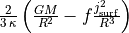


Fix abar/zbar bug in
bburn.fthat affected neutrino loss. Bad bug from 2002.
Some bug fixes for
qsetandcmdfiles.
Changes:
xfracml
Subtract any “surface” mass loss specified by xmlossm (p 220) or xmloss0 (p 221) from the zone closest to the surface that still has more than
fracsgrams of material overlying it.
name
number
type
default
unit
xfracml
225
float
0.01
-
fracsis computed based on xfracml (p 225) according to
value
result
fracs
0.
1.
fracs
fracsThis should be set so that mass is not extracted from zones too near the surface in order to avoid excessive dezoning, small timesteps, and luminosity fluctuations.
Changed In Version 17.8.5.
Todo
TODO: Rewrite to add/note new schemes.
Original entry:
Mass Loss Parameters
Another fix heating for simultaneous accretion and mass loss.
Fix low-temperature fit for Tumino+2018 carbon burning rate (contributed by Projjwal Banerjee).
Fix heating for simultaneous accretion and mass loss, e.g., as in the case of super-Eddington XRBs and superbursts.
Additions:
ir1212
name
number
type
default
unit
ir1212
573
integer
0
-Is used in both APPROX and BURN networks.
Specail values:
value
result
0use CF88.
1use Tumino+ 2018 rate. Fit by Projjwal Banerjee.
Added In Version 17.8.
Original entry:
Nuclear Reaction Parameters
sumb and sumi family of commands, and plot
9(y etc.) will now exclude zones below bmasslow (p 419).
Changes:
sumb
Display an edit of the mass fraction of BURN species.
name
parameters
sumb[ ( ISOSYM+ [ ZONE [ ZONE ] ] ) | ( ZONE [ ZONE ] [ISOSYM+] ) ]
sumb
sumb 1 10
sumb -1. 0 c13
sumb 1 9999
sumb c12
sumb 1 c12
sumb c12 c13
sumb c12 1 1.d33
sumb c12 c13 1 1.d33
sumb 0 -10 c12 c13
ZONE [ ZONE ]
Zone or zone range (inclusive) over which to sum. Similar to <j> command zone numbers out side the usual range of zones from
1to jm (q 2) are transformed. Zone numbers less than1are counted “outward in” from the surface, with-1corresponding to the surface zone, i.e., jm (q 2)1are truncated to1. Finally, if the first resulting number is larger then the second, the numbers are swapped.If ZONE is a float, KEPLER will try to translate it to a zone number. First, if the magnitude of the value is less than
1.e+10it is assumed the number is in solar masses. Next, values less than0.are, as above, counted from the surface, i.e., the total mass of the star, zmIf there is an overflow at the upper mass limit (ZONE
ISOSYM
BURN species symbol. If supplied, only those species are edited.
If ISOSYM is not supplied, all species with abundances larger than abunlimb (p 272) are printed.
Changed In Version 17.7.5: Adjusted zone range treatment.
Changed In Version 18.38.4: Now
-1is the surface zone and not0Original entry:
Normal Program Managment Commands
sumbg
Display an edit of the mass of BURN species in
g.
name
parameters
sumbg[ ( ISOSYM [ ZONE [ ZONE ] ] ) | ( ZONE [ ZONE ] [ISOSYM] ) ]
Same as sumb otherwise.
Changed In Version 17.7.5: Adjusted zone range treatment.
Original entry:
Normal Program Managment Commands
sumbsun
Display an edit of the mass of BURN species in
Msun.
name
parameters
sumbsun[ ( ISOSYM [ ZONE [ ZONE ] ] ) | ( ZONE [ ZONE ] [ISOSYM] ) ]
Same as sumb otherwise.
Changed In Version 17.7.5: Adjusted zone range treatment.
Original entry:
Normal Program Managment Commands
sumi
Display an edit of the mass fraction of APPROX / ISE / NSE ions.
name
parameters
sumi[ ( IONSYM+ [ ZONE [ ZONE ] ] ) | ( ZONE [ ZONE ] [IONSYM+] ) ]
sumi
sumi 1 10
sumi -1. 0 n14
sumi 1 9999
sumi c12 o16
sumi c12 1 1.d33
IONSYM
APPROX / ISE / QSE species symbol. If supplied, only those species are edited.
Same as sumb otherwise.
Changed In Version 17.7.5: Adjusted zone range treatment.
Original entry:
Normal Program Managment Commands
sumig
Display an edit of the mass of APPROX / ISE / NSE ions in
g.
name
parameters
sumig[ ( IONSYM [ ZONE [ ZONE ] ] ) | ( ZONE [ ZONE ] [ISOSYM] ) ]
Same as sumi otherwise.
Changed In Version 17.7.5: Adjusted zone range treatment.
Original entry:
Normal Program Managment Commands
sumisun
Display an edit of the mass of APPROX / ISE / NSE ions in
Msun.
name
parameters
sumisun[ ( IONSYM [ ZONE [ ZONE ] ] ) | ( ZONE [ ZONE ] [ISOSYM] ) ]
Same as sumi otherwise.
Changed In Version 17.7.5: Adjusted zone range treatment.
Original entry:
Normal Program Managment Commands
iproyld
Determines the BURN abundance plot type (plot 9).
name
number
type
default
unit
iproyld
399
integer
0
-The following plot types are currently supported:
value
result
0Total decayed mass fractions relative to solar (“production factors”). See profmin (p 413) and profmax (p 414).
1Decayed isotope masses in solar masse (yield). See proymin (p 402) and proymax (p 403).
2Decayed isotope mass fraction. See proamin (p 415) and proamax (p 416).
3Undecayed isotope masses in solar masses (yield). See proymin (p 402) and proymax (p 403).
4Undecayed isotope mass fraction. See proamin (p 415) and proamax (p 416).
5Elemental decayed production factor relative to solar. See profmin (p 413) and profmax (p 414).
6Decayed mass of all elements in solar masses (yield). See proymin (p 402) and proymax (p 403).
7Decayed mass fraction of all elements. See proamin (p 415) and proamax (p 416).
8undecayed elemental yield (solar masses) See proymin (p 402) and proymax (p 403).
9undecayed elemental yield (mass fraction) See proamin (p 415) and proamax (p 416).
10decayed isobaric production factor (solar) See profmin (p 413) and profmax (p 414).
11decayed isobaric yield (solar masses) See proymin (p 402) and proymax (p 403).
12decayed isobaric yield (mass fraction) See proamin (p 415) and proamax (p 416).
13undecayed isobaric yield (solar masses) See proymin (p 402) and proymax (p 403).
14undecayed isobaric yield (mass fraction) See proamin (p 415) and proamax (p 416).
101Values in
burnamax, undecayed isotope mass fraction.
102Values in
burnmmax, mass coordinates.
103Values in
ibcmax, cycle numbers.Stable isotopes are drawn as filled dots, unstable ones a circles.
Added In Version 15.22.
Changed In Version 17.7.4: Updated limits.
Changed In Version 17.7.5: Switched plot types
2and3for consistency of ordering with other plot types.Original entry:
Abundance Plot Parameters
Changes:
iproyld
Determines the BURN abundance plot type (plot 9).
name
number
type
default
unit
iproyld
399
integer
0
-The following plot types are currently supported:
value
result
0Total decayed mass fractions relative to solar (“production factors”). See profmin (p 413) and profmax (p 414).
1Decayed isotope masses in solar masse (yield). See proymin (p 402) and proymax (p 403).
2Decayed isotope mass fraction. See proamin (p 415) and proamax (p 416).
3Undecayed isotope masses in solar masses (yield). See proymin (p 402) and proymax (p 403).
4Undecayed isotope mass fraction. See proamin (p 415) and proamax (p 416).
5Elemental decayed production factor relative to solar. See profmin (p 413) and profmax (p 414).
6Decayed mass of all elements in solar masses (yield). See proymin (p 402) and proymax (p 403).
7Decayed mass fraction of all elements. See proamin (p 415) and proamax (p 416).
8undecayed elemental yield (solar masses) See proymin (p 402) and proymax (p 403).
9undecayed elemental yield (mass fraction) See proamin (p 415) and proamax (p 416).
10decayed isobaric production factor (solar) See profmin (p 413) and profmax (p 414).
11decayed isobaric yield (solar masses) See proymin (p 402) and proymax (p 403).
12decayed isobaric yield (mass fraction) See proamin (p 415) and proamax (p 416).
13undecayed isobaric yield (solar masses) See proymin (p 402) and proymax (p 403).
14undecayed isobaric yield (mass fraction) See proamin (p 415) and proamax (p 416).
101Values in
burnamax, undecayed isotope mass fraction.
102Values in
burnmmax, mass coordinates.
103Values in
ibcmax, cycle numbers.Stable isotopes are drawn as filled dots, unstable ones a circles.
Added In Version 15.22.
Changed In Version 17.7.4: Updated limits.
Changed In Version 17.7.5: Switched plot types
2and3for consistency of ordering with other plot types.Original entry:
Abundance Plot Parameters
proymin
Minimum value for yield in BURN plot types
1,2,6,8,11, and13(iproyld (p 399)).
name
number
type
default
unit
proymin
402
float
1.e-10
-Automatic determination if set to
0.. If set to a negative value it forces (negated) this value, even if not required to show the data.Added In Version 15.22.
Changed In Version 17.7.4: Added
8,11, and13.Original entry:
Abundance Plot Parameters
proymax
Maximum value for yield in BURN plot types
1,2,6,8,11, and13(iproyld (p 399)).
name
number
type
default
unit
proymax
403
float
1000.
-Automatic determination if set to
0.. If set to a negative value it forces (negated) this value, even if not required to show the data.Added In Version 15.22.
Changed In Version 17.7.4: Added
8,11, and13.Original entry:
Abundance Plot Parameters
profmin
Minimum value for production factor in BURN plot types
0,5, and10(iproyld (p 399)).
name
number
type
default
unit
profmin
413
float
0.0001
-Automatic determination if set to
0.. If set to a negative value it forces (negated) this value, even if not required to show the data.Added In Version 16.1.
Changed In Version 17.7.4: Added
10.Original entry:
Abundance Plot Parameters
profmax
Maximum value for production factor in BURN plot types:n:0,
5, and10(iproyld (p 399)).
name
number
type
default
unit
profmax
414
float
1000.
-Automatic determination if set to
0.. If set to a negative value it forces (negated) this value, even if not required to show the data.Added In Version 16.1.
Changed In Version 17.7.4: Added
10.Original entry:
Abundance Plot Parameters
proamin
Minimum value for the mass fraction BURN plot types
3,4,7,9,12, and14(iproyld (p 399)).
name
number
type
default
unit
proamin
415
float
1.e-12
-Automatic determination if set to
0.. If set to a negative value it forces (negated) this value, even if not required to show the data.Added In Version 16.2.
Changed In Version 17.7.4: Added
9,12, and14.Original entry:
Abundance Plot Parameters
proamax
Maximum value for the mass fraction BURN plot types
3,47,9,12, and14(iproyld (p 399)).
name
number
type
default
unit
proamax
416
float
1000.
-Automatic determination if set to
0.. If set to a negative value it forces (negated) this value, even if not required to show the data.Added In Version 16.2.
Changed In Version 17.7.4: Added
9,12, and14.Original entry:
Abundance Plot Parameters
Additions:
burnmplt
name
parameters
burnmpltplot the mass coordinate where maximum abundances reached in the BURN network
burnmpltAdded In Version 17.7.3.
Original entry:
Graphics Edit Commands
burncplt
name
parameters
burncpltplot the cycle number when maximum abundances reached in the BURN network
burncpltAdded In Version 17.7.3.
Original entry:
Graphics Edit Commands
zero
Reset all relevant parameter as if stating a fresh run.
name
parameters
zeroThis is to be used after, e.g., some initial relaxation step.
zeroh1init (q 101), q:he4init, zinit (q 134), and totm0 (p 222) are intentionally not reset to retain initial properties.
Added In Version 17.7.3.
Changed In Version 18.20.1: Add some more resets.
Changed In Version 18.21: Should be mostly complete now.
Original entry:
Link Input Cards
Bug fix in zoning from . Documentation updated to HTML5 and added favicon.
Changes:
irtype
name
number
type
default
unit
irtype
132
integer
3
-
value
result
1log radius (
cm)
2interior mass fraction
3interior mass in
Msun(including summ0 (p 61))
4radius (
cm)
5log interior mass in
Msun(including summ0 (p 61))
6zone number
7log interior mass (
Msun) using jp0 (p 119) and jp1 (p 120)
8interior mass (
Msun) using jp0 (p 119) and jp1 (p 120)
9log exterior mass (
Msun) using jp0 (p 119) and jp1 (p 120)
10exterior mass (
Msun) using jp0 (p 119) and jp1 (p 120)
11log column density (
g/cm**2) using jp0 (p 119) and jp1 (p 120)
12column density (
g/cm**2) using jp0 (p 119) and jp1 (p 120)
13pressure (
erg/cc) using jp0 (p 119) and jp1 (p 120)
14log pressure (
erg/cc) using jp0 (p 119) and jp1 (p 120)
15(non-relativistic) gravitational potential (
cm**2/sec**2) using jp0 (p 119) and jp1 (p 120)
16log (non-relativistic) gravitational potential (
cm**2/sec**2) using jp0 (p 119) and jp1 (p 120)
17normalized (non-relativistic) gravitational potential (
c**2) using jp0 (p 119) and jp1 (p 120)
18log normalized (non-relativistic) gravitational potential (
c**2) using jp0 (p 119) and jp1 (p 120)
19gravitational redshift using jp0 (p 119) and jp1 (p 120)
20log gravitational redshift using jp0 (p 119) and jp1 (p 120)
21enclosed volume (
cc) using jp0 (p 119) and jp1 (p 120)
22log enclosed volume (
cc) using jp0 (p 119) and jp1 (p 120)
23enclosed volume (
Rsun**3) using jp0 (p 119) and jp1 (p 120)
24log enclosed volume (
Rsun**3) using jp0 (p 119) and jp1 (p 120)
25optical depth using jp0 (p 119) and jp1 (p 120)
26log optical depth using jp0 (p 119) and jp1 (p 120)
27moment of inertia coordinate (
g*cm**2)
28log moment of inertia coordinate (
g*cm**2)
29moment of inertia coordinate (
Msun*Rsun**2)
30log moment of inertia coordinate (
Msun*Rsun**2)
31log radius (
Rsun)
32radius (
Rsun)Note
For
2and3the diffusion coefficients in Plot Types7and8are shown in mass units, as it is most useful for investigating mixing of chemical species, for1and4they are radius mass units, and for5they are given in moment of inertia coordinates, as it is most useful if transport of angular momentum is considered. For Plot Types :912the surface of the star is to the left.Changed In Version <15: Added new plot types.
Changed In Version >15: Added new plot types.
Changed In Version 17.0.13: Added plot types
25and26.Changed In Version 17.7.1: Moved plot type
5to29. Added new plot5and plots27,28, and30.Changed In Version 18.22.2: Added plot types
31and32.Original entry:
Radial Coordinate-Control Graphics Parameters
Additions:
taumin
Use optical depth-based zoning where
taumin (p 570).
name
number
type
default
unit
taumin
570
float
0.
-If set to
0.then use optical depth-based zoning out to surface.Zones are rezoned (and kept rezoned) roughly when their optical depth ratio is greater than taurat (p 571), with a cut-off at taulim (p 572) for consideration in computing the ratio.
Note
This is will only have an effect is zoning is switched on for densities and radii at the surface layers, i.e., consider the settings of parameters, e.g., dnmin (p 84), tnmin (p 83), rnmax (p 88), zonermin (p 457), zonemmin (p 336).
Note
This is now on by current default.
Added In Version 17.7.
Original entry:
General Rezoning Parameters
taurat
Optical depth ratio used in rezoning.
name
number
type
default
unit
taurat
571
float
0.2
-See taumin (p 570).
Added In Version 17.7.
Original entry:
General Rezoning Parameters
taulim
Optical depth limit used in rezoning.
name
number
type
default
unit
taulim
572
float
0.1
-See taumin (p 570).
Added In Version 17.7.
Original entry:
General Rezoning Parameters
Add
convertstatement directly to all unformatted I/Oopenstatements. This way we no longer require environment variable, which may conflict with other FORTRAN code.Note
Code compiled this way can still be influenced by the environment variable, e.g., if set for other codes.
This largely affects the Python model. Coming from a library, the compile-time convert statement has no effect as this only affects the main program - and for a library there is none.
adzonenow copies convective status of middle interface to both new interfaces.Todo
Add flag to allow add preventing zone from becoming convective if interfacing with is network boundary.
Changes:
noqsecon
Flags regulating transition to QSE for convectively coupled zones.
name
number
type
default
unit
noqsecon
210
integer
0
-
value
result
1Don’t force zones that are convectively coupled to ISE zones to go to ISE
2Don’t transition zones to ISE that are convectively coupled to APPROX zones
Flags may be combined (added).
Warning
This parameter should be kept zero unless you really understand what you’re doing.
For noqsecon (p 210)
0, if a zone is converted to ISE, all zones convectively coupled to it would go to ISE as well (in order to allow convective mixing). noqsecon (p 210)1prevents that, the zone just goes to ISE, but the zones above don’t, even if convectively coupled, basically spitting the convective mixing as APPROX and ISE don’t mix.For noqsecon (p 210)
2, instead, the zone is prevented from going to ISE if it is coupled to a convective region in APPROX. It remains APPROX. This is a different choice, and may be the better choice at times. But not always. Depends on situation and use case.Changed In Version 17.6.9: Added noqsecon (p 210) flag
2. In previous versions noqsecon (p 210)0was used instead of flag1.Original entry:
ISE Network Transition Parameters
Default value for iold (p 388) for versions
1for consistency with other iold (p 388) levels.Note
There is now also a new mongo version for Linux x86 for gfortran version
Fix typo in
checkazn.
Fix format problem in
dumpiowhen loading old models.
Add fix for double counting neutrino spallation (iold (p 388)
16). Reformat some routines to useimplicit noneand coding style updates.
Changes:
iold
Set to value other than 0 to use old physics - mostly fix that energy generation in APPROX did not include neutrino losses and mass excess but only considered differences in binding energy. These are used as flags.
name
number
type
default
unit
iold
388
integer
0
-
value
result
0Use current physics.
1(bit 0) No nu loss in H burning and BE instead of ME and old nu loss routines (old1/old2, < 1997) this should not affect lburn (p 434) as that was only implemented later, i.e., here was no bug to be fixed - where lburn (p 434) is used, iold (p 388)
2(bit 1) Use old nu loss (old3)
4(bit 2) Use old (1997) nu loss and ME estimates (bad)
8(bit 3) Use old (1975) Iben electron conductivity. The revised version fixes a factor
2
16(bit 4) Double counting of
32(bit 5) Do not use fix in
64(bit 6) FFN weak rates are used for nu loss in BURN even if rates are zeroed because of being outside temperature/density range.
128(bit 7) QSE does not consider mass defect from weak rates.
256(bit 8) Do not use crude fix for coulomb corrections. rates.
512(bit 9) Do not use new coulomb corrections. rates.
Added In Version 15.15.
Changed In Version 17.0.5: Added
2.Changed In Version 17.0.8: Added
4.Changed In Version 17.0.11: Added
8.Changed In Version 17.6.5: Added
16.Changed In Version 17.9.1: Added
32.Changed In Version 18.10.3: Added
64.Changed In Version 18.29: Added
128.Changed In Version 18.30: Added
256.Changed In Version 18.46: Added
512.Original entry:
Physics Parameters
Add reaction type
23for spontaneous emission of neutrons and protons (i_ns,i_ps) for corresponding reaclib rates.
Update solas09.dat to jupiter values of
:
abundance ratio of
1:435(mol fraction).Note
solas09.dat - current solar abundance should be used for production factors, however, solas12.dat and solas12bg should be used to generate models of initial solar composition.
Add mixdiff function to ttycom and as a subroutine. Make zone parameters to mix command optional.
Additions:
mixdiff
Simulate mixing due to RT instabilities using diffusion approach.
name
parameters
mixdiff[ NZMIN NZMAX ] DLTMASS [ TERMINATE ]
mixdiff 293 507 0.5NZMIN NZMAX
Zone range (inclusive) in which to mix. Processing of the zone specifications is done the same way as for the sumb command. If omitted, all zones are mixed.
DLTMASS
Mass of mixing width. (
Msun)TERMINATE
Terminate KEPLER if mixing fails and TERMINATE is
1but continue otherwise, which can be dangerous and will not produce useful results in general. Default value is1Mix composition using one-step implicit diffusion solver with a DLTMASS
(
Msun) diffusion-like approach with diffusion relative to mass coordinate (diffusion is constant relative to mass coordinate). Mixing is done in the zone range starting with zone NZMIN and ending with zone NZMAX.Reset the equation of state in mixed zones. Used for light-curve calculations to simulate Rayleigh-Taylor mixing.
Added In Version 17.6.2.
Original entry:
Special Purpose Commands
Changes:
mix
Simulate mixing due to RT instabilities.
name
parameters
mix[ NZMIN NZMAX ] DLTMASS [ TERMINATE ]
mix 293 507 0.5 0NZMIN NZMAX
Zone range (inclusive) in which to mix. Processing of the zone specifications is done the same way as for the sumb command. If omitted, all zones are mixed.
DLTMASS
Mass of mixing window (
Msun)TERMINATE
Terminate KEPLER if mixing fails and TERMINATE is
1but continue otherwise, which can be dangerous and will not produce useful results in general. Default value is1Mix composition outwards starting with zone NZMIN and ending with zone NZMAX in mass increments of DLTMASS (
Msun). Reset the equation of state in mixed zones. Used for light-curve calculations to simulate Rayleigh-Taylor mixing.Changed In Version 17.0.2: Generalized zone range specification.
Changed In Version 17.6.1: Default value for TERMINATE changed from
0to1.Changed In Version 17.6.2: Make NZMIN and NZMAX optional.
Original entry:
Special Purpose Commands
Separate mix and novamix functions into its one subroutine, fix but that delmass was used in mix procedure but also was used as a q parameter in kepcom.
Changes:
mix
Simulate mixing due to RT instabilities.
name
parameters
mix[ NZMIN NZMAX ] DLTMASS [ TERMINATE ]
mix 293 507 0.5 0NZMIN NZMAX
Zone range (inclusive) in which to mix. Processing of the zone specifications is done the same way as for the sumb command. If omitted, all zones are mixed.
DLTMASS
Mass of mixing window (
Msun)TERMINATE
Terminate KEPLER if mixing fails and TERMINATE is
1but continue otherwise, which can be dangerous and will not produce useful results in general. Default value is1Mix composition outwards starting with zone NZMIN and ending with zone NZMAX in mass increments of DLTMASS (
Msun). Reset the equation of state in mixed zones. Used for light-curve calculations to simulate Rayleigh-Taylor mixing.Changed In Version 17.0.2: Generalized zone range specification.
Changed In Version 17.6.1: Default value for TERMINATE changed from
0to1.Changed In Version 17.6.2: Make NZMIN and NZMAX optional.
Original entry:
Special Purpose Commands
Add branch name to history (maximum 16 characters).
Write message if git was not clean.
Additions:
Debug and Production Runs
By default KEPLER will no longer run if built from a non-clean git status of the
sourcedirectory. You can for running force debug purpose if you specify thexflag on the command line.Important
The purpose of this change is to ensure code git hashes for the KEPLER version running a problem remain accurate. Results from non-clean git repos can never be traced back later with any level of confidence.
Added In Version 17.6.
Changes:
(optional) is a set of one or more space delimited words in arbitrary order chosen from among the following possibilities:
Option
Meaning
s
To suspend the code after starting.
k
do not load BURN data and kill burning, similar to the killburn command.
d
To destroy the ASCII output files after sending them to the microfiche printer (not currently implemented – see also the discussion of parameter iautoout (p 159).
h
To automatically make a paper copy of the ASCII output files (not currently implemented).
c
write out stored command file (overwrite existing).
a
append stored command file.
p
make plot on start-up.
n
suppress graphical output, e.g., for batch mode.
x
DEBUG mode. Allow running without proper git hash.
X
Extended DEBUG mode. Could be used to enable internal debugging code. Adds
2to internalidebugvariable.e
Allow experts to overwrite of ittyv (p 538) by command files. This is for the
% ittyvcommand file directive.Changed In Version >15: Added k option.
Changed In Version 17.1: Added c and a options.
Changed In Version 17.6: Added x option.
Changed In Version 17.11.7: Added p and n options.
Changed In Version 18.0.1: Added X option.
Changed In Version 18.37.1: Added e option.
Update build process (
Makefile.make) to cleanly separate source code from build directory suing include files (-Idirective). This will now only compile if there is actual changes to source rather than every timemakeis called.Important
You may want to remove the files
uuid_com
kepcom
zcom
from the build directory. You can also just call
make
clean
in the build directory to be on the save side.Important
You need to remove the files
gitcom
gridcom
nburncom
fuldat.f
from the source directory. Just to be sure, this has been added to
make cleanas well.Note
The same applies for building the Python module.
Fix
reverse rate in
specl0.f. Contributed by Stan.

Some refactoring in
setrate. The partition function now allows the individual levels independent of polynomial fit. A bug was fixed that allowed to add up to6levels whereas the array was only good for up to3- this could have led to overflows, unchecked … there is now a new parameterNISTwith current default3to set maximum number of levels for partition function statistical weight.
Additions:
convmass
Don’t do convcetion outside convmass (p 569).
name
number
type
default
unit
convmass
569
float
1.e+99
-Note
Unit of convmass (p 569) is in uints of solar masses if
1.e+10otherwise in unit of grams.Added In Version 17.5.
Original entry:
Convection Parameters
Additions:
iaccunit
Unit in which to measure accretion depth.
name
number
type
default
unit
iaccunit
568
integer
0
-
value
result
0use mass or mass fraction as measured from surface (see accdepth (p 514).
1use optical depth from surface.
Added In Version 17.4.
Original entry:
Accretion Parameters
Changes:
Note
If you’d like to adjust the standard values of BURN isotopes,
nburnand or the maximum zone number,jmz, you can specify those values using the variable namesNBURNandJMZ, respectively. These can be specified statically in theMakefile, e.g.,SOURCE = $(HOME)/kepler/source SYSTEM = gfortran VERSION = O64 NBURN = 500 JMZ = 32767 include $(SOURCE)/Makefile.makeor, alternatively, add the definitions to the
makecommand line, e.g.,make JMZ=1983 NBURN=4096Whereas any changes in this file should propagate to all paces where these definitions are needed, it is not clear, however, whether this is the case consistently. It is therefore recommended, for the time of this writing, to perform a
make cleanbefore recompiling the code using
make.Warning
JMZneeds to be an odd number andNBURNneeds to be an even number.NBURNshould be at least 500.To switch the plot routine used, use the
PLOTvariable. Current plot interfaces are
value
result
mongotraditional X11 mongo interface (default)
nilno plot for cases where no plot interface can be linked or is desired
pyPython interface for Python module
PLOT = nilDepending on whether to compile for a standalone executable or for the Python interface, one can select the set of interface utility subroutines to include using the
UTILSvariable.
value
result
futilities for standalone Fortran executable (default)
pyutilities for Python interface
UTILS = fWarning
Usually, this should not be change manually, leave at default.
For compilation on older system where the FORTRAN 2003 intrinsic
ieee_arithmeticis not defined, we may chose an alternate version to use, with its corresponding compile flagsIEEEVALS = ieeevals_gcc4.f90 IEEEFLAGS := -fno-range-checkFor development to disable
xflag, we may chose an alternate version to usePROGDBG = progdbg_devel.f90To disable compilation for native architecture use in
ARCH = nonein
Makefile.For
gfortranthere is now also the option to overwrite the compilers and linker using the variableFOR90,CCOMP, andlinker. You may set extra compiler flags usingFLAGSXto all three parts (Fortran, C, linker) or useFFLAGSXfor options use for Fortran and C,CFLAGSXfor additional compiler options for C, andLFLAGSXfor extra linker options.To add a note to the program that is printed on startup, use the
NOTEoption.NOTE = Hello World!When KEPLER is compiled while not on a clean
gitcommit, the source files are included in the KEPLER executable. These are also saved to each dump file. These include all the make files, Python scripts,.cand.f90files. By default, theMakefilein the build directory is always included as well.One can set compiler executable using
CandFORTRANto set the executable name andCOMPDIRto set a common executable directory, if needed.Note
compdirneeds to include the trailing path separator/.For example, to overwrite the use of gnu C compiler on Apple, you may use
C = gcc-14The
MakefilevariableSAVESOURCEcontrols what source files are included
value
result
0never save any source
1save all source if not on git always save Makefile (default)
-1save all source if not on git do not save Makefile when on git
SAVESOURCE = -1Changed In Version 17.2.1: Added
JMZandNBURNvariables toMakefile.Changed In Version 17.3.2: Added
FULDATvariable toMakefile.Changed In Version 18.2.3: Added variables
IEEEVALSandIEEEFLAGStoMakefile.Changed In Version 18.3: Added variables
PROGDBGandARCHtoMakefile.Changed In Version 18.7.11: Variable
FULDATreplaced by variableFULDEF.Changed In Version 18.7.16: Variable
FULDATdeprecated. Use proper link to desiredfuldatversion instead.Changed In Version 18.15.3: Added Makefile capability to overwrite default compile flags for
gfortran.Changed In Version 18.39: Added variables
NOTEandSAVESOURCEtoMakefile.Changed In Version 18.39.5: Added variables
CandFORTRANtoMakefile.
Update prompt to include problem name
nameprob.
Changes:
* [ NAME ]
Alternate entry point.
Command file execution is also started/tested at these points. Named entry points are only executed using the
cmd_callsubroutine (currently used for all standard aliases), or can be accessed using the ! command** bounceChanged In Version 17.0.2: added NAME option
Changed In Version 17.3.1: called for standard aliases.
Additions:
loczone
Flag to switch on local criterion for new mass grid on adzoning and dezoning.
name
number
type
default
unit
loczone
567
integer
0
-
value
result
0Use masses of neighbouring zones to determine ratio of new zones.
1Use only local zone masses within region of rezoning.
It has been noted that if a range neighbouring zones are rezoned the order of zoning does matter if the non-local criterion is used. In particular, if a region of constant mass zoning were to be re-zoned, a zig-zack pattern in zone masses results since the bottom of the rezone region would try to match the already refined zones below, whereas the at the upper end the algorithm would try to match the not yet refined zones.
Added In Version 17.3.
Original entry:
General Rezoning Parameters
Changes:
Note
If you’d like to adjust the standard values of BURN isotopes,
nburnand or the maximum zone number,jmz, you can specify those values using the variable namesNBURNandJMZ, respectively. These can be specified statically in theMakefile, e.g.,SOURCE = $(HOME)/kepler/source SYSTEM = gfortran VERSION = O64 NBURN = 500 JMZ = 32767 include $(SOURCE)/Makefile.makeor, alternatively, add the definitions to the
makecommand line, e.g.,make JMZ=1983 NBURN=4096Whereas any changes in this file should propagate to all paces where these definitions are needed, it is not clear, however, whether this is the case consistently. It is therefore recommended, for the time of this writing, to perform a
make cleanbefore recompiling the code using
make.Warning
JMZneeds to be an odd number andNBURNneeds to be an even number.NBURNshould be at least 500.To switch the plot routine used, use the
PLOTvariable. Current plot interfaces are
value
result
mongotraditional X11 mongo interface (default)
nilno plot for cases where no plot interface can be linked or is desired
pyPython interface for Python module
PLOT = nilDepending on whether to compile for a standalone executable or for the Python interface, one can select the set of interface utility subroutines to include using the
UTILSvariable.
value
result
futilities for standalone Fortran executable (default)
pyutilities for Python interface
UTILS = fWarning
Usually, this should not be change manually, leave at default.
For compilation on older system where the FORTRAN 2003 intrinsic
ieee_arithmeticis not defined, we may chose an alternate version to use, with its corresponding compile flagsIEEEVALS = ieeevals_gcc4.f90 IEEEFLAGS := -fno-range-checkFor development to disable
xflag, we may chose an alternate version to usePROGDBG = progdbg_devel.f90To disable compilation for native architecture use in
ARCH = nonein
Makefile.For
gfortranthere is now also the option to overwrite the compilers and linker using the variableFOR90,CCOMP, andlinker. You may set extra compiler flags usingFLAGSXto all three parts (Fortran, C, linker) or useFFLAGSXfor options use for Fortran and C,CFLAGSXfor additional compiler options for C, andLFLAGSXfor extra linker options.To add a note to the program that is printed on startup, use the
NOTEoption.NOTE = Hello World!When KEPLER is compiled while not on a clean
gitcommit, the source files are included in the KEPLER executable. These are also saved to each dump file. These include all the make files, Python scripts,.cand.f90files. By default, theMakefilein the build directory is always included as well.One can set compiler executable using
CandFORTRANto set the executable name andCOMPDIRto set a common executable directory, if needed.Note
compdirneeds to include the trailing path separator/.For example, to overwrite the use of gnu C compiler on Apple, you may use
C = gcc-14The
MakefilevariableSAVESOURCEcontrols what source files are included
value
result
0never save any source
1save all source if not on git always save Makefile (default)
-1save all source if not on git do not save Makefile when on git
SAVESOURCE = -1Changed In Version 17.2.1: Added
JMZandNBURNvariables toMakefile.Changed In Version 17.3.2: Added
FULDATvariable toMakefile.Changed In Version 18.2.3: Added variables
IEEEVALSandIEEEFLAGStoMakefile.Changed In Version 18.3: Added variables
PROGDBGandARCHtoMakefile.Changed In Version 18.7.11: Variable
FULDATreplaced by variableFULDEF.Changed In Version 18.7.16: Variable
FULDATdeprecated. Use proper link to desiredfuldatversion instead.Changed In Version 18.15.3: Added Makefile capability to overwrite default compile flags for
gfortran.Changed In Version 18.39: Added variables
NOTEandSAVESOURCEtoMakefile.Changed In Version 18.39.5: Added variables
CandFORTRANtoMakefile.
Add
gamedit variable.
Additions:
xmlosse
Mass loss for super-eddignton luminosity.
name
number
type
default
unit
xmlosse
565
float
0.
-Mulitplier on mass loss if luminosity exceeds Eddington luminosity. This is corrected for GR for X-ray burst simulations, although this is not full GR but the XRB still uses local Newtonian gravity.
where
and
Values of
,
,
are taken at
jm-jslosse (p 566).Added In Version 17.2.
Original entry:
Mass Loss Parameters



jslosse
Determine zone where values for Eddington luminosity mass loss are taken.
name
number
type
default
unit
jslosse
566
integer
1
-See xmlosse (p 565) for details.
Added In Version 17.2.
Original entry:
Mass Loss Parameters
Update format for neutrino binary output “*.nu” file.
Changes:
ipup
Abundance update parameter. Update abundances only if ipup (p 28) :math:’ne’
0.
name
number
type
default
unit
ipup
28
integer
1
-
value
result
1only calculate zonal reaction rates, no updates
0no abundance updates anywhere
1abundance updates everywhere (normal)
2no updates in zones less than jshell0 (p 93)
3no updates in zones jshell0 (p 93)
j
4no updates in zones
jgreater than jshell1 (p 94)
5no updates in zones below bmasslow (p 419)
Changed In Version 17.1.9: Added Option
5for accretion/XRB problemOriginal entry:
Nuclear Reaction Parameters
Prevent mixing between BURN and APPROX regions in APPROX network in case lburn (p 434) is set to
1.
Changes:
d
Make a restart dump.
name
parameters
d[ FILENAME ]
d s12g
d #mydump
FILENAME
name of file to which to write a current restart dump
If FILENAME is not provided, the restart dump is written to file name NAMEPROBz where NAMEPROB is the current problem name.
If FILENAME starts with # then the dump is written to file name NAMEPROB#FILENAME.
If FILENAME is # then the dump is written to file name NAMEPROB#NCYC where NCYC is ncyc (q 4).
Changed In Version >16: Added #FILENAME option.
Changed In Version 17.1.7: Added blank # option.
Original entry:
Normal Program Managment Commands
Initialise zinit (q 134) on generation so it is available in cycle 1
setratefix allowing all decays at low temperature
Changes:
n14pg
Version of N14(p,g) rate to use.
name
number
type
default
unit
n14pg
483
integer
3
-
value
result
0original CF88 N14(p,g) rate
1multiply the first term of the CF88 N14(p,g) rate by 0.54
2use Imbriani et al. (2005) rate, REACLIB implementation
3use Imbriani et al. (2005) rate, original formula
This is to account for new measurements.
Added In Version 16.57.
Changed In Version 17.1.3: Added Options
2and3.Changed In Version 17.1.4: New default value for new runs is
3.Original entry:
Nuclear Reaction Parameters
Changes:
n14pg
Version of N14(p,g) rate to use.
name
number
type
default
unit
n14pg
483
integer
3
-
value
result
0original CF88 N14(p,g) rate
1multiply the first term of the CF88 N14(p,g) rate by 0.54
2use Imbriani et al. (2005) rate, REACLIB implementation
3use Imbriani et al. (2005) rate, original formula
This is to account for new measurements.
Added In Version 16.57.
Changed In Version 17.1.3: Added Options
2and3.Changed In Version 17.1.4: New default value for new runs is
3.Original entry:
Nuclear Reaction Parameters
ivrate
Version of the APPROX network rate subroutine to use.
name
number
type
default
unit
ivrate
422
integer
1
-Currently:
value
result
0WW95 rate set
1use the rath00 rate set including the
2uses the NACRE c12ag rate.
3use the rath00 rate set and the adopted values of Kunz et al.(2002, ApJ).
4use the rath00 rate set and the low values of Kunz et al.(2002, ApJ).
5use the rath00 rate set and the high values of Kunz et al.(2002, ApJ).
6use the rath00 rate set and the REACLIB implementation of Kunz et al.(2002, ApJ).
On restart of older programs a value of
0is initialized.ivrate (p 422) values of
3,4, and5also selects these rates in the rath00 rate set BURN co-processing “special” subroutinespecl0(seespecl.fandspecl0.f.)Added In Version 16.10.
Changed In Version 17.1.3: Added Option
6.Changed In Version 18.8.6: Now Option
1_actually_ uses NACRE c12ag rate, and Iotion0_actually_ uses the cf88 c12ag rate.Original entry:
BURN Physics Parameters
Changes:
accdepth
Depth where mass is to be accreted.
name
number
type
default
unit
accdepth
514
float
0.
-
value
result
0.zones are accreted at the surface (traditional behavior).
0.accrete a zone with mass fraction
ymtotm (q 17).
0.accrete at location accdepth (p 514)
ym.Added In Version 16.80.
Changed In Version 17.1.2: Negative values scale with totm (q 17) not totm0 (p 222) to allow dynamic adjustment for accreton problems with significant growth of mass.
Original entry:
Accretion Parameters
Set default value for rmaxeadv (p 564) on restart to
1.e+99.
Added sha, version number, user name, and machine name to history. Added storage of current command file to dump.
Changes:
(optional) is a set of one or more space delimited words in arbitrary order chosen from among the following possibilities:
Option
Meaning
s
To suspend the code after starting.
k
do not load BURN data and kill burning, similar to the killburn command.
d
To destroy the ASCII output files after sending them to the microfiche printer (not currently implemented – see also the discussion of parameter iautoout (p 159).
h
To automatically make a paper copy of the ASCII output files (not currently implemented).
c
write out stored command file (overwrite existing).
a
append stored command file.
p
make plot on start-up.
n
suppress graphical output, e.g., for batch mode.
x
DEBUG mode. Allow running without proper git hash.
X
Extended DEBUG mode. Could be used to enable internal debugging code. Adds
2to internalidebugvariable.e
Allow experts to overwrite of ittyv (p 538) by command files. This is for the
% ittyvcommand file directive.Changed In Version >15: Added k option.
Changed In Version 17.1: Added c and a options.
Changed In Version 17.6: Added x option.
Changed In Version 17.11.7: Added p and n options.
Changed In Version 18.0.1: Added X option.
Changed In Version 18.37.1: Added e option.
Additions:
Set the value of ittyv (p 538) used in command execution. Note that you requite to use the command line flag e to enable this expert feature.
% xsaveAdded In Version 17.0.13.
The noxsave flag disables saving of command file before each command execution. This save a lot of write operations, however, changes to command file may be lost in case KEPLER terminates during execution, e.g., for a end command.
% noxsaveAdded In Version 17.0.13.
The end flag end KEPLER in a save way, also saving the command file properly before termination.
% endAdded In Version 17.0.13.
The delete directive deletes the command file and terminates its execution.
% deleteAdded In Version 17.0.13.
The delsec directive deletes the current section and skips to the next section.
*
: tn(1) > 1.d8
p 1 1.
@ dn(1) > 1.d6
% delsec
Added In Version 17.0.13.
>
Jump back to origin of previous labelled.
:
< ttest
> home tn(1) > 1.d9
>
< home
p 1 1.
>
Added In Version 17.0.13.
>>
Skip rest of section.
:
c example of coding if/then/else
c
> home tn(1) > 1.d9
p 1 2. *
>>
< home
p 1 2. /
If executing external call to alternate entry point, just return, identical to the !! directive.
Added In Version 17.0.13.
>>>
Terminate execution of command file.
>>>If executing external call to alternate entry point, just return, identical to the !! directive.
Added In Version 17.0.13.
dtau
Optical thickness of zone.
name
type
unit
centering
storage
dtau
float
-
center
loadbufAdded In Version 17.0.13.
Original entry:
Miscellaneous
newt
Calculate new temperature current internal energies and densities.
name
parameters
newtThis may be useful when depositing energy to fix EOS issues.
Added In Version 17.0.13.
Original entry:
Special Purpose Commands
rmaxeadv
Maximum radius for which energy deposition for advection from accretion is considered.
name
number
type
default
unit
rmaxeadv
564
float
1.e+99
-Useful for XRB simulations if the photosphere expands beyond the inner edge of the accretion disk. Should be set to the radius of the innermost stable orbit in these cases.
Added In Version 17.0.13.
Original entry:
Accretion Parameters
jaccemx
Maximum zone for which accretion advection luminosity is added.
name
number
type
unit
jaccemx
149
integer
-Added In Version 17.0.13.
Original entry:
Accretion-Related Parameters
Changes:
@ [ EXPRESSION ]
If EXPRESSION evaluates to
.TRUE., the @ command is removed and the subsequent command are executed and removed until the next @, :, ;, or * command. An empty expression is interpreted as.TRUE., allowing to specify sections to be executed only once.@ tn(0) > 1.d4 p xmlossn 1.* : > lowt tn(1) < 1.d9 p 13 0. p 69 0. @ zerotime >> < lowt p 13 .1 p 69 {pn(0) * 0.5}Changed In Version 17.0.13: Make expression optional.
Kepler Variables
A selection of KEPLER variables can also be used, including p and q parameters (by name or number), and user-defined optional o parameters. Also allowed are any zonal variables accessible through
loadbufwhere zone number or mass coordinate can be used similar to the z interactive command.This includes a small set of KEPLER physical and mathematical constants, pie, c, k, me, a, sigt, gee, n0, solmass, solrad, year, h, ev, mev, amu, and rgas.
Changed In Version 18.15: Added h, ev, mev, and amu.
One can also use a small selection of array functions named after the FORTRAN functions on loadbuf quantities and specify ranges using the : (colon) syntax where omitted first and last indices stand for
1and jm (q 2) respectively.
function
type
description
sum
float
sum up values
maxval
float
maximum value
minval
float
minimum value
maxloc
integer
index of maximum
minloc
integer
index of minimum
To obtain location of variable values in
loadbufarrays, the following functions can be used. You may use , or ; to separate arguments, or omit brackets where the expression remains unique, but you must retain “,” or “;”.
function
type
description
locl
integer
lower zone number
loc
integer
closest zone number
loch
integer
higher zone number
locx
float
linear interpolated floating zone number
mocl
integer
lower zone number (test outside-in)
moc
integer
closest zone number (test outside-in)
moch
integer
higher zone number (test outside-in)
mocx
float
linear interpolated floating zone number (test outside-in)
@ loc(rn,1.d12) > 1000
@ loc rn(:1200),1.d12  > 1000
Changed In Version 17.11.7: Added “;” as allowed separator. Allow range specification. Require separator. Add “m” functions.
To test where condition is fulfilled anywhere for
loadbufarrays, the following functions can be used. You may omit brackets for call syntax where the expression remains unique. You can use the FORTRAN operators <, <=, ==, =, >=, >, /=, and !=.
function
type
description
any
logical
condition fulfilled for any array value
all
logical
condition fulfilled for all array values
@ all(rn < 1.d12)
@ any convect == 4
Added In Version 17.11.7.
Changed In Version 18.7.2: Added = and !=.
Note
Dissection of the expression fails with variable names that contain operators, e.g., for some reaction rates. In this case, square brackets, [ and ] can be used to keep these together.
@ [o16+o16](1) > 1.d10
d #oign
Changed In Version 17.0.13.
iaccadv
Advection of composition during accretion.
name
number
type
default
unit
iaccadv
521
integer
1
-
value
result
0composition is not advected this can be useful for setting up initial models for accretion problems
1enable composition advection (recommended).
2add composition (and angular momentum) at the location of the accretion depth, accdepth (p 514). This can be useful in case of accretion streams of common envelope models.
Added In Version 16.83.
Changed In Version 17.0.13: Added option
2Original entry:
Accretion Parameters
irtype
name
number
type
default
unit
irtype
132
integer
3
-
value
result
1log radius (
cm)
2interior mass fraction
3interior mass in
Msun(including summ0 (p 61))
4radius (
cm)
5log interior mass in
Msun(including summ0 (p 61))
6zone number
7log interior mass (
Msun) using jp0 (p 119) and jp1 (p 120)
8interior mass (
Msun) using jp0 (p 119) and jp1 (p 120)
9log exterior mass (
Msun) using jp0 (p 119) and jp1 (p 120)
10exterior mass (
Msun) using jp0 (p 119) and jp1 (p 120)
11log column density (
g/cm**2) using jp0 (p 119) and jp1 (p 120)
12column density (
g/cm**2) using jp0 (p 119) and jp1 (p 120)
13pressure (
erg/cc) using jp0 (p 119) and jp1 (p 120)
14log pressure (
erg/cc) using jp0 (p 119) and jp1 (p 120)
15(non-relativistic) gravitational potential (
cm**2/sec**2) using jp0 (p 119) and jp1 (p 120)
16log (non-relativistic) gravitational potential (
cm**2/sec**2) using jp0 (p 119) and jp1 (p 120)
17normalized (non-relativistic) gravitational potential (
c**2) using jp0 (p 119) and jp1 (p 120)
18log normalized (non-relativistic) gravitational potential (
c**2) using jp0 (p 119) and jp1 (p 120)
19gravitational redshift using jp0 (p 119) and jp1 (p 120)
20log gravitational redshift using jp0 (p 119) and jp1 (p 120)
21enclosed volume (
cc) using jp0 (p 119) and jp1 (p 120)
22log enclosed volume (
cc) using jp0 (p 119) and jp1 (p 120)
23enclosed volume (
Rsun**3) using jp0 (p 119) and jp1 (p 120)
24log enclosed volume (
Rsun**3) using jp0 (p 119) and jp1 (p 120)
25optical depth using jp0 (p 119) and jp1 (p 120)
26log optical depth using jp0 (p 119) and jp1 (p 120)
27moment of inertia coordinate (
g*cm**2)
28log moment of inertia coordinate (
g*cm**2)
29moment of inertia coordinate (
Msun*Rsun**2)
30log moment of inertia coordinate (
Msun*Rsun**2)
31log radius (
Rsun)
32radius (
Rsun)Note
For
2and3the diffusion coefficients in Plot Types7and8are shown in mass units, as it is most useful for investigating mixing of chemical species, for1and4they are radius mass units, and for5they are given in moment of inertia coordinates, as it is most useful if transport of angular momentum is considered. For Plot Types :912the surface of the star is to the left.Changed In Version <15: Added new plot types.
Changed In Version >15: Added new plot types.
Changed In Version 17.0.13: Added plot types
25and26.Changed In Version 17.7.1: Moved plot type
5to29. Added new plot5and plots27,28, and30.Changed In Version 18.22.2: Added plot types
31and32.Original entry:
Radial Coordinate-Control Graphics Parameters
Added parameters for a heating layer, to be used for X-ray (super)burst simulations. The heat is deposited in the form of a Gaussian at a fixed location relative to the surface.
Additions:
The nodebug flag switches debugging off (default).
% nodebugAdded In Version 17.0.12.
The noecho flag disables printout of expression tests to console.
% noechoAdded In Version 17.0.12.
The echo flag enables printout of expression tests to console (possibly misguided default).
% echoAdded In Version 17.0.12.
!!
return from entry point (if applicable)
* bounce
p 1 1.
!!
Added In Version 17.0.12.
?
Evaluate expression.
name
parameters
?EXPRESSION
? p 2 * 2.
? dn(3) * rn(3)**3
EXPRESSION
legal expression that can be evaluated in command files
If no expression is supplied, print current run status, similar to
s ?Added In Version 17.0.12.
Changed In Version 18.34.8: Added blank ? option.
Original entry:
Normal Program Managment Commands
@
Evaluate logical expression.
name
parameters
@EXPRESSION
@ p 2 > 2.
@ dn(3) * rn(3)**3 >= dn(4) * rn(4)**3
EXPRESSION
legal expression that can be evaluated in command files
Added In Version 17.0.12.
Original entry:
Normal Program Managment Commands
Variable Replacement
You may specify an expression in curly braces to be replaced by the result of evaluating it, using the same procedure as outlined for command files.
p 38 {p 2}
p 38 {p 2*2.}
Added In Version 17.0.12.
xheatl
Rate of energy deposition from extra heating.
name
number
type
default
unit
xheatl
561
float
0.
erg/secKEPLER will deposit extra heat a location xheatym (p 562) in a Gaussian window of width
xheatdm (p 563) and at a total rate (luminosity) of xheatl (p 561). For check, the total rate of energy deposition is also recorded in enxheatd (q 147) and the total energy deposited over the run in enxheat (q 148).
Added In Version 17.0.12.
Original entry:
X-ray Burst Parameters
xheatym
Center of mass where energy is deposited; mass is measured relative to surface.
name
number
type
default
unit
xheatym
562
float
-1.e+99
gAdded In Version 17.0.12.
Original entry:
X-ray Burst Parameters
xheatdm
Width (
) of the Gaussian in mass where energy is deposited.
name
number
type
default
unit
xheatdm
563
float
0.
gAdded In Version 17.0.12.
Original entry:
X-ray Burst Parameters
enxheatd
Total rate of energy deposition by extra heating.
name
number
type
unit
enxheatd
147
float
erg/secAdded In Version 17.0.12.
Original entry:
X-Ray Burst-related Parameters
enxheat
Total energy deposition by extra heating.
name
number
type
unit
enxheat
148
float
ergAdded In Version 17.0.12.
Original entry:
X-Ray Burst-related Parameters
Changes:
> NAME [ EXPRESSION ]
Jump to jump target labelled NAME. If the optional argument EXPRESSION is specified, the jump is only executed if the expression evaluates to
.TRUE..@ tn(1) > 1.d9 > homeA loop example:
:
o i 0 def
< yyy
> xxx i>10
o i {i + 1}
z en {i}
>yyy
<xxx
% end
Added In Version 17.0.2.
Changed In Version 17.0.12: Added jump condition.
Arithmetic Expressions
In arithmetic expressions integer and float numbers can be used. Arithmetic operations permitted are +, -, * , / , % (modulo), ** (power), and brackets, ( and ), however, the operands must be of same type (integer or float).
Additionally, the abs, log (logarithm base 10), ln (logarithm base
The type conversion functions aint (truncate to integer - returns float), int (truncate to integer - returns integer), nint (nearest integer - returns integer), floor (nearest integer below - returns integer), ceil (nearest integer above - returns integer), and dble (returns float), and real (returns float) are defined as well.
The min and max functions return the lower or larger of the two arguments, separated by , or ;. Both arguments need to have same type, which is also type returned.
Changed In Version 17.0.12.
Changed In Version 18.7.4: Removed ^ (now used for xor).
Changed In Version 18.7.5: Add min and max functions.
Changed In Version 18.43: Add dble function.
vloss
Remove the outer zone if its velocity exceeds vloss (p 271) and its radius is larger than rlossmin (p 436), but do not change the previous values of pbound (p 69) and tbound (p 68).
name
number
type
default
unit
vloss
271
float
1.e+99
cm/secThe APPROX and BURN isotope masses are added to the “wind” arrays.
if vloss (p 271)
0.then the absolute value of vloss (p 271) is interpreted as a multiple of the local escape velocity,(same in GR),
sqrt2geegeemult (p 359)zmrnChanged In Version >15.14: Wind mass loss recording added.
Changed In Version 16.25: Added rlossmin (p 436).
Changed In Version 17.0.12: Added vesc.
Original entry:
Mass-Loss-Connected Rezoning Parameters
Additions:
//*
Same as // but delete all old command files.
name
parameters
//*Note
This is done only once during generation, the first time it is encountered.
Added In Version 17.0.11.
Original entry:
Optional Cards
Changes:
kapedit
Write out table for EOS and opacities.
name
parameters
kapeditZONE TLOW THI NTEMP DLOW DHI NRHO EPS
kapedit 1 1.E+6 1.E+9 20 1. 1.E+6 30 1.d-8ZONE
Zone from which to take composition. Processing of zone specification is done similar to the <j> command.
TLOW
starting temperature of table in
KTHI
ending temperature of table in
KNTEMP
number of temperature steps
DLOW
starting density of table in
g/ccDHI
ending density of table in
g/ccNRHO
number of density steps
EPS
relative change in temperature and density used for numerical derivatives
Using the composition from zone ZONE, a table of opacity information is written to the screen for a logarithmic grid of temperatures (from TLOW to THI with NTEMP
1grid points) and densities (from DLOW to DHI with NRRO1grid points). Here TLOW and THI are inKand DLOW and DHI are ing/cc.The output is a list of temperature, density, opacity, analytical derivative of the opacity for temperature and density, respectively, numerical derivative of opacity for temperature and density, respectively, using EPS and, finally, the deviations between the numerical and analytical determinations of the derivatives. Numerical derivatives are computed by varying temperature and density by
1Changed In Version 17.0.2: added treatment of specification of ZONE similar to <j>.
Changed In Version 17.0.11: corrected to call EOS to update quantities needed in opacity routine.
Original entry:
Other ASCII Output-File Edit Commands
iold
Set to value other than 0 to use old physics - mostly fix that energy generation in APPROX did not include neutrino losses and mass excess but only considered differences in binding energy. These are used as flags.
name
number
type
default
unit
iold
388
integer
0
-
value
result
0Use current physics.
1(bit 0) No nu loss in H burning and BE instead of ME and old nu loss routines (old1/old2, < 1997) this should not affect lburn (p 434) as that was only implemented later, i.e., here was no bug to be fixed - where lburn (p 434) is used, iold (p 388)
2(bit 1) Use old nu loss (old3)
4(bit 2) Use old (1997) nu loss and ME estimates (bad)
8(bit 3) Use old (1975) Iben electron conductivity. The revised version fixes a factor
2
16(bit 4) Double counting of
32(bit 5) Do not use fix in
64(bit 6) FFN weak rates are used for nu loss in BURN even if rates are zeroed because of being outside temperature/density range.
128(bit 7) QSE does not consider mass defect from weak rates.
256(bit 8) Do not use crude fix for coulomb corrections. rates.
512(bit 9) Do not use new coulomb corrections. rates.
Added In Version 15.15.
Changed In Version 17.0.5: Added
2.Changed In Version 17.0.8: Added
4.Changed In Version 17.0.11: Added
8.Changed In Version 17.6.5: Added
16.Changed In Version 17.9.1: Added
32.Changed In Version 18.10.3: Added
64.Changed In Version 18.29: Added
128.Changed In Version 18.30: Added
256.Changed In Version 18.46: Added
512.Original entry:
Physics Parameters
Added time-dependent magnetic field for pulsar energy deposition. This now also operates for high-temperature cases.
Additions:
\\
End current command file, BURN generator file section, or other output file section.
name
parameters
\\\\Added In Version 17.0.10.
Original entry:
Optional Cards
pulsb150
Initial magnetic field strength.
name
number
type
default
unit
pulsb150
559
float
1.
1.e+15 GUse this extended formula with field decay if both pulsb150 (p 559) and pulstau (p 560) are
0:
where
is the pulsar rotation rate
where
is the current magnetic field,
is an arbitrary assumption that causes initial field
(pulsb150 (p 559)) to decay to
(pulsb15 (p 516)) on a characteristic time
(pulstau (p 560)), and
is the time since timex0 (p 38), i.e.,
Warning
If timex0 (p 38)
0then no pulsar energy is deposited.Added In Version 17.0.10.
Original entry:
GRB / Magnetar Simulation Parameters



pulstau
Decay time of initial magnetic field toward.
name
number
type
default
unit
pulstau
560
float
100.
1.e+15 GSee pulsb150 (p 559).
Added In Version 17.0.10.
Original entry:
GRB / Magnetar Simulation Parameters
Changes:
r3amult
Multiplier on triple-alpha reaction rate.
name
number
type
default
unit
r3amult
484
float
1.
-Is used in both APPROX and BURN networks.
Special values:
value
result
-1.use rate by Ogota, fit by Richard Cybert, added 20091006.
-2.use rate by Nguyen et al. (2012) for

Kand CF88 for
K, added 20130514 by Laurens Keek.
-3.use rate by Fybno et al. (2005) for added 20140506 by Alexander Heger rate provided by Raphael Hirschi
Added In Version 16.58.
Changed In Version 17.0.1: Added
-2.Changed In Version 17.0.10: Added
-3.Original entry:
Nuclear Reaction Parameters
Added record of energy for pulsar engine and nickel decay.
Corrected pulsar module.
Additions:
enpuls
Energy depositied by pulsar.
name
number
type
unit
enpuls
143
float
ergAdded In Version 17.0.9.
Original entry:
Supernova-Related Parameters
enpulsd
Energy deposition rate by pulsar.
name
number
type
unit
enpulsd
144
float
erg/secAdded In Version 17.0.9.
Original entry:
Supernova-Related Parameters
ennidec
Energy depositied by
decay.
name
number
type
unit
ennidec
145
float
ergAdded In Version 17.0.9.
Original entry:
Supernova-Related Parameters
ennidecd
Energy deposition rate by
name
number
type
unit
ennidecd
146
float
erg/secAdded In Version 17.0.9.
Original entry:
Supernova-Related Parameters
Corrected APPROX energy generation for weak rates and neutrino losses.
Changes:
iold
Set to value other than 0 to use old physics - mostly fix that energy generation in APPROX did not include neutrino losses and mass excess but only considered differences in binding energy. These are used as flags.
name
number
type
default
unit
iold
388
integer
0
-
value
result
0Use current physics.
1(bit 0) No nu loss in H burning and BE instead of ME and old nu loss routines (old1/old2, < 1997) this should not affect lburn (p 434) as that was only implemented later, i.e., here was no bug to be fixed - where lburn (p 434) is used, iold (p 388)
2(bit 1) Use old nu loss (old3)
4(bit 2) Use old (1997) nu loss and ME estimates (bad)
8(bit 3) Use old (1975) Iben electron conductivity. The revised version fixes a factor
2
16(bit 4) Double counting of
32(bit 5) Do not use fix in
64(bit 6) FFN weak rates are used for nu loss in BURN even if rates are zeroed because of being outside temperature/density range.
128(bit 7) QSE does not consider mass defect from weak rates.
256(bit 8) Do not use crude fix for coulomb corrections. rates.
512(bit 9) Do not use new coulomb corrections. rates.
Added In Version 15.15.
Changed In Version 17.0.5: Added
2.Changed In Version 17.0.8: Added
4.Changed In Version 17.0.11: Added
8.Changed In Version 17.6.5: Added
16.Changed In Version 17.9.1: Added
32.Changed In Version 18.10.3: Added
64.Changed In Version 18.29: Added
128.Changed In Version 18.30: Added
256.Changed In Version 18.46: Added
512.Original entry:
Physics Parameters
Added neutrino output format
Additions:
nnuout
Write out data file for neutrino information every nnuout (p 558) cycles.
name
number
type
default
unit
nnuout
558
integer
0
-Usually should write out data every cycle.
Added In Version 17.0.7.
Original entry:
Various Files
Added separate switched for nickel decay, pulsar energy generation, and low-T neutrino losses. These are now all additive.
Additions:
nidecay
Switch for
name
number
type
default
unit
nidecay
557
integer
1
-
value
result
0switch
1switch
See timex0 (p 38) for a detailed description.
Added In Version 17.0.6.
Original entry:
Supernova Parameters
Corrected bug in neutrino loss routine from 2000 (bug originated from Frank Timmes).
Changes:
iold
Set to value other than 0 to use old physics - mostly fix that energy generation in APPROX did not include neutrino losses and mass excess but only considered differences in binding energy. These are used as flags.
name
number
type
default
unit
iold
388
integer
0
-
value
result
0Use current physics.
1(bit 0) No nu loss in H burning and BE instead of ME and old nu loss routines (old1/old2, < 1997) this should not affect lburn (p 434) as that was only implemented later, i.e., here was no bug to be fixed - where lburn (p 434) is used, iold (p 388)
2(bit 1) Use old nu loss (old3)
4(bit 2) Use old (1997) nu loss and ME estimates (bad)
8(bit 3) Use old (1975) Iben electron conductivity. The revised version fixes a factor
2
16(bit 4) Double counting of
32(bit 5) Do not use fix in
64(bit 6) FFN weak rates are used for nu loss in BURN even if rates are zeroed because of being outside temperature/density range.
128(bit 7) QSE does not consider mass defect from weak rates.
256(bit 8) Do not use crude fix for coulomb corrections. rates.
512(bit 9) Do not use new coulomb corrections. rates.
Added In Version 15.15.
Changed In Version 17.0.5: Added
2.Changed In Version 17.0.8: Added
4.Changed In Version 17.0.11: Added
8.Changed In Version 17.6.5: Added
16.Changed In Version 17.9.1: Added
32.Changed In Version 18.10.3: Added
64.Changed In Version 18.29: Added
128.Changed In Version 18.30: Added
256.Changed In Version 18.46: Added
512.Original entry:
Physics Parameters
Add UUID version tracking by restart (execution) and execution history. The purpose is to be able to track restarts.
Changes:
uuid
Print current UUID info.
name
parameters
uuiduuidThe output looks like this:
--------------------------------------------------
VERS                                170100
SHA   8267afd66f45371c2bbdf493a64804cd50cdb855
PROG  699678ba-f4d8-11e4-927c-606720611230 of Thu May  7 12:45:04 2015
EXEC  729bd3ec-f4d8-11e4-b460-606720611230 of Thu May  7 12:45:20 2015
CYCLE f7deac36-7adb-11e4-a00b-00259058e8e4 of Wed Dec  3 06:03:10 2014
DUMP  75d7ed3e-f4d8-11e4-b460-606720611230 of Thu May  7 12:45:25 2015
CYCLE                               500000
FILE                                  xxxz
USER                                  alex
HOST                 zinc.maths.monash.edu
--------------------------------------------------
VERS                                170100
SHA   8267afd66f45371c2bbdf493a64804cd50cdb855
PROG  7c850138-f4da-11e4-b469-606720611230 of Thu May  7 12:59:55 2015
RUN   07b99f8a-d18b-11e3-a013-00259058e8e4 of Thu May  1 19:48:01 2014
EXEC  2e26bc6a-f4db-11e4-9e46-606720611230 of Thu May  7 13:04:53 2015
PREV  f3784bde-7adb-11e4-a00b-00259058e8e4 of Wed Dec  3 06:03:02 2014
CYCLE f7deac36-7adb-11e4-a00b-00259058e8e4 of Wed Dec  3 06:03:10 2014
USER                                  alex
HOST                 zinc.maths.monash.edu
The first section gives the execution history (if present), the seceond the current UUID information.
The meaning of the lines is as follows:
value
result
PROGUUID of the current executable
RUNUUID of the current run
PREVUUID of the previous cycle
CYCLEUUID of the current cycle
EXECUUID of the current execution
Note
KEPLER uses Type
1UUIDs that are comopsed of time since start ot Julian Calendar (in 100 ns) and the machine MAC address.Added In Version 16.85.
Changed In Version 17.0.4: Added execution UUID. Added execution history.
Original entry:
Other Terminal Edit Commands
Add
Additions:
iccrate
Select BR for
name
number
type
default
unit
iccrate
556
integer
0
-
value
result
0default (Dayras et al. 1976)
-1Xiao-Dong Tang 20130912 pc - temporary CCN BR
-2Xiao-Dong Tang 20130912 pc - temporary CCN BR upper limit
-3Xiao-Dong Tang 20130912 pc - temporary CCN BR lower limit
Added In Version 17.0.3.
Original entry:
Nuclear Reaction Parameters
Many major changes. Including new command file, optional parameters, new streamlined syntax for most commands “cards.” Notably, cutsurf behaves differently and the z command no longer accepts a single negative number as a range. All commands that that zones numbers now take mass coordinates and ranges as well. See, e.g., <j> command.
Additions:
The debug flag allows debugging of expression interpretation.
% debugAdded In Version 17.0.2.
! NAME
execute the named entry point
@ un(1) > 0.
! bounce
Added In Version 17.0.2.
< NAME
Jump target, ignored otherwise.
< homeAdded In Version 17.0.2.
> NAME [ EXPRESSION ]
Jump to jump target labelled NAME. If the optional argument EXPRESSION is specified, the jump is only executed if the expression evaluates to
.TRUE..@ tn(1) > 1.d9 > homeA loop example:
:
o i 0 def
< yyy
> xxx i>10
o i {i + 1}
z en {i}
>yyy
<xxx
% end
Added In Version 17.0.2.
Changed In Version 17.0.12: Added jump condition.
Used-Defind Optional (‘O’) Parameters
These parameters can be used in commad files or to specify other quantities that are useful to analysis later. They are set and modified using the o command.
See also
The mode of the parameters (fixed or floating point) follows the normal FORTRAN convention. The current values of the parameters are remembered in the restart dumps.
Added In Version 17.0.2.
//
The following lines will be appended to command file until
\\command or end of file.
name
parameters
//Added In Version 17.0.2.
Original entry:
Optional Cards
o
Obtain/set/define/delete optional user-defined (‘O’) parameters.
name
parameters
o[ NAME [ VALUE [ OPERATION ] | ( VALUE [ def | dev | redef | @ | & | ^ ) | ( del | # ) ] ( OPERATION | @ | & | ^) VALUE ] | VALUE list ]
o i 1 def
o i 1 +
o i
o
o i del
NAME
is the name of the parameter to be specified. By default no parameters are initilazed by KEPLER.
OPERATION
add | mul | div | sub | mod | * | - | + | / | % | ^ | **
These can be used in commad files or to specify other quantities that are useful to analysis later.
The plain form o without any other parameters will list all currently defined parameters.
The form with only NAME specified will return the value of the parameter.
The form with NAME and VALUE will set the parameter to the new value. The VALUE should observe the type of the parameter.
The form with NAME, VALUE, and OPERATION will perfom the operation on the parameter and set it to the resulting value. The operand VALUE should observe the type of the parameter.
The form with NAME, VALUE, and def or @ will define the new parameter and set its value to VALUE. The variable type is inferred from the type of the initial value. An error results if the variable NAME already exists.
The form with NAME, VALUE, and dev or & will define a new parameter and set its value to VALUE if NAME does not yes exits, otherwise NAME remains unchanged. An error results if the variable NAME already exists and has a different type than VALUE.
The form with NAME, VALUE, and redef or ^ will define a new parameter and set its value to VALUE if NAME does not yes exits, otherwise will assign the new value to NAME. An error results if the variable NAME already exists and has a different type than VALUE.
The form with NAME, ( OPERATION or dev or & ) VALUE is also allowed with the purposes as above, just last two arguments switched.
The form NAME VALUE list prints all parameters with that value.
The form with NAME and del or # will delete the optional parameter.
Note
In contrast to p and q parameters the o parameters cannot be addressed by number. This limitation was imposed as the parameters can be added and removed randomly.
parmetercard ::= "o" ( listspec | setspec | defspec | delspec )
listspec     ::= [ parameter ]
setspec      ::= parameter ( value [ operation ] | operation value )
defspec      ::= parameter ( value ( "def" | "dev" | "redef" | "@" | "&" | "^" ) ) | ( "@" | "&" | "^" ) value )
delspec      ::= parameter ( "del" | "#" )
parameter    ::= name
name         ::= string
number       ::= integer
value        ::= float | integer
operation    ::= "add" | "mul" | "div" | "sub" | "mod" | "*" | "-" | "+" | "/" | "%" | "^" | "**"
Added In Version 17.0.2.
Changed In Version 18.1.3: Add “@”, “#”, “^”, “**”, and pow.
Changed In Version 18.2: Parameters no longer need to be defined but instead the first assignment will be used as implicit definition if impoparm (p 587) is
1.Changed In Version 18.7.7: Added dev.
Changed In Version 18.7.20: Add & and option for reverse order of definition operators.
Changed In Version 18.35.4: Add redef and ^ for redefinition without error.
Original entry:
Normal Program Managment Commands
*
Execute special section from command file.
name
parameters
*SENTINEL
* t9SENTINEL
sentinel of special section to execute
If a the command file contains a specila section, e.g.,
* t9
d #t9
end
this would be executed with the sample command given above.
Note
If the special section does not exits, nothing happens and no error is issued.
Added In Version 17.0.2.
Original entry:
Special Purpose Commands
/
Add command after “
/” at the end of command file.
name
parameters
/COMMAND
/ *
/ @tn(1)>1.d9
/ d #tc9
/ end
COMMAND
string to add to command file
See the page on command files for command file name resolution rules.
Added In Version 17.0.2.
Original entry:
Special Purpose Commands
qset
Overwrite value of q parameter.
name
parameters
qsetQPARM VALUE
setq 1 1.QPARM
Name or number of q parameter to change.
VALUE
New value of parameter. Must be of correct type.
Warning
You should not have to use this.
Added In Version 17.0.2.
Original entry:
Special Purpose Commands
Resolution of Commands
The commands desribed in this section are processed by the
ttycomsubroutine and its entry pointexecutefor KEPLER Generator Input Cards, BURN Generator Cards, and Command Files. If input processing is done by any of these latter, KEPLER first matches against commands local to these functions before passing execution tottycomas described below.Changed In Version >16.
Note
Some of the commands originally were desined for special functions, e.g., “link” files that have now been generalized, and make no sense to use in isolation, i.e., some of them require several commands to yield a menaingful result, e.g., the pst card.
KEPLER first tries to match the input string against the listed commands. In case the commands starts with an
integerorfloatvariable, this implies the <j> command.If no command is found that matches, KEPLER will also try to locate, in this sequence,
Changable (‘P’) Parameters by name
Edit (‘Q’) Parameters by name
and in case these are found, then a command is executed as if p, q, or o had been specified (implcitly).
Added In Version 17.0.2: automatic matching of names against p, q, and o parameters
Changes:
New Commad File Syntax
Changed In Version 17.0.2: the cmd package was rewritten from scratch, including addition of Used-Defind Optional (‘O’) Parameters.
Supported command file-specific commands
% OPTIONS
Options/flags/directives to the command file interpreter. The number of spaces between
%and the command may beThe debug flag allows debugging of expression interpretation.
% debugAdded In Version 17.0.2.
The nodebug flag switches debugging off (default).
% nodebugAdded In Version 17.0.12.
The simpleq flag switches to simple, single-level “if” statement evaluation (default).
% simpleqAdded In Version 18.7.7.
The nestedq flag switches to simple, single-level “if” statement evaluation.
% nestedqAdded In Version 18.7.7.
The noecho flag disables printout of expression tests to console.
% noechoAdded In Version 17.0.12.
The echo flag enables printout of expression tests to console (possibly misguided default).
% echoAdded In Version 17.0.12.
The xsave flag enables saving of command file before each command execution. This is to prevent loss of changes to command file in case KEPLER terminates during execution, e.g., for a end command.
% ittyv NUMAdded In Version 18.37.2.
Set the value of ittyv (p 538) used in command execution. Note that you requite to use the command line flag e to enable this expert feature.
% xsaveAdded In Version 17.0.13.
The noxsave flag disables saving of command file before each command execution. This save a lot of write operations, however, changes to command file may be lost in case KEPLER terminates during execution, e.g., for a end command.
% noxsaveAdded In Version 17.0.13.
The end flag end KEPLER in a save way, also saving the command file properly before termination.
% endAdded In Version 17.0.13.
The delete directive deletes the command file and terminates its execution.
% deleteAdded In Version 17.0.13.
The delsec directive deletes the current section and skips to the next section.
*
: tn(1) > 1.d8
p 1 1.
@ dn(1) > 1.d6
% delsec
Added In Version 17.0.13.
Changed In Version 17.11.7: Replace # by % to distinguish from comment lines for the off chance of an accidental collision.
* [ NAME ]
Alternate entry point.
Command file execution is also started/tested at these points. Named entry points are only executed using the
cmd_callsubroutine (currently used for all standard aliases), or can be accessed using the ! command** bounceChanged In Version 17.0.2: added NAME option
Changed In Version 17.3.1: called for standard aliases.
! NAME
execute the named entry point
@ un(1) > 0.
! bounce
Added In Version 17.0.2.
!!
return from entry point (if applicable)
* bounce
p 1 1.
!!
Added In Version 17.0.12.
< NAME
Jump target, ignored otherwise.
< homeAdded In Version 17.0.2.
> NAME [ EXPRESSION ]
Jump to jump target labelled NAME. If the optional argument EXPRESSION is specified, the jump is only executed if the expression evaluates to
.TRUE..@ tn(1) > 1.d9 > homeA loop example:
:
o i 0 def
< yyy
> xxx i>10
o i {i + 1}
z en {i}
>yyy
<xxx
% end
Added In Version 17.0.2.
Changed In Version 17.0.12: Added jump condition.
;
All lines until next entry point are ignored.
*
p 1 1.
;
p 1 2.
*
@ tn(1) > 1.d7
p 13 .1
>
Jump back to origin of previous labelled.
:
< ttest
> home tn(1) > 1.d9
>
< home
p 1 1.
>
Added In Version 17.0.13.
>>
Skip rest of section.
:
c example of coding if/then/else
c
> home tn(1) > 1.d9
p 1 2. *
>>
< home
p 1 2. /
If executing external call to alternate entry point, just return, identical to the !! directive.
Added In Version 17.0.13.
>>>
Terminate execution of command file.
>>>If executing external call to alternate entry point, just return, identical to the !! directive.
Added In Version 17.0.13.
@ [ EXPRESSION ]
If EXPRESSION evaluates to
.TRUE., the @ command is removed and the subsequent command are executed and removed until the next @, :, ;, or * command. An empty expression is interpreted as.TRUE., allowing to specify sections to be executed only once.@ tn(0) > 1.d4 p xmlossn 1.* : > lowt tn(1) < 1.d9 p 13 0. p 69 0. @ zerotime >> < lowt p 13 .1 p 69 {pn(0) * 0.5}Changed In Version 17.0.13: Make expression optional.
: [ EXPRESSION ]
If EXPRESSION evaluates to
.TRUE., the commands following up to the next @, :, ;, or * command are executed but not removed. An empty expression is interpreted as.TRUE., allowing to specify sections to be executed repeatedly.: ncyc % 100 == 0 d #{ncyc}~
Similar to : command but always evaluates to
.FALSE.. This can be used, e.g., to store “subroutine” code sections that are retained unconditionally. Really the same as: FAdded In Version 17.11.7.
? [ EXPRESSION ]
If EXPRESSION evaluates evaluates to
.TRUE., then the commands following up to the next ? or ?? command are executed (ifstatement) and if it evaluates to.FALSE.they are skipped. Removal is independent of whether they are executed or skipped, but is only governed whether on is in a @ or : section. If EXPRESSION is not provided, this serves as a marker for the end of theifstatement (endif).In simpleq mode, any new ? ends the previous section and starts a new one, code after a ? without an EXPRESSION is executed unconditionally.
In nestedq mode, any new ? with an EXPRESSION introduces a new level that is only ended by a final ? without an EXPRESSION.
% simpleq

*
:
dev xl 0.
xl = 1.e8
? (xmlossr > 1.e20)
xl = 5.e7
? (xmlossr > 1.e21)
x = 2.e7
? (xmlossr > 1.e22)
xl = 1.e7
? (xl < 0.99 * xmlossr) | (xl > 1.01 * xmlossr)
dtmax = {xl}
Added In Version 18.7.7.
?? [ EXPRESSION ]
If EXPRESSION evaluates evaluates to
.TRUE.or is missing and the previous section was not executed, then the commands following up to the next ? or ?? command are executed (elseif/elsestatements) and otherwise they are skipped. Removal is independent of whether they are executed or skipped, but is only governed whether on is in a @ or : section.% nestedq * : dev xl {pie} ? (xmlossr > 1.e22) xl = 1.e7 ?? (xmlossr > 1.e21) x = 2.e7 ?? (xmlossr > 1.e20) xl = 5.e7 ?? xl = 1.e8 ? ? (xl < 0.99 * xmlossr) | (xl > 1.01 * xmlossr) dtmax = {xl}Added In Version 18.7.7.
Variable Replacement in Commands
All other commands are processed by
ttycomas regular input. Prior to passing the command tottycom, however, and strings enclosed in curly braces, { and }, are arithmetically interpreted similar to the @ and : commands. The result is converted to a string of same type (integer or float) and passed tottycom. One extra variable name allowed here is nameprob which is replaced by the current problem name.One-Time and Persistent Commands
All executed commands not in sections lead by :, including @ commands that match, until the next entry point (*) or comment section (;), are removed from the command file and the revised version is written back to disk. Entry points, (*) and section comments (;) remain unless they mark empty sections.
Arithmetic Expressions
In arithmetic expressions integer and float numbers can be used. Arithmetic operations permitted are +, -, * , / , % (modulo), ** (power), and brackets, ( and ), however, the operands must be of same type (integer or float).
Additionally, the abs, log (logarithm base 10), ln (logarithm base
The type conversion functions aint (truncate to integer - returns float), int (truncate to integer - returns integer), nint (nearest integer - returns integer), floor (nearest integer below - returns integer), ceil (nearest integer above - returns integer), and dble (returns float), and real (returns float) are defined as well.
The min and max functions return the lower or larger of the two arguments, separated by , or ;. Both arguments need to have same type, which is also type returned.
Changed In Version 17.0.12.
Changed In Version 18.7.4: Removed ^ (now used for xor).
Changed In Version 18.7.5: Add min and max functions.
Changed In Version 18.43: Add dble function.
Command Expressions
Command expressions consist of a logical expression that use the comparison operators >, <, >=, <=, ==, = (same as ==), /=, and != (same as /=) to compare arithmetic expressions. More complex expression can be composed using and brackets, ( and ), ~ (not), & (and), or ^ (xor), and | (or), in that order of precedence. You may use logical values .TRUE., .True., .true., T, .FALSE., .False., .false., or F in or as logical expressions. Use cases may be limited.
Changed In Version 17.11.7: Added logical values and logical not (~).
Changed In Version 18.7.2: Added /= and !=.
Changed In Version 18.7.4: Added ^ for xor (removed as allowed symbol for power).
Special Variables
Special variables are cputime, which returns the CPU time used since start of the current execution, and timeused, which returns the CPU time since start of the problem, both as float and in
sec.Changed In Version 18.7.19: Renamed cpu_time to cputime.
Kepler Variables
A selection of KEPLER variables can also be used, including p and q parameters (by name or number), and user-defined optional o parameters. Also allowed are any zonal variables accessible through
loadbufwhere zone number or mass coordinate can be used similar to the z interactive command.This includes a small set of KEPLER physical and mathematical constants, pie, c, k, me, a, sigt, gee, n0, solmass, solrad, year, h, ev, mev, amu, and rgas.
Changed In Version 18.15: Added h, ev, mev, and amu.
One can also use a small selection of array functions named after the FORTRAN functions on loadbuf quantities and specify ranges using the : (colon) syntax where omitted first and last indices stand for
1and jm (q 2) respectively.
function
type
description
sum
float
sum up values
maxval
float
maximum value
minval
float
minimum value
maxloc
integer
index of maximum
minloc
integer
index of minimum
To obtain location of variable values in
loadbufarrays, the following functions can be used. You may use , or ; to separate arguments, or omit brackets where the expression remains unique, but you must retain “,” or “;”.
function
type
description
locl
integer
lower zone number
loc
integer
closest zone number
loch
integer
higher zone number
locx
float
linear interpolated floating zone number
mocl
integer
lower zone number (test outside-in)
moc
integer
closest zone number (test outside-in)
moch
integer
higher zone number (test outside-in)
mocx
float
linear interpolated floating zone number (test outside-in)
@ loc(rn,1.d12) > 1000
@ loc rn(:1200),1.d12  > 1000
Changed In Version 17.11.7: Added “;” as allowed separator. Allow range specification. Require separator. Add “m” functions.
To test where condition is fulfilled anywhere for
loadbufarrays, the following functions can be used. You may omit brackets for call syntax where the expression remains unique. You can use the FORTRAN operators <, <=, ==, =, >=, >, /=, and !=.
function
type
description
any
logical
condition fulfilled for any array value
all
logical
condition fulfilled for all array values
@ all(rn < 1.d12)
@ any convect == 4
Added In Version 17.11.7.
Changed In Version 18.7.2: Added = and !=.
Note
Dissection of the expression fails with variable names that contain operators, e.g., for some reaction rates. In this case, square brackets, [ and ] can be used to keep these together.
@ [o16+o16](1) > 1.d10
d #oign
Changed In Version 17.0.13.
Examples
% debug
:
o i 1 def
: (dn(.0) > 0. | (dn(i+1) < 1.e+10))
z dn 1
o i 1 +
p { i + 1 } {p i} +
c {abs (- i)}
c {10.**3}
>xxx
o i del
*
~
<xxx
p 1
d {nameprob}#{i}
% debug p vinstopm 2. @ zm(minloc(un(:vinstopm))) < 3.d33 d {nameprob}#mysn % endWarning
Currently, when a command like end that terminates KEPLER is executed, the modified command file is not saved back to disk before the program ends. The file is only written back when command execution comes to a normal end. Instead, use the
%
end
macro as in example above.
* [ NAME ]
Alternate entry point.
Command file execution is also started/tested at these points. Named entry points are only executed using the
cmd_callsubroutine (currently used for all standard aliases), or can be accessed using the ! command** bounceChanged In Version 17.0.2: added NAME option
Changed In Version 17.3.1: called for standard aliases.
link
Include other files.
name
parameters
linkFILENAME
link sollo03g
- FILENAME
name of file to include.
Commands from include file are inserted and executed literally.
Note
Include files can be nested (include files may contain further include files), however, the maximum nesting level is nine (9).
Note
This is different from the link command as it needs to process the generator commands and set flags for generation of the star. Files linked using the link command must not contain generator cards.
Added In Version >15.
Changed In Version 17.0.2: The name of the card used to be “
include” but has been renamed to reflect that it has a evry similar functunallity as the input card with the same name.Original entry:
Optional Cards
p
Edit changable (‘P’) parameters.
name
parameters
p[ ( PARAMETER [ ( .. PARAMETER ) | ( VALUE [ OPERATION ] ) ] ) | ( LISTVALUE [ list ] ) ]
p
p 1
p 1 1.e-5
p 1 2. *
p 1 * 3.
p 1 .. 3
p 1 .0001 %
p 1 list
p 1.d-14
p *time
PARAMETER
is the name or number of the parameter to be specified. See Changable (‘P’) Parameters for a list of the changeable parameters in the code and their units and default values.
VALUE
is the value to be assigned to this parameter. Note that fixed point parameters must have fixed pointed values specified, and floating point parameters must be given floating point values (i.e.,
OPERATION
add | mul | div | sub | mod | pow | * | - | + | / | % | ^ | **
LISTVALUE
Value for parameter list by value. Integer or float.
Note
If the desired list value is also valid parameter number, then use the “list” keyword, otherwise it may be omitted.
Parameters are internally first set to their default values, but can be overwritten uisng input cards, e.g., in generators or interactively.
For editing parameters one may use either their number or name.
Current parameter values can be querried using the “p command by just specifying their numer or name. A range of parameters can be listed using “-” or “..”. The “*” wildcard can be used at the beginning or the end to list all parmeters with matching names where the usual UNIX shell-type maching is performed, “*” standing for any number of arbitrary characters. Parameters can be listed by matching numerical value using the “list” keyword. If the numeric value is of type float or integer and out of the allowed range of allowed parameter numbers, the “list” keyword may be omitted.
Parameters can be changed by specifying the new value or using one of the operations “*”, “-”, “+”, “/”, “%”, “^”, or “**” on the current value. The operators “^” and , “**” do the same things.
parmetercard ::= "p" listspec | setspec | vallistspec
listspec     ::= [ parameter [ rangeop parameter ] ] | wildspec
rangeop      ::= ".."
wildspec     ::= "*"string | string"*" | "*"string"*"
setspec      ::= parameter value [ operation ] | parameter simpleop value
vallistspec  ::= value [ "list" ]
parameter    ::= name | number
name         ::= string
number       ::= integer
value        ::= float | integer | string
operation    ::= simpleop | complexop
simpleop     ::= "*" | "-" | "+" | "/" | "%" | "^"
complexop    ::= "add" | "mul" | "div" | "sub" | "mod" | "pow"
Changed In Version >15: Added matching by wildchard and parameter range.
Changed In Version 16.85: procession of p cards by
ttycomallows the use of parameter names in generators. Prior to that, only parameter numners were allowed in generators.Changed In Version 17.0.2: List parameters by value.
Changed In Version 18.1.3: Add “^”, “**”, and pow.
Changed In Version 18.7.1: only allow .. for parameter range selection
Original entry:
Normal Program Managment Commands
enucb
name
parameters
enucbZONE TEMPERATURE DENSITY TIMESTEP
enucb 51 1.d9 1.d6 1.ZONE
Zone from which to take composition. Processing of zone specification is done similar to the <j> command.
TEMPERATURE
temerature for flow calcualtion (
K). Use temperature from zone if set to “-”DENSITY
density for flow calcualtion (
g/cc). Use density from zone if set to “-”TIMESTEP
time step for flow calcualtion (
sec). Use current new time step dtnew (p 1) if set to “-”Added In Version 17.0.1: Implemented by Laurens Keek.
Changed In Version 17.0.2: Added standardized treatment of zone specification
Original entry:
Other Terminal Edit Commands
eostable
Write out table for EOS and opacities.
name
parameters
eostableZONE TLOW THI NTEMP DLOW DHI NRHO
eostable 1 1.E+6 1.E+9 20 1. 1.E+6 30ZONE
Zone from which to take composition. Processing of zone specification is done similar to the <j> command.
TLOW
starting temperature of table in
KTHI
ending temperature of table in
KNTEMP
number of temperature steps
DLOW
starting density of table in
g/ccDHI
ending density of table in
g/ccNRHO
number of density steps
Using the composition from zone ZONE, a table of EOS and opacity information is written into the normal ASCII output file for a logarithmic grid of temperatures (from TLOW to THI with NTEMP
1grid points) and densities (from DLOW to DHI with NRRO1grid points). Here TLOW and THI are inKand DLOW and DHI are ing/cc.The information written is
,
,
,
,
,
, and
, all in
cgsunits.Changed In Version 17.0.2: Fixed bug in output of
Original entry:
Other ASCII Output-File Edit Commands
eostab2
Write out table for EOS with derivatives and opacities.
name
parameters
eostab2ZONE TLOW THI NTEMP DLOW DHI NRHO
eostab2 1 1.E+6 1.E+9 20 1. 1.E+6 30Parameters are the same as for eostable but the output is
,
,
,
,
,
,
cgsunits, andin
kb/baryon.Added In Version >16.
Changed In Version 17.0.2: use to have
,
,
, and
.
Changed In Version 17.0.2: added treatment of specification of ZONE similar to <j>.
Original entry:
Other ASCII Output-File Edit Commands
eostab2
Write out table for EOS with derivatives and opacities.
name
parameters
eostab2ZONE TLOW THI NTEMP DLOW DHI NRHO
eostab2 1 1.E+6 1.E+9 20 1. 1.E+6 30Parameters are the same as for eostable but the output is
cgsunits, andkb/baryon.Added In Version >16.
Changed In Version 17.0.2: use to have
Changed In Version 17.0.2: added treatment of specification of ZONE similar to <j>.
Original entry:
Other ASCII Output-File Edit Commands
flowb
Edit BURN nuclear reaction flow data.
name
parameters
flowbZONE ( TEMPERATURE | - ) ( DENSITY : - ) ( TIMESTEP | - ) [ RADIUS | + ] [ ( FILENAME | - | matrix ) ]
flowb 300 - - - + -ZONE
Zone from which to take composition. Processing of zone specification is done similar to the <j> command.
TEMPERATURE
temerature for flow calcualtion (
K). Use temperature from zone if set to “-”DENSITY
density for flow calcualtion (
g/cc). Use density from zone if set to “-”TIMESTEP
time step for flow calcualtion (
sec). Use current new time step dtnew (p 1) if set to “-”RADIUS
radius for flow calcualtion (
cm). Use radius from zone if set to “+”FILENAME
Name of output file.
If omitted, data is printed on the screen.
If the filename is “-” is specified, then the output tis written to a file with a name of the form
nameprob+ncyc (q 4)+ZONEIf the filename is matrix a diagnostic of non-zero matrix elements is printed to the screen.
Edit the BURN flows, abundances, partition functions, and reaction rates of zone ZONE for temperature TEMPERATURE (
K), density DENSITY (g/cc), and time step TIMESTEP. For neutrino exposure the radius RADIUS (cm) is used or1.e+99cmif omitted (no neutrino flux).If
TEMPERATUREorDENSITYare set to “-”, the current values of zone ZONE are used.If
TIMESTEPis set to “-”, the current new time-step dtnew (p 1) is used.If
RADIUSis set to “+”, the current value of zone ZONE is used.Added In Version >16.
Changed In Version 17.0.2: Add handling of zones similar to the <j> command.
Todo
Add explanation of flow output
Original entry:
Other ASCII Output-File Edit Commands
kapedit
Write out table for EOS and opacities.
name
parameters
kapeditZONE TLOW THI NTEMP DLOW DHI NRHO EPS
kapedit 1 1.E+6 1.E+9 20 1. 1.E+6 30 1.d-8ZONE
Zone from which to take composition. Processing of zone specification is done similar to the <j> command.
TLOW
starting temperature of table in
KTHI
ending temperature of table in
KNTEMP
number of temperature steps
DLOW
starting density of table in
g/ccDHI
ending density of table in
g/ccNRHO
number of density steps
EPS
relative change in temperature and density used for numerical derivatives
Using the composition from zone ZONE, a table of opacity information is written to the screen for a logarithmic grid of temperatures (from TLOW to THI with NTEMP
1grid points) and densities (from DLOW to DHI with NRRO1grid points). Here TLOW and THI are inKand DLOW and DHI are ing/cc.The output is a list of temperature, density, opacity, analytical derivative of the opacity for temperature and density, respectively, numerical derivative of opacity for temperature and density, respectively, using EPS and, finally, the deviations between the numerical and analytical determinations of the derivatives. Numerical derivatives are computed by varying temperature and density by
1Changed In Version 17.0.2: added treatment of specification of ZONE similar to <j>.
Changed In Version 17.0.11: corrected to call EOS to update quantities needed in opacity routine.
Original entry:
Other ASCII Output-File Edit Commands
pl
Make a PostScript plot of the current problem status in landscape orientation.
name
parameters
pl[ NPLOT ] [ FILENAME ]
pl
pl 31
pl myplot.ps
pl 31 myplot.ps
pl myplot.ps 31
NPLOT
numerical plot layout (see ipixtype (p 113))
FILENAME
filename to which the plot is made
NPLOT is the plot type defined in the same way as in the plot command. If NPLOT is not specified, it is taken to be ipixtype (p 113).
If FILENAME is specified, the picture is saved in a PostScript file with that name, if omitted, it is printed on the local laser printer instead.
Changed In Version >15: Removed automatic printing and file name generation.
Changed In Version 17.0.2: FILENAME can be specified without specifying NPLOT
Note
The original documentation states:
If 'ok' is given for FILENAME, a new file-name is generated
automatically in the form NAMEPROB:NCYC, where NAMEPROB is
the current problem name and NCYC is the current cycle.
Original entry:
Graphics Edit Commands
pf
Plot production factor of all stable isotopes relative to solar after decay.
name
parameters
pf[ approx | burn | wind | ( ZSTART [ ZEND ] ) ]
pf
pf wind
pf 1 9999
approx
everything in the APPROX network plus the wind is summed up
burn
everything that is processed by the BURN network, i.e., that has a mass coordinate at the base of the zone bigger than bmasslow (p 419), plus the wind is summed up
wind
only the wind is summed up
ZSTART
Single zone or lower bound of range of zones to be summed.
ZEND
Upper bound zone to be summed.
If only ZSTART is specified, ZEND is assumed to be equal to ZSTART. If neither ZSTART or ZEND is given, then ZSTART
1and ZENDIf only ZSTART is supplied, processing of zone specification is done similar to the <j> command. If the resulting zone is beyond the outer boundary of the star, the wind “zone” is summed up.
0corresponds to just the surface zone.If both both ZSTART and ZEND are supplied, processing is similar to the sumb command. If there is an “overflow” (one of the processed zone specifications is beyond the outer boundary of the star), the wind is included. That is, to include everything in star above a given shell number but excluding the wind,
0(zero) should be chosen as upper boundary. If both ZSTART and ZEND are beyon the upper edge of the star, then only the wind shown.Added In Version >16.
Changed In Version 17.0.2: Genral processing of zone specifications
Original entry:
Abundance and Production Factor Plots
YD
Plot mass of all stable isotopes after decay (
Msun).
name
parameters
YD[ approx | burn | wind | ( ZSTART [ ZEND ] ) ]
YD
YD approx
YD 1 0
Same as pf otherwise.
Added In Version >16.
Changed In Version 17.0.2: Genral processing of zone specifications
Original entry:
Abundance and Production Factor Plots
yd
Plot mass fraction of all stable isotopes after decay.
name
parameters
yd[ approx | burn | wind | ( ZSTART [ ZEND ] ) ]
yd
yd approx
yd 1 0
Same as pf otherwise.
Added In Version >16.
Changed In Version 17.0.2: Genral processing of zone specifications
Original entry:
Abundance and Production Factor Plots
Y
Plot mass of all isotopes (
Msun).
name
parameters
Y[ approx | burn | wind | ( ZSTART [ ZEND ] ) ]
Y windStable isotopes are indicated by filled circles, unstable isotopes are shown as hollow circles.
Same as pf otherwise.
Added In Version >16.
Changed In Version 17.0.2: Genral processing of zone specifications
Original entry:
Abundance and Production Factor Plots
pfe
Plot production factor of all elements relative to solar after decay.
name
parameters
pfe[ approx | burn | wind | ( ZSTART [ ZEND ] ) ]
pfe
pfe burn
Same as pf otherwise.
Added In Version >16.
Changed In Version 17.0.2: Genral processing of zone specifications
Original entry:
Abundance and Production Factor Plots
pfa
Plot production factor of all isobars relative to solar after decay.
name
parameters
pfa[ approx | burn | wind | ( ZSTART [ ZEND ] ) ]
pfa
pfa burn
Same as pf otherwise.
Added In Version >16.
Changed In Version 17.0.2: Genral processing of zone specifications
Original entry:
Abundance and Production Factor Plots
ya
Plot yield of all isobars.
name
parameters
ya[ approx | burn | wind | ( ZSTART [ ZEND ] ) ]
ya
ya burn
Same as pf otherwise.
Added In Version >16.
Changed In Version 17.0.2: Genral processing of zone specifications
Original entry:
Abundance and Production Factor Plots
yda
Plot yield of all isobars relative after decay.
name
parameters
yda[ approx | burn | wind | ( ZSTART [ ZEND ] ) ]
yda
yda burn
Same as pf otherwise.
Added In Version >16.
Changed In Version 17.0.2: Genral processing of zone specifications
Original entry:
Abundance and Production Factor Plots
YE
Plot mass of all elements (
Msun).
name
parameters
YE[ approx | burn | wind | ( ZSTART [ ZEND ] ) ]
YESame as pf otherwise.
Added In Version >16.
Changed In Version 17.0.2: Genral processing of zone specifications
Original entry:
Abundance and Production Factor Plots
YA
Plot decayed mass of all isobars (
Msun).
name
parameters
YA[ approx | burn | wind | ( ZSTART [ ZEND ] ) ]
YASame as pf otherwise.
Added In Version >16.
Changed In Version 17.0.2: Genral processing of zone specifications
Original entry:
Abundance and Production Factor Plots
YDE
Plot mass of all elements after decay (
Msun).
name
parameters
YDE[ approx | burn | wind | ( ZSTART [ ZEND ] ) ]
YDESame as pf otherwise.
Added In Version >16.
Changed In Version 17.0.2: Genral processing of zone specifications
Original entry:
Abundance and Production Factor Plots
YDA
Plot mass of all isobars after decay (
Msun).
name
parameters
YDA[ approx | burn | wind | ( ZSTART [ ZEND ] ) ]
YDASame as pf otherwise.
Added In Version >16.
Changed In Version 17.0.2: Genral processing of zone specifications
Original entry:
Abundance and Production Factor Plots
Ye
Plot decayed mass of all elements (
Msun).
name
parameters
Ye[ approx | burn | wind | ( ZSTART [ ZEND ] ) ]
YeSame as pf otherwise.
Added In Version >16.
Changed In Version 17.0.2: The command was renamed form
yetoYea name clash with the ye cards.Added general processing of zone specifications.
Original entry:
Abundance and Production Factor Plots
adzone
Manually adzone zones ZONE
1to zones ZONE2.
name
parameters
adzoneZONE
adzone 2
adzone -1
ZONE
Zone where to insert new zones. Processing of zone specification is done similar to the <j> command.
Added In Version >16.
Changed In Version 17.0.2: Added general zone processing similar to the <j> card.
Original entry:
Special Purpose Commands
dezone
Manulally dezone zones ZONE
2to zones ZONE1.
name
parameters
dezoneZONE [ - ]
dezone 2
dezone -2
ZONE
Zone where to insert new zones. Processing of zone specification is done similar to the <j> command.
-
ignore gradient constraints on rejecting “dezoning”
Added In Version >16.
Changed In Version 17.0.2: Added general zone processing similar to the <j> card.
Original entry:
Special Purpose Commands
chngcomp
Change the composition in zones JMIN through JMAX.
name
parameters
chngcompZONE ZONE [ ZONEORG | ( FIRSTION# ( MFRAC )+ ) | ( MFRAC ION )+ ]
chngcomp 10 20 1 0. 0. 0. 0. 0. .5 0. .5
chngcomp 0 -10 -11
chngcomp 0. 1. 0.
JMIN JMAX
Zone range (inclusive) in which to change composition. Processing of the zone specifications is done the same way as for the sumb command.
ZONEORG
Zone from which to copy composition. Processing of the zone specifications is done the same way as for the <j> command.
FIRSTION#
number of first ion in APPROX network
MFRAC
new mass fraction of ion
ION
name of ion from APPROX network
Change the composition in zones JMIN through JMAX to the ion mass fractions specified. At least one and up to eight mass fractions can be given on the command line. The compositions changed begin with that of the ion corresponding to APPROX ion number FIRSTION# and continue on in ion number order. All other mass fractions are set to
0..Alternatively, ions can be specified ion-by-ion giving pairs of mass fraction, MFRAC, and the APPROX ion name, ION.
If an orgin zone, ZONEORG is specified, the composiiton information from that zone is copied.
If no ions are specified, the information currently stored in the
xnwcomparray is used to set the composition of the zones. The information in that array can be changed using the setcomp and copycomp commands and be viewed using the prncomp command.setcomp clear setcomp 6 .5 setcomp 8 .5 prncomp chngcomp 10 20Mass fractions will be renonnalized to sum to unity, and the equation of state will be recomputed for the new composition. All old abundance information from these zones is disregarded. Check zonal compositions afterwards using the “<j> i” command.
Warning
Radically altering the composition in any zone may cause discontinuous changes in its internal energy, pressure, etc. and lead to convergence problems. Take special care in degenerate cases. The newe command may be useful here.
Note
The user takes full responsibility for any misleading and/or unphysical results that may be produced due to the use of this command.
Warning
BURN abuncaes are not copied in the present version. Hence this command should not be used with lburn (p 434)
1, with iburnye (p 357)1, or just with BURN in general.Changed In Version 17.0.2: Added generalized zone specification. Added automatic resetting of
xnwcompif mass fractions are specified.Note
The command description used to state:
::Non-specified abundances are given whatever garbage values may have initially been in xnwcomp and multiple use of this command is complicated by the fact that the mass fractions of the current contents of the xnwcomp array are renormalized to unity after each use.
Repeated use of this command can set all the elements in the XNWCOMP array in subroutine TTYCOM (which is then used to change the zonal abundances).
Original entry:
Special Purpose Commands
compsurf
Set the mass fraction values in the
compsurfarray.
name
parameters
compsurf[ ( FIRSTION# ( MFRAC )+ ) | ( MFRAC ION )+ | ZONEORG | clear | show ]
compsurf
compsurf -1
compsurf -1.
compsurf clear
compsurf 1 0. .7 0. 0. .28 0. .02
compsurf show


number of first ion in |APPROX| :ref:`network <ion>`
MFRAC
new mass fraction of ion
ION
name of ion from APPROX network
ZONEORG
Zone from which to copy composition. Processing of the zone specifications is done the same way as for the <j> command.
clear
reset
compsurfarray to all0.show
show current content of
compsurfarrayThese compositions are used to set the composition of the surface zones added by the addsurf command.
Starting with its FIRSTION#th entry, set the values of subsequent entries of the
compsurfarray inkepcomequal to the list of MFRAC+ vlaues given. At least one, and up to10such values can be given on each command line. Repeated use of this command can thus set all the elements of thecompsurfarray. The compositions are numbered corresponding to APPROX ion number.Alternatively, ions can be specified ion-by-ion giving pairs of mass fraction, MFRAC, and the APPROX ion name, ION.
If just ZONEORG is given, the composition of that zone is used to initialize the
compsurfarray.If no parameter is specified, the composition of the outermost zone is used to initialize the
compsurfarray.Warning
It is quite useful to use the clear option to reset the
compsurfarray before setting values. If that has not been done before, the content of the array may be undefined.Note
This array is stored in the restart dump for later use.
Note
Note that by default the abundances of the outermost zone are copied in the surface composition vectors on problem generation so that, if this is desired, no additional compsurf or compsurb commands are required.
Added In Version >16.
Changed In Version 17.0.2: Added to allow multiple ion abundances simialr to the generator m card.
Changed In Version 17.0.2: The undocumented behavior that compsurf without argumnets also does the same operation for
compsurfbhas been discontinued.Original entry:
Special Purpose Commands
compsurf
Set the mass fraction values in the
compsurfarray.
name
parameters
compsurf[ ( FIRSTION# ( MFRAC )+ ) | ( MFRAC ION )+ | ZONEORG | clear | show ]
compsurf
compsurf -1
compsurf -1.
compsurf clear
compsurf 1 0. .7 0. 0. .28 0. .02
compsurf show


number of first ion in |APPROX| :ref:`network <ion>`
MFRAC
new mass fraction of ion
ION
name of ion from APPROX network
ZONEORG
Zone from which to copy composition. Processing of the zone specifications is done the same way as for the <j> command.
clear
reset
compsurfarray to all0.show
show current content of
compsurfarrayThese compositions are used to set the composition of the surface zones added by the addsurf command.
Starting with its FIRSTION#th entry, set the values of subsequent entries of the
compsurfarray inkepcomequal to the list of MFRAC+ vlaues given. At least one, and up to10such values can be given on each command line. Repeated use of this command can thus set all the elements of thecompsurfarray. The compositions are numbered corresponding to APPROX ion number.Alternatively, ions can be specified ion-by-ion giving pairs of mass fraction, MFRAC, and the APPROX ion name, ION.
If just ZONEORG is given, the composition of that zone is used to initialize the
compsurfarray.If no parameter is specified, the composition of the outermost zone is used to initialize the
compsurfarray.Warning
It is quite useful to use the clear option to reset the
compsurfarray before setting values. If that has not been done before, the content of the array may be undefined.Note
This array is stored in the restart dump for later use.
Note
Note that by default the abundances of the outermost zone are copied in the surface composition vectors on problem generation so that, if this is desired, no additional compsurf or compsurb commands are required.
Added In Version >16.
Changed In Version 17.0.2: Added to allow multiple ion abundances simialr to the generator m card.
Changed In Version 17.0.2: The undocumented behavior that compsurf without argumnets also does the same operation for
compsurfbhas been discontinued.Original entry:
Special Purpose Commands
cnviso
Convert fraction FRACTIO of BURN isotope ISO_FROM to BURN isotope ISO_TO in zones ZONE_START to ZONE_END.
name
parameters
cnvisoISO_FROM ISO_TO FRACTION ZONE_START ZONE_END
conviso c13 c12 1. 1 0ISO_FROM
source isotope symbol
ISO_TO
target isotope symbol
FRACTION
fraction of isotope to convert
ZONE_START ZONE_END
Zone range (inclusive) in which to change composition. Processing of the zone specifications is done the same way as for the sumb command.
Warning
At this time, this is all that happens; APPROX is not updates, neither are any thermodynamic quantities. Therefore you should use this command only with small mass fractions.
Added In Version >16.
Changed In Version 17.0.2: Added general processing of zone specifications.
Original entry:
Special Purpose Commands
setcomp
Set the mass fraction values in the
xnwcomparray.
name
parameters
setcomp( FIRSTION# ( MFRAC )+ ) | ( MFRAC ION )+ | ZONEORG | clear | show
setcomp -1
setcomp -1.
setcomp clear
setcomp 1 0. .7 0. 0. .28 0. .02
setcomp show


number of first ion in |APPROX| :ref:`network <ion>`
MFRAC
new mass fraction of ion
ION
name of ion from APPROX network
ZONEORG
Zone from which to copy composition. Processing of the zone specifications is done the same way as for the <j> command.
clear
reset
xnwcomparray to all0.show
show current content of
xnwcomparray. Same as prncomp.These compositions are used to set the composition of the surface zones added by the addsurf command.
Starting with its FIRSTION#th entry, set the values of subsequent entries of the
xnwcomparray inkepcomequal to the list of MFRAC+ vlaues given. At least one, and up to10such values can be given on each command line. Repeated use of this command can thus set all the elements of thexnwcomparray. The compositions are numbered corresponding to APPROX ion number.Alternatively, ions can be specified ion-by-ion giving pairs of mass fraction, MFRAC, and the APPROX ion name, ION.
If just ZONEORG is given, the composition of that zone is used to initialize the
xnwcomparray in the same was as copycomp.Warning
It is quite useful to use the clear option to reset the
xnwcomparray before setting values. If that has not been done before, the content of the array may be undefined.Note
This array is stored in the restart dump for later use.
Added In Version >16.
Changed In Version 17.0.2: Add isotopes by ion name.
Original entry:
Special Purpose Commands
cutsurf
Remove zones outside ZSURF from the surface of the star.
name
parameters
cutsurf[ ZSURF ] [ - | + ]
cutsurf -
cutsurf -3 -
cutsurf 511
ZSURF
zone above which to cut surface layers
+
keep tbound (p 68) unchanged but update pbound (p 69)
-
keep both tbound (p 68) and pbound (p 69) unchanged
pbound (p 69) and tbound (p 68) are automatically reset to correspond to the innermost zone removed unless the flag - or + are specified. When + is specified, only pbound (p 69) is updated whereas tbound (p 68) remians unchanged. Processing of zone specification ZSURF is done similar to the <j> command. If ZSURF is not specified, one zone is cut from the surface.
This option is sometimes useful in removing essentially “frozen” outer layers of the star so that available zones can be concentrated on core processing or to remove high velocity surface zones that are trying to form a stellar wind.
The APPROX and BURN abuncanes in the truncated zones are added to the
windandwindbarrays.Changed In Version 16: Truncated mass is added to
windandwindbarrays.Changed In Version >16: Added - and + and specification of absolute zone numbers.
Changed In Version 16.85: cutsurf for link files and generators is processed by
ttycomChanged In Version 17.0.2: Zone specification was brought in line with other functions. Allow “plain” cutsurf command without ZSURF to cut just one zone. Proviosly positive values of ZSURF specified the number of zones to be truncated and negative numbers an absolute zone numer; float values were not allowed.
Warning
The change in zone specification introduced with 17.00.02 requires to use “negative zone mumer” where previously a positive number was provided. On the positive side, one can just specity the number of the last zone to keep on the grid as parameter - something that happened often in practice.
Todo
add cutting by density, radius, velocity, temperature, or spacing criterium.
Original entry:
Special Purpose Commands
mix
Simulate mixing due to RT instabilities.
name
parameters
mix[ NZMIN NZMAX ] DLTMASS [ TERMINATE ]
mix 293 507 0.5 0NZMIN NZMAX
Zone range (inclusive) in which to mix. Processing of the zone specifications is done the same way as for the sumb command. If omitted, all zones are mixed.
DLTMASS
Mass of mixing window (
Msun)TERMINATE
Terminate KEPLER if mixing fails and TERMINATE is
1but continue otherwise, which can be dangerous and will not produce useful results in general. Default value is1Mix composition outwards starting with zone NZMIN and ending with zone NZMAX in mass increments of DLTMASS (
Msun). Reset the equation of state in mixed zones. Used for light-curve calculations to simulate Rayleigh-Taylor mixing.Changed In Version 17.0.2: Generalized zone range specification.
Changed In Version 17.6.1: Default value for TERMINATE changed from
0to1.Changed In Version 17.6.2: Make NZMIN and NZMAX optional.
Original entry:
Special Purpose Commands
pst
Piston Cards.
name
parameters
pst( TIME INNER-RADIUS ) | clear
pst clear
pst 0.     1.0072e+7
pst 1.e+10 1.0072e+7
Note
At least two required if any are specified.
INNER-RADIUS
radius of the inner boundary of the problem (
cm)TIME
time of piston location (unit:sec)
clear
reset piston data and disable piston
A series of such cards with monotonically increasing values of TIME are used to build up a discrete time history of the inner problem boundary, which the code uses to get intermediate values by interpolation. If the INNER-RADIUS given is 0., this serves as a flag for the code to reset its value to RADIUS0, so that a higher precision value can given. This is sometimes useful in treating compact configurations such as surface layers on neutron stars. The range of times covered must exceed the range of times for which the problem is to be run and at least two piston cards must be specified.
Currently, a maximum of
npistz300pst cards are allowed.npistzis a FORTRAN parameter set inkepcom.Changed In Version 16.85: Piston is handled in
ttycom.Changed In Version 17.0.2: Added clear option.
Note
It used to be the case that:
The code does not remember data from 'PST' cards in any
previously read |LINK| decks, but does remember this current
'PST' data in restart dumps.
Now all use pst clear to reset piston, otherwise it is always stored.
Original entry:
Link Input Cards
cut
Cut out the inner ZONE zones.
name
parameters
cutZONE
cut 1.5
cut 12
ZONE
Upper zone (inclusive) which is to be removed. Processing of zone specification is done similar to the <j> command.
radius0 (p 60) and summ0 (p 61) are updated accordingly.
Changed In Version 16.85: moved from link to
ttycomChanged In Version 17.0.2: Added general evaluation of zone specification.
Original entry:
Link Input Cards
bounce
Generate piston (pst cards) from analytic formula.
name
parameters
bounceXCUT TMIN RMIN RMAX ALPHA [ cut] [ scut ] [ accel ]
XCUT
Zone for piston. Processing of the zone specifications is done the same way as for the <j> command.
If XCUT is a floating point number, however, it is interpreted as the
TMIN
Time for infall (
sec) or acceleration multiplier if accel is specified.RMIN
maximum position of piston (
cm)RMAX
maximum (terminal) position of piston (
cm)ALPHA
multiplier on free fall acceleration for outward movement of piston
cut
The innermost XCUT zones are cut away (see cut command).
scut
Interprete XCUT as the entropy (
kb/baryon) value where to locate the piston.accel
TMIN is interpreted as the acceleration for the piston infall instead. The time of bounce then depends on the structure of the star. A typical value for TMIN in this case may eb around
0.25(Thomas Janka, prov. com.).This card generates a piston that moves inward from the outer boundary radius of zone XCUT to the radius RMIN (
cm) in a time TMIN (sec). The radius as a function of time is fit by a parabola with the initial slope being the velocity at the outer boundary of zone XCUT. After TMIN the piston moves outwards with the (negated) free fall velocity from a point at radius RMAX (cm) in a gravitational field that is ALPHA times that of the mass enclosed by the outer boundary of zone XCUT. When the maximum position of the piston is reached, the movement of the piston is stopped.If the piston is generated successfully, tshock (p 343) is set accordingly. This is particularly useful if the accel option is used
Added In Version >15.
Changed In Version 17.0.2: Generalized treatment of zone specification was added.
Original entry:
Link Input Cards
ye
cards for ISE initialization.
name
parameters
ye( ARBITRARY INTERIOR-MASS YEQ0 ) | clear
ye clear
ye 1 0. 0.48
ye 2 2. 0.50
Note
At least two are required if any are given.
ARBITRARY
arbitrary, but required, value that is generally used to number the ye card
INTERIOR-MASS
interior mass coordinate (
Msun) for thisYEQ0
value of
mol/g)clear
reset
A series of such cards with monotonically increasing values of INTERIOR-MASS are used to build up a discrete representation of the post-oxygen burning Ye profile, which the code uses to get intennediate values by linear interpolation (see subroutine
sdot). Out of the range of mass coordinates specified by such a set of ye cards, the code uses the minimum of the current (APPROX-generated) value ofChanged In Version 16.85: ye is handled in
ttycom.Changed In Version 17.0.2: Fixed initialization and added clear option.
Note
It used to be the case that:
The code does not remember data from "ye" cards in any
previously read |LINK| decks, but does remember this current
"ye" data in restart dumps.
Now use ye clear to reset
Original entry:
Link Input Cards
Deprececations:
Old Command Files
Note
Prior to version 17.00.02 the command file was based on a library that was developed for the STERN code. Only a limited set of cmd-files command was supported, including
the @ command for
cycle (integer, ncyc (q 4))
ttcc (float, tstop (p 15)
timesec (float, time (p 0))
un(1) (float, un
1tn(1) (float, tn
1dn(1) (float, tn
1T_eff (float, teff (q 48))
R_eff (float, radius (q 47))
totm (float, totm (q 17))
jm (float, jm (q 2))
dtnew (float, dtnew (p 1))
Allowed comparison operators are >, <, >=, <=, and == (following FORTRAN standard). No spaces are allowed.
% for comments (line ignored)
* alternate entry point
; all lines after this are ignored up to the next entry point
All other commands are processed by
ttycomas regular input.Example:
@un(1)<=1.d+6
d xxx#infall
exit
*
@dn(1)>=1.d10
d xxx#d10
exit
All executed commands, including @ commands that match, are removed from the command file and the revised version is written back to disk. Entry points, (*) and section comments (;) remain unless they make empty sections.
Added In Version >15.
Deprecated Since Version 17.0.2: Replaced with New Syntax
Add co-rotation for binary WD setups.
Additions:
enucb
name
parameters
enucbZONE TEMPERATURE DENSITY TIMESTEP
enucb 51 1.d9 1.d6 1.ZONE
Zone from which to take composition. Processing of zone specification is done similar to the <j> command.
TEMPERATURE
temerature for flow calcualtion (
K). Use temperature from zone if set to “-”DENSITY
density for flow calcualtion (
g/cc). Use density from zone if set to “-”TIMESTEP
time step for flow calcualtion (
sec). Use current new time step dtnew (p 1) if set to “-”Added In Version 17.0.1: Implemented by Laurens Keek.
Changed In Version 17.0.2: Added standardized treatment of zone specification
Original entry:
Other Terminal Edit Commands
taucorot
Time scale on which co-rotation is established.
name
number
type
default
unit
taucorot
555
float
0.
secSee ymcorot (p 431), awcorotx (p 581), awcoroty (p 582), and awcorotz (p 430) for details.
Added In Version 17.0.1.
Original entry:
Rotation Parameters
Changes:
kaptab
Select opacity table.
name
number
type
default
unit
kaptab
377
integer
1
-
value
result
0old
1OPAL’96
2OPAL’96 only in H-rich regions
3Potekhin et al.~2006 (
condall06,)
4Itoh et al. 2008 (
)
The Tables 3 and 4 for are implemented by Laurens Keek for use in thick NS crust models.
Note
Itoh et al. 2008 is officially only valid for liquids (
), but Laurens removed the check for this. Otherwise you revert to the old opacities at the edges of your model, which is probably not any better.
Itoh maps isotopes onto
11isotopes (heaviest is iron); Potekhin uses a mean ion approach.Added In Version 15.5.
Changed In Version 17.0.1: Added Options 3 and 4 (Keek)
Original entry:
Heat Diffusion Parameters
r3amult
Multiplier on triple-alpha reaction rate.
name
number
type
default
unit
r3amult
484
float
1.
-Is used in both APPROX and BURN networks.
Special values:
value
result
-1.use rate by Ogota, fit by Richard Cybert, added 20091006.
-2.use rate by Nguyen et al. (2012) for
Kand CF88 forK, added 20130514 by Laurens Keek.
-3.use rate by Fybno et al. (2005) for added 20140506 by Alexander Heger rate provided by Raphael Hirschi
Added In Version 16.58.
Changed In Version 17.0.1: Added
-2.Changed In Version 17.0.10: Added
-3.Original entry:
Nuclear Reaction Parameters
Add new version numbers with double “.”. These (nsetparm (p 66)) are now saved as integers. Add density factor for accretion. Add effetive diffusivities to dump file and adjust amout of data stored.
Additions:
accdnfac
Density of newly accreted zone relative to outermost zone.
name
number
type
default
unit
accdnfac
554
float
0.5
-Added In Version 17.
Original entry:
Accretion Parameters
Changes:
Getting an Account
We will need the IP address of the machine from which you connect to the server and a ssh public key secured by passphrase.
To make that ssh key, if you do not yet have one already, use
ssh-keygen -a 256 -t ed25519which, however, may overwrite any existing id_ed25519 keys, though it will ask you whether you do want to overwrite it or not. So, no worries here if you are careful and read the screen output.
Note
If and only if you already have a
ed25519key and would like to create a new one for access to this git server, you could name it, e.g.,id_git_starand use insteadssh-keygen -a 256 -t ed25519 -f ~/.ssh/id_git_starto create a new key named
id_git_star. At the time of this writing, you may, however, yet be unlikely to already have aed25519key. In the section below you would the usessh-add id_git_starinstead of the line
ssh-addI also ask you to use a secure passphrase to secure your key. If I can crack it, it will be rejected or deleted at a later time.
When you have a key, send it (the file
~/.ssh/id_ed25519.pubor~/.ssh/id_git_star.pub) along with the IP address of the machine from which you will access the repository.Note
A static IP address is needed and easiest. If you do not have a static IP address, we can still try with a dynamic host name as you would get from DynDNS or NoIp. But either fixed IP or host name are needed. Please do send these along.
If you have ssh access to a computer with a static IP address, you can use that as a proxy to connect to the server. Please provide the IP address of that server then.
Changed In Version 17.
Useful Input Cards
Note
The following cards are not specific to generators.
c
Comment - ignored.
name
parameters
c[ COMMENT ]
c the parameter settings below make the run more smoothComment Card.
- COMMENT
is an arbitrary alphanumeric string that is ignored by the code. Note that it must be separated from the c by at least one space.
Main entry:
Normal Program Managment Commands
p
Edit changable (‘P’) parameters.
name
parameters
p[ ( PARAMETER [ ( .. PARAMETER ) | ( VALUE [ OPERATION ] ) ] ) | ( LISTVALUE [ list ] ) ]
p
p 1
p 1 1.e-5
p 1 2. *
p 1 * 3.
p 1 .. 3
p 1 .0001 %
p 1 list
p 1.d-14
p *time
PARAMETER
is the name or number of the parameter to be specified. See Changable (‘P’) Parameters for a list of the changeable parameters in the code and their units and default values.
VALUE
is the value to be assigned to this parameter. Note that fixed point parameters must have fixed pointed values specified, and floating point parameters must be given floating point values (i.e.,
OPERATION
add | mul | div | sub | mod | pow | * | - | + | / | % | ^ | **
LISTVALUE
Value for parameter list by value. Integer or float.
Note
If the desired list value is also valid parameter number, then use the “list” keyword, otherwise it may be omitted.
Parameters are internally first set to their default values, but can be overwritten uisng input cards, e.g., in generators or interactively.
For editing parameters one may use either their number or name.
Current parameter values can be querried using the “p command by just specifying their numer or name. A range of parameters can be listed using “-” or “..”. The “*” wildcard can be used at the beginning or the end to list all parmeters with matching names where the usual UNIX shell-type maching is performed, “*” standing for any number of arbitrary characters. Parameters can be listed by matching numerical value using the “list” keyword. If the numeric value is of type float or integer and out of the allowed range of allowed parameter numbers, the “list” keyword may be omitted.
Parameters can be changed by specifying the new value or using one of the operations “*”, “-”, “+”, “/”, “%”, “^”, or “**” on the current value. The operators “^” and , “**” do the same things.
parmetercard ::= "p" listspec | setspec | vallistspec
listspec     ::= [ parameter [ rangeop parameter ] ] | wildspec
rangeop      ::= ".."
wildspec     ::= "*"string | string"*" | "*"string"*"
setspec      ::= parameter value [ operation ] | parameter simpleop value
vallistspec  ::= value [ "list" ]
parameter    ::= name | number
name         ::= string
number       ::= integer
value        ::= float | integer | string
operation    ::= simpleop | complexop
simpleop     ::= "*" | "-" | "+" | "/" | "%" | "^"
complexop    ::= "add" | "mul" | "div" | "sub" | "mod" | "pow"
Changed In Version >15: Added matching by wildchard and parameter range.
Changed In Version 16.85: procession of p cards by
ttycomallows the use of parameter names in generators. Prior to that, only parameter numners were allowed in generators.Changed In Version 17.0.2: List parameters by value.
Changed In Version 18.1.3: Add “^”, “**”, and pow.
Changed In Version 18.7.1: only allow .. for parameter range selection
Main entry:
Normal Program Managment Commands
Note
All forms of the p card are allowed in generators, however, only setting values has any useful impact.
Changed In Version 17: generator p cards used to allow only setting parameters and only allowed to specify parameters by number.; now any form of the p card is allowed in generators (as they are processed by the same routine as other input).
datapath
Set or enquire path to data files.
name
parameters
datapath[ PATH | clear ]
datapath /home/alex/kepler/local_data/PATH
path to data files.
clear
reset the data path.
Set the data path if PATH is specified. Delete the content of
datapathof “clear” is specifies. Display the current data path otherwise.The
datapathvariable is where KEPLER looks for data files if they cannot be found in the local directory.If the environment variable
KEPLER_DATAis set, KEPLER will also look in the path specified in the variable for data file if they cannot be found in the local directory or the directory specified indatapath(if set). This allows for a machine-dependent setting of the data path and is probably the better way in most cases when general/global files are to be used. The use of datapath allows. however, to give the location of specialized files (maybe as relative path). In both cases,datapathandKEPLER_DATA, the character “~” (tilde) is replaced by the value of the system variable “HOME”, allowing for machine-independent specification of paths.Note
It is more portable to use environment variables or keep the data files or links to them in the local directory.
Added In Version >15.
Todo
Check whether this is not already in
ttycomMain entry:
Special Purpose Commands
dump
Add dump variable
DUMPVARto the list of variables to be dumped to the qq post-processor dump file or change its dump parameters if it is already in the dump list.
name
parameters
dumpDUMPVAR RATZDUMP RATIODEZ RATIOADZ
dump convect .l -1. 0.
DUMPVARmay be any zonal edit variable, and in addition it may take the values:
value
result
parm
to dump the values of the changeable (‘p’) parameters
qparm
to dump the values of the edit (‘q’) parameters
RATZDUMP
the maximum allowed fractional change between dumps of the specified zonal
RATIODEZ
the minimum fractional change of this zonal dump variable allowed between two adjacent dump grid points before the dump grid for the variable is dezoned
RATIOADZ
the maximum fractional change of this zonal dump variable allowed between two adjacent dump grid points before the dump grid for the variable is adzoned
The associated dump parameters must be given for each variable. In the case of parm and qparm the values of RATIOADZ and RATIODEZ are ignored but dummy values must still be given.
Note
Note that the dump command for new variables is usually given in the problem generator file.
Note
This command may be useful in generators
Deprecated Since Version >15.
Main entry:
Special Purpose Commands
zedit
Initiate that a special multiple column ASCII edit of the specified zonal edit variables (EDITVAR+ )to be written every NCYCZED cycles.
name
parameters
zeditIZED NCYCZED ( EDITVAR )+ [ ZEDMASSl [ ZEDMASS2 ] ]
zedit 1 50 dn tn sige sigi sigr 0. 2.IZED
Edit variable index number (max
nzedz).NCYCZED
Cycle frequency. Set to
0to terminate edits.EDITVAR
Edit variable, see Zonal Edit Varlables.
ZEDMASSl
Lower bound of mass range in scalem (p 273) units or mass coordinate (
) for which edits are made.
ZEDMASS2
Uper bound of mass range in scalem (p 273) units for which edit is made.
This command causes a special multiple column ASCII edit of the specified zonal edit variables (EDITVAR+) to be written every NCYCZED cycles. Here lZED is an index number (maximum of
NZEDZ, which currently is30, seekepcom) that distinguishes separate zedit requests, and ZEDMASSl and ZEDMASS2 specify an optional interior mass range (in scalem (p 273) units) to be edited. If only ZEDMASSl is specified, aNote
Setting NCYCZED
0ternlinates the edit.Note
This command is especially useful in generators.
Deprecated Since Version >15.
Main entry:
Other ASCII Output-File Edit Commands
/
Add command after “
/” at the end of command file.
name
parameters
/COMMAND
/ *
/ @tn(1)>1.d9
/ d #tc9
/ end
COMMAND
string to add to command file
See the page on command files for command file name resolution rules.
Added In Version 17.0.2.
Main entry:
Special Purpose Commands
Useful Input Cards
Note
The following cards are not specific to generators.
c
Comment - ignored.
name
parameters
c[ COMMENT ]
c the parameter settings below make the run more smoothComment Card.
- COMMENT
is an arbitrary alphanumeric string that is ignored by the code. Note that it must be separated from the c by at least one space.
Main entry:
Normal Program Managment Commands
p
Edit changable (‘P’) parameters.
name
parameters
p[ ( PARAMETER [ ( .. PARAMETER ) | ( VALUE [ OPERATION ] ) ] ) | ( LISTVALUE [ list ] ) ]
p
p 1
p 1 1.e-5
p 1 2. *
p 1 * 3.
p 1 .. 3
p 1 .0001 %
p 1 list
p 1.d-14
p *time
PARAMETER
is the name or number of the parameter to be specified. See Changable (‘P’) Parameters for a list of the changeable parameters in the code and their units and default values.
VALUE
is the value to be assigned to this parameter. Note that fixed point parameters must have fixed pointed values specified, and floating point parameters must be given floating point values (i.e.,
OPERATION
add | mul | div | sub | mod | pow | * | - | + | / | % | ^ | **
LISTVALUE
Value for parameter list by value. Integer or float.
Note
If the desired list value is also valid parameter number, then use the “list” keyword, otherwise it may be omitted.
Parameters are internally first set to their default values, but can be overwritten uisng input cards, e.g., in generators or interactively.
For editing parameters one may use either their number or name.
Current parameter values can be querried using the “p command by just specifying their numer or name. A range of parameters can be listed using “-” or “..”. The “*” wildcard can be used at the beginning or the end to list all parmeters with matching names where the usual UNIX shell-type maching is performed, “*” standing for any number of arbitrary characters. Parameters can be listed by matching numerical value using the “list” keyword. If the numeric value is of type float or integer and out of the allowed range of allowed parameter numbers, the “list” keyword may be omitted.
Parameters can be changed by specifying the new value or using one of the operations “*”, “-”, “+”, “/”, “%”, “^”, or “**” on the current value. The operators “^” and , “**” do the same things.
parmetercard ::= "p" listspec | setspec | vallistspec
listspec     ::= [ parameter [ rangeop parameter ] ] | wildspec
rangeop      ::= ".."
wildspec     ::= "*"string | string"*" | "*"string"*"
setspec      ::= parameter value [ operation ] | parameter simpleop value
vallistspec  ::= value [ "list" ]
parameter    ::= name | number
name         ::= string
number       ::= integer
value        ::= float | integer | string
operation    ::= simpleop | complexop
simpleop     ::= "*" | "-" | "+" | "/" | "%" | "^"
complexop    ::= "add" | "mul" | "div" | "sub" | "mod" | "pow"
Changed In Version >15: Added matching by wildchard and parameter range.
Changed In Version 16.85: procession of p cards by
ttycomallows the use of parameter names in generators. Prior to that, only parameter numners were allowed in generators.Changed In Version 17.0.2: List parameters by value.
Changed In Version 18.1.3: Add “^”, “**”, and pow.
Changed In Version 18.7.1: only allow .. for parameter range selection
Main entry:
Normal Program Managment Commands
Note
All forms of the p card are allowed in generators, however, only setting values has any useful impact.
Changed In Version 17: generator p cards used to allow only setting parameters and only allowed to specify parameters by number.; now any form of the p card is allowed in generators (as they are processed by the same routine as other input).
See also
nsetparm
Initialize new parameters in subroutine
restartand re-arrange/add/remove/initialize internal arrays and edit quantities if nsetparm (p 66)
name
number
type
default
unit
nsetparm
66
integer
170001
-nsetparm (p 66) is then set to the current value after all updates have been made.
Changed In Version 17: Now an integer variable with
10000times major version. There was never any need for this to be a float.Changed In Version 15: .. note:: It is no longer possible to write out older versions KEPLER data format. This is because some internal data arrays are re-arranged on loading by
restartWarning
Do not change manually unless you really know what you do and only after checking
restartcarefully.Note
p 66used to be a float value. The old documentation read:"xk" represents a floating point number used in subroutine "restart" as an index for the version of KEPLER is which the last set new parameters has been introduced. After such a new parameter update is made "SETPARM" is reset to "xk"+l. This allows restart dumps written by older versions of KEPLER with fewer parameters to be used by any later version of the code.Original entry:
Miscellaneous Parameters
Add new model for magnetic field based on shear. Used, e.g., for WD mergers.
Additions:
xmagfbr
Strength of equipartition radial magnetic field used for simple dynamo with magnet (p 423)
8.
name
number
type
default
unit
xmagfbr
552
float
0.0001
-Added In Version 16.99.
Original entry:
Magnetic Fields
xmagfbt
Strength of equipartition toroidal magnetic field used for simple dynamo with magnet (p 423)
8.
name
number
type
default
unit
xmagfbt
553
float
0.01
-Added In Version 16.99.
Original entry:
Magnetic Fields
Changes:
magnet
Switch to enable magnetic fields according to [Spr02].
name
number
type
default
unit
magnet
423
integer
0
-
value
result
0off
1in semiconvective regions only the
limiting case of Spruit’s description is considered.
2in semiconvective regions the geometric mean between the
3
0.1.
4an old buggy case is reproduced in which
does not include the second term in the
maxstatement of equation (36) of [Spr02]
5an old buggy case is reproduced in which
is missing a factor
.
8use a simple equipartition model using xmagfbr (p 552) and xmagfbt (p 553). (Woosley & Heger, 2013, in prep. ?)
Added In Version 16.11.
Changed In Version 16.99: Added Case
8.Note
A description of Case
8-physics would be nice.Original entry:
Magnetic Fields
Add proper (intrinsically condervative) model for viscous heating. Add record of it to dump file.
Additions:
sv
Shear viscous heating rate.
name
type
unit
centering
storage
sv
float
erg/g/sec
center
dumpAdded In Version 16.98.
Original entry:
Saved Zonal BURN Co-Processor Arrays
nangdis
Rotational energy source from dissipation.
name
number
type
default
unit
nangdis
551
integer
0
-Mostly, this releases energy due to dissipation. But transport in general could also lead to energy “cost”. This should be used in combination with mixcycl (p 433)
only.
For cases of mixcycl (p 433)
0: a value of1will try to conserve energy, a value of2will keep the specific rate constant during the iteration, violating energy conservation.Added In Version 16.98.
Original entry:
Rotation Parameters
env
Total viscous energy dissipated.
name
number
type
unit
env
139
float
ergAdded In Version 16.98.
Original entry:
Viscous Energy Deposition
envd
Viscous energy dissipation rate in last time step.
name
number
type
unit
envd
140
float
erg/secAdded In Version 16.98.
Original entry:
Viscous Energy Deposition
envc
Total viscous energy dissipation check.
name
number
type
unit
envc
141
float
ergAdded In Version 16.98.
Original entry:
Viscous Energy Deposition
envcd
Viscous energy dissipation rate check in last time step.
name
number
type
unit
envcd
142
float
erg/secAdded In Version 16.98.
Original entry:
Viscous Energy Deposition
Add factors for accretion rate and luminosity to model redshift variations from observational data.
Add record of accretion/decretion.
Additions:
accratef
Multiplier on accretion rate from time-dependent input file.
name
number
type
default
unit
accratef
550
float
1.
-For use with GR corrections in XRB problems.
Added In Version 16.96.
Original entry:
Accretion Parameters
dvacc
Volume change due to mass accretion.
name
number
type
unit
dvacc
137
float
ccAdded In Version 16.96.
Original entry:
Accretion-Related Parameters
dvloss
Volume change due to mass loss.
name
number
type
unit
dvloss
136
float
ccAdded In Version 16.96.
Original entry:
Decretion-Related Parameters
dvdec
Volume change due to mass decretion (from bottom).
name
number
type
unit
dvdec
138
float
ccAdded In Version 16.96.
Original entry:
Decretion-Related Parameters
Add entropy output file.
Additions:
nentout
Frequency to write out *.ent file.
name
number
type
default
unit
nentout
546
integer
0
-Values less than
1disable output.Added In Version 16.95.
Original entry:
Entropy Files
nentlev
Number of levels to write out in *.ent file.
name
number
type
default
unit
nentlev
547
integer
0
-
value
result
0write out the entire star.
0write out only central values
0number of levels to write out.
See nentout (p 546).
Added In Version 16.95.
Original entry:
Entropy Files
entdm
Mass of level interval to write out into *.ent file.
name
number
type
default
unit
entdm
548
float
0.5
Msun
value
result
0write out relative mass coordinate (normalized to
1.
0write out every zone.
0zone mass of levels to write out.
Added In Version 16.95.
Original entry:
Entropy Files
Add record of advection “luminosity.”
Additions:
xladv
Current advection luminosity.
name
number
type
unit
xladv
135
float
erg/secAdded In Version 16.94.
Original entry:
Accretion-Related Parameters
Add extra dumps in hydrogen burning. Relocate BURN data to end of dump file.
Additions:
hm2
execued when central
h1burnt exceeds h1hm2 (p 543) relative to the initial value set by KEPLER in h1init (q 101).Set h1hm2 (p 543) to a value larger than
1.to disable.Writes
#hm2dump.Added In Version 16.93.
hm5
execued when central
h1burnt exceeds h1hm5 (p 544) relative to the initial value set by KEPLER in h1init (q 101).Set h1hm5 (p 544) to a value larger than
1.to disable.Writes
#hm5dump.Added In Version 16.93.
hm10
execued when central
h1burnt exceeds h1hm10 (p 545) relative to the initial value set by KEPLER in h1init (q 101).Set h1hm10 (p 545) to a value larger than
1.to disable.Writes
#hm10dump.Added In Version 16.93.
h1hm2
Mass fraction of
h1burnt to write out the #hm2 dump.
name
number
type
default
unit
h1hm2
543
float
0.02
-KEPLER sets h1init (q 101) to the initial value found at the end of the first time step at the center and computes the burnt hydrogen mass fraction relative to that.
Added In Version 16.93.
Original entry:
Special Command Execution And Dump Parameters
h1hm5
Mass fraction of
h1burnt to write out the #hm5 dump.
name
number
type
default
unit
h1hm5
544
float
0.05
-KEPLER sets h1init (q 101) to the initial value found at the end of the first time step at the center and computes the burnt hydrogen mass fraction relative to that.
Added In Version 16.93.
Original entry:
Special Command Execution And Dump Parameters
h1hm10
Mass fraction of
h1burnt to write out the #hm10 dump.
name
number
type
default
unit
h1hm10
545
float
0.1
-KEPLER sets h1init (q 101) to the initial value found at the end of the first time step at the center and computes the burnt hydrogen mass fraction relative to that.
Added In Version 16.93.
Original entry:
Special Command Execution And Dump Parameters
Record inital values of
Additions:
he4init
Initial
He4.
name
number
type
unit
he4init
133
float
-Added In Version 16.92.
Original entry:
Initial Composition Parameters
Add option to chnage overwrite behavior of bdat and built-in rates.
Additions:
ibdatov
Overwriting of hard-coded and
bdatrates.
name
number
type
default
unit
ibdatov
542
integer
0
-
value
result
-1all
bdatrates will be overwritten if hard-coded rates exist
0only rates
21and22will be overwritten.
1
bdatrates to overwrite anyspecl*.fratesAdded In Version 16.91.
Original entry:
BURN Physics Parameters
Add new neutrino interactions for nucleosynthesis (Projjwal Bandergee).
Additions:
ihe4cc
Switch on charged current neutrino reactions on
he4if set to1.
name
number
type
default
unit
ihe4cc
539
integer
1
-This reaction was added to KEPLER on 20110317 thanks ot Projjwal Banerjee.
Added In Version 16.90.
Original entry:
BURN Physics Parameters
inuenc
Switch on neutral current due to electron neutrinos if set to
1.
name
number
type
default
unit
inuenc
540
integer
1
-This reaction was added to KEPLER on 20110317 to allow for hard electron neutrinos due to oscillations, thanks ot Projjwal Banerjee.
Added In Version 16.90.
Original entry:
BURN Physics Parameters
inuebnc
Switch on neutral current due to electron anti-neutrinos if set to
1.
name
number
type
default
unit
inuebnc
541
integer
1
-This reaction was added to KEPLER on 20110317 to allow for hard electron neutrinos due to oscillations, thanks to Projjwal Banerjee.
Added In Version 16.90.
Original entry:
BURN Physics Parameters
Add output of SE file link for NuGrid. Verbosity of adapnet and tty.
Additions:
ittyv
Verbosity of
ttyoutput.
name
number
type
default
unit
ittyv
538
integer
-1
-Be quiet if set to
0.By default, all outputs are enabled.
value
result
bit
0enable echo for parameter changes
bit
1enable echo for command execution
bit
2enable echo for burn zone mapping
bit
2enable echo for load/save of source code
Added In Version 16.89.
Changed In Version 18.37: Disable echos for parameter change and command execution.
Changed In Version 18.42.1: Disable echos for BURN abundance mapping.
Changed In Version 18.44: Disable echos for source code load/save.
Original entry:
General Edit Control Parameters
iadapv
Verbosity of
adapentoutput.
name
number
type
default
unit
iadapv
537
integer
1
-Be quiet if set to
0.Added In Version 16.89.
Original entry:
BURN Coprocessing Control Parameters
nsekout
Write out data file for NuGrid every nsekout (p 536) cycles.
name
number
type
default
unit
nsekout
536
integer
0
-Usually should write out data every cycle.
Added In Version 16.89.
Original entry:
Various Files
Add factors for accretion and base luminosity time scale.
Additions:
acctimef
Multiply accretion time and time scale by this factor for accretion data from a file.
name
number
type
default
unit
acctimef
534
float
1.
-This is to simulate redshift time delay.
Added In Version 16.88.
Original entry:
Accretion Parameters
xl0timef
Multiply base luminosity time and time scale by this factor for accretion data from a file.
name
number
type
default
unit
xl0timef
535
float
1.
-This is to simulate redshift time delay. Usually you would use this in combination with acctimef (p 534).
Added In Version 16.88.
Original entry:
Accretion Parameters
Add base luminosity file input and diganostic for current accretion rate.
Additions:
lumfile
Use
nameprob.lum file for time-dependent base luminosity.
name
number
type
default
unit
lumfile
533
integer
0
-The file contains a comment line with version information, then a line with the number of entries
(I6), then the data in two columns: time insecand base luminosity xlum0 (p 62) inerg/sec:(2E13.6).Added In Version 16.87.
Original entry:
Accretion Parameters
xmacrate
Accretion rate.
name
number
type
unit
xmacrate
132
float
g/secAdded In Version 16.87.
Original entry:
Accretion-Related Parameters
Changes:
accrate
Rate at which mass in the form of new zones is added to the surface of the star.
name
number
type
default
unit
accrate
211
float
0.
Msun/yrThe accumulated mass is stored in xmacrete (p 212) until it is large enough to be added as a whole zone. The surface boundary pressure is gradually increased at a rate proportional to accrate (p 211) until a mass (in xmacrete (p 212)) equal to that in the current outer zone is reached. Then a new zone, the mirror image of the old outer zone, is added. Accretion composition is set by the compsurf command in
ttycom. The boundary pressure from the accretion phantom is stored in pboundac (q 96).Note
This prescription will work best for coarse and roughly equal surface zoning.
Negative accretion rate means to reads in time-dependent accretion rate data from file
nameprob.acc. The file contains a comment line with version information, then a line with the number of entries ((I6)), then the data in two columns: time in seconds and accretion rate in grams per second. Format:(2E25.17). The resulting rate is multiplied byChanged In Version 16.47: The boundary pressure from the accretion phantom zone is no longer added to pbound (p 69). It goes into pboundac (q 96) instead.
Changed In Version 16.87: negative values makes it read timedependent data from from file
Original entry:
Accretion Parameters
Add decretion zone location
Additions:
jmdec
Zone from which to remove mass in decretion.
name
number
type
default
unit
jmdec
532
integer
1
-Added In Version 16.86.
Original entry:
Decretion Parameters
Major changes. Add log file and UUIDs. Add decretion and diagnostics. Minumum mass coordinates fir|APPROX| and neutrino energy losses. Extra switches for nuclear buneing and neutrino losses.
Additions:
uuid
Print current UUID info.
name
parameters
uuiduuidThe output looks like this:
--------------------------------------------------
VERS                                170100
SHA   8267afd66f45371c2bbdf493a64804cd50cdb855
PROG  699678ba-f4d8-11e4-927c-606720611230 of Thu May  7 12:45:04 2015
EXEC  729bd3ec-f4d8-11e4-b460-606720611230 of Thu May  7 12:45:20 2015
CYCLE f7deac36-7adb-11e4-a00b-00259058e8e4 of Wed Dec  3 06:03:10 2014
DUMP  75d7ed3e-f4d8-11e4-b460-606720611230 of Thu May  7 12:45:25 2015
CYCLE                               500000
FILE                                  xxxz
USER                                  alex
HOST                 zinc.maths.monash.edu
--------------------------------------------------
VERS                                170100
SHA   8267afd66f45371c2bbdf493a64804cd50cdb855
PROG  7c850138-f4da-11e4-b469-606720611230 of Thu May  7 12:59:55 2015
RUN   07b99f8a-d18b-11e3-a013-00259058e8e4 of Thu May  1 19:48:01 2014
EXEC  2e26bc6a-f4db-11e4-9e46-606720611230 of Thu May  7 13:04:53 2015
PREV  f3784bde-7adb-11e4-a00b-00259058e8e4 of Wed Dec  3 06:03:02 2014
CYCLE f7deac36-7adb-11e4-a00b-00259058e8e4 of Wed Dec  3 06:03:10 2014
USER                                  alex
HOST                 zinc.maths.monash.edu
The first section gives the execution history (if present), the seceond the current UUID information.
The meaning of the lines is as follows:
value
result
PROGUUID of the current executable
RUNUUID of the current run
PREVUUID of the previous cycle
CYCLEUUID of the current cycle
EXECUUID of the current execution
Note
KEPLER uses Type
1UUIDs that are comopsed of time since start ot Julian Calendar (in 100 ns) and the machine MAC address.Added In Version 16.85.
Changed In Version 17.0.4: Added execution UUID. Added execution history.
Original entry:
Other Terminal Edit Commands
resetdec
Reset deretion parameters xmdec (q 129) and decmass (q 130) to
0..
name
parameters
resetdecAdded In Version 16.85.
Original entry:
Special Purpose Commands
ipnuc
Do nuclear burning/energy generation.
name
number
type
default
unit
ipnuc
525
integer
1
-Same use of jshell0 (p 93) and jshell1 (p 94) as ipup (p 28).
Added In Version 16.85.
Changed In Version 18.11.4: add bmasslow (p 419)
Original entry:
Nuclear Reaction Parameters
ipnu
Do neutrino losses.
name
number
type
default
unit
ipnu
526
integer
1
-Same use of jshell0 (p 93) and jshell1 (p 94) as ipup (p 28).
Added In Version 16.85.
Changed In Version 18.11.4: add bmasslow (p 419)
Original entry:
Nuclear Reaction Parameters
idecmode
Mode for “decretion” model.
name
number
type
default
unit
idecmode
529
integer
1
-
value
result
0No decretion
1decreted mass is added to decmass (q 130)
else
decreted mass is added to summ0 (p 61)
The decreted mass will always also be added to xmdec (q 129).
Added In Version 16.85.
Original entry:
Decretion Parameters
decrate
Rate of mass decretion from inner zone.
name
number
type
default
unit
decrate
530
float
0.
-Use accretion rate if set to a negative value.
Added In Version 16.85.
Original entry:
Decretion Parameters
fracdec
Fraction of mass of inner zone for dezoning if in decretion mode.
name
number
type
default
unit
fracdec
531
float
1.
-Added In Version 16.85.
Original entry:
Decretion Parameters
amasslow
Minimum mass coordinate for APPROX network.
name
number
type
default
unit
amasslow
527
float
-1.e+99
-Similar to bmasslow (p 419).
Added In Version 16.85.
Original entry:
Physics Parameters
umasslow
Minimum mass for neutrino losses.
name
number
type
default
unit
umasslow
528
float
-1.e+99
-Similar to bmasslow (p 419).
Added In Version 16.85.
Original entry:
Physics Parameters
nlogout
Output log file if set to
1.
name
number
type
default
unit
nlogout
524
integer
1
-Writing out log files less often the every step does not make sense.
Added In Version 16.85.
Original entry:
Various Files
xmdec
Total mass removed from bottom.
name
number
type
unit
xmdec
129
float
gAdded In Version 16.85.
Original entry:
Decretion-Related Parameters
decmass
Total mass removed from bottom and not added to substrate.
name
number
type
unit
decmass
130
float
gAdded In Version 16.85.
Original entry:
Decretion-Related Parameters
dmdec
Mass removed in last time step.
name
number
type
unit
dmdec
131
float
gAdded In Version 16.85.
Original entry:
Decretion-Related Parameters
Changes:
p
Edit changable (‘P’) parameters.
name
parameters
p[ ( PARAMETER [ ( .. PARAMETER ) | ( VALUE [ OPERATION ] ) ] ) | ( LISTVALUE [ list ] ) ]
p
p 1
p 1 1.e-5
p 1 2. *
p 1 * 3.
p 1 .. 3
p 1 .0001 %
p 1 list
p 1.d-14
p *time
PARAMETER
is the name or number of the parameter to be specified. See Changable (‘P’) Parameters for a list of the changeable parameters in the code and their units and default values.
VALUE
is the value to be assigned to this parameter. Note that fixed point parameters must have fixed pointed values specified, and floating point parameters must be given floating point values (i.e.,
OPERATION
add | mul | div | sub | mod | pow | * | - | + | / | % | ^ | **
LISTVALUE
Value for parameter list by value. Integer or float.
Note
If the desired list value is also valid parameter number, then use the “list” keyword, otherwise it may be omitted.
Parameters are internally first set to their default values, but can be overwritten uisng input cards, e.g., in generators or interactively.
For editing parameters one may use either their number or name.
Current parameter values can be querried using the “p command by just specifying their numer or name. A range of parameters can be listed using “-” or “..”. The “*” wildcard can be used at the beginning or the end to list all parmeters with matching names where the usual UNIX shell-type maching is performed, “*” standing for any number of arbitrary characters. Parameters can be listed by matching numerical value using the “list” keyword. If the numeric value is of type float or integer and out of the allowed range of allowed parameter numbers, the “list” keyword may be omitted.
Parameters can be changed by specifying the new value or using one of the operations “*”, “-”, “+”, “/”, “%”, “^”, or “**” on the current value. The operators “^” and , “**” do the same things.
parmetercard ::= "p" listspec | setspec | vallistspec
listspec     ::= [ parameter [ rangeop parameter ] ] | wildspec
rangeop      ::= ".."
wildspec     ::= "*"string | string"*" | "*"string"*"
setspec      ::= parameter value [ operation ] | parameter simpleop value
vallistspec  ::= value [ "list" ]
parameter    ::= name | number
name         ::= string
number       ::= integer
value        ::= float | integer | string
operation    ::= simpleop | complexop
simpleop     ::= "*" | "-" | "+" | "/" | "%" | "^"
complexop    ::= "add" | "mul" | "div" | "sub" | "mod" | "pow"
Changed In Version >15: Added matching by wildchard and parameter range.
Changed In Version 16.85: procession of p cards by
ttycomallows the use of parameter names in generators. Prior to that, only parameter numners were allowed in generators.Changed In Version 17.0.2: List parameters by value.
Changed In Version 18.1.3: Add “^”, “**”, and pow.
Changed In Version 18.7.1: only allow .. for parameter range selection
Original entry:
Normal Program Managment Commands
cutsurf
Remove zones outside ZSURF from the surface of the star.
name
parameters
cutsurf[ ZSURF ] [ - | + ]
cutsurf -
cutsurf -3 -
cutsurf 511
ZSURF
zone above which to cut surface layers
+
keep tbound (p 68) unchanged but update pbound (p 69)
-
keep both tbound (p 68) and pbound (p 69) unchanged
pbound (p 69) and tbound (p 68) are automatically reset to correspond to the innermost zone removed unless the flag - or + are specified. When + is specified, only pbound (p 69) is updated whereas tbound (p 68) remians unchanged. Processing of zone specification ZSURF is done similar to the <j> command. If ZSURF is not specified, one zone is cut from the surface.
This option is sometimes useful in removing essentially “frozen” outer layers of the star so that available zones can be concentrated on core processing or to remove high velocity surface zones that are trying to form a stellar wind.
The APPROX and BURN abuncanes in the truncated zones are added to the
windandwindbarrays.Changed In Version 16: Truncated mass is added to
windandwindbarrays.Changed In Version >16: Added - and + and specification of absolute zone numbers.
Changed In Version 16.85: cutsurf for link files and generators is processed by
ttycomChanged In Version 17.0.2: Zone specification was brought in line with other functions. Allow “plain” cutsurf command without ZSURF to cut just one zone. Proviosly positive values of ZSURF specified the number of zones to be truncated and negative numbers an absolute zone numer; float values were not allowed.
Warning
The change in zone specification introduced with 17.00.02 requires to use “negative zone mumer” where previously a positive number was provided. On the positive side, one can just specity the number of the last zone to keep on the grid as parameter - something that happened often in practice.
Todo
add cutting by density, radius, velocity, temperature, or spacing criterium.
Original entry:
Special Purpose Commands
link
Read and execute the LINK file.
name
parameters
linknamelink
link linkwlsnRead and execute the LINK file named NAMELINK. The link file may contain the information needed to link the results of specialized core collapse calculations or parameterized models back to KEPLER in order to follow the subsequent explosion and nuclear processing. See the
linksubroutine.Changed In Version 16.85: The link file may contain any TTY command and any command that used to be in the LINK files is now accesssible, though not always useful, as interactive command.
Original entry:
Special Purpose Commands
pst
Piston Cards.
name
parameters
pst( TIME INNER-RADIUS ) | clear
pst clear
pst 0.     1.0072e+7
pst 1.e+10 1.0072e+7
Note
At least two required if any are specified.
INNER-RADIUS
radius of the inner boundary of the problem (
cm)TIME
time of piston location (unit:sec)
clear
reset piston data and disable piston
A series of such cards with monotonically increasing values of TIME are used to build up a discrete time history of the inner problem boundary, which the code uses to get intermediate values by interpolation. If the INNER-RADIUS given is 0., this serves as a flag for the code to reset its value to RADIUS0, so that a higher precision value can given. This is sometimes useful in treating compact configurations such as surface layers on neutron stars. The range of times covered must exceed the range of times for which the problem is to be run and at least two piston cards must be specified.
Currently, a maximum of
npistz300pst cards are allowed.npistzis a FORTRAN parameter set inkepcom.Changed In Version 16.85: Piston is handled in
ttycom.Changed In Version 17.0.2: Added clear option.
Note
It used to be the case that:
The code does not remember data from 'PST' cards in any
previously read |LINK| decks, but does remember this current
'PST' data in restart dumps.
Now all use pst clear to reset piston, otherwise it is always stored.
Original entry:
Link Input Cards
cut
Cut out the inner ZONE zones.
name
parameters
cutZONE
cut 1.5
cut 12
ZONE
Upper zone (inclusive) which is to be removed. Processing of zone specification is done similar to the <j> command.
radius0 (p 60) and summ0 (p 61) are updated accordingly.
Changed In Version 16.85: moved from link to
ttycomChanged In Version 17.0.2: Added general evaluation of zone specification.
Original entry:
Link Input Cards
ye
name
parameters
ye( ARBITRARY INTERIOR-MASS YEQ0 ) | clear
ye clear
ye 1 0. 0.48
ye 2 2. 0.50
Note
At least two are required if any are given.
ARBITRARY
arbitrary, but required, value that is generally used to number the ye card
INTERIOR-MASS
interior mass coordinate (
Msun) for thisYEQ0
value of
mol/g)clear
reset
A series of such cards with monotonically increasing values of INTERIOR-MASS are used to build up a discrete representation of the post-oxygen burning Ye profile, which the code uses to get intennediate values by linear interpolation (see subroutine
sdot). Out of the range of mass coordinates specified by such a set of ye cards, the code uses the minimum of the current (APPROX-generated) value ofChanged In Version 16.85: ye is handled in
ttycom.Changed In Version 17.0.2: Fixed initialization and added clear option.
Note
It used to be the case that:
The code does not remember data from "ye" cards in any
previously read |LINK| decks, but does remember this current
"ye" data in restart dumps.
Now use ye clear to reset
Original entry:
Link Input Cards
Deprececations:
version
Type out information about the dates on which the current code modules were last modified. (deprecated).
name
parameters
versionOriginal entry:
Other Terminal Edit Commands
Minimum temeprature for neutrino losses.
Additions:
tnumin
Minimum temperature for neutrino losses if APPROX and BURN are not active.
name
number
type
default
unit
tnumin
522
float
1.e+7
-Added In Version 16.84.
Original entry:
Physics Parameters
isurf
Choose atmosphere model for added boundary pressure
0.
name
number
type
default
unit
isurf
523
integer
0
-
value
result
1(bit0)flag to switch on use of electron scattering opacity (fully ionised) rather than using opacity of surface zone
2(bit1)Use full (corrected) equation from Cox & Giuli (1968),
4(bit2)Flag to add pressure from radiation flux at infinity,
8(bit3)Similar to
4but use formulation based on temperature of outermost zone,Note
4and8are exclusiveAdding
2and4(for a value for6) is the same as neglecting the factor2or4. Adding1switches to the use of electron scattering opacity, e.g., use of3is common to avoid opacity peaks.In the formula above,
angj(jm). To use the centrifugal force at the equator, use a value of2.25, but1.may be a better choice for a value representing the average.The boundary pressure computed from the model is multiplied by psurfmlt (p 575) and then added to the surface boundary pressure from pbound (p 69) and from accretion mass, xmacrete (p 212).
Warning
Hence, if you do not have an accretion model and want to use the atmosphere model only, you need to set pbound (p 69) to
0..Note
Surface boundary temperature is not modified.
Added In Version 16.84.
Changed In Version 17.9: The use of the numerical values has been re-defined, and this is also the first actually working version.
Original entry:
Physics Parameters
Add composition advection for accretion.
Additions:
iaccadv
Advection of composition during accretion.
name
number
type
default
unit
iaccadv
521
integer
1
-
value
result
0composition is not advected this can be useful for setting up initial models for accretion problems
1enable composition advection (recommended).
2add composition (and angular momentum) at the location of the accretion depth, accdepth (p 514). This can be useful in case of accretion streams of common envelope models.
Added In Version 16.83.
Changed In Version 17.0.13: Added option
2Original entry:
Accretion Parameters
Add energy for accretion/decretion. Accrion energy generation rate stored in dump file.
Additions:
sadv
Advection specofoc energy generation rate.
name
type
unit
centering
storage
sadv
float
erg/g/sec
center
dumpAdded In Version 16.82.
Original entry:
Saved Zonal BURN Co-Processor Arrays
resetacc
Reset accretion parameter xmacc (q 124) to
0..
name
parameters
resetaccAdded In Version 16.82.
Original entry:
Special Purpose Commands
fracadz
Maximum ratio of mass accreting zone before it is forced to
adzone.
name
number
type
default
unit
fracadz
518
float
2.
-Added In Version 16.82.
Original entry:
Accretion Parameters
losseadv
Include energy term from advection in mass loss.
name
number
type
default
unit
losseadv
519
integer
1
-
value
result
0switched off.
1average of zone interface values (recommended).
2a simple symmetric scheme that is second order for equidistant zone masses.
3use average gradient and zone center pressure.
4use second-order gradient and zone center pressure.
5downward differencing (poor choice).
6upward differencing (poor choice).
7use downward boundary value only (seems sub-optimal choice).
8use upward boundary value only (seems sub-optimal choice).
Added In Version 16.82.
Original entry:
Accretion Parameters
iacceadv
Include energy term from advection in accretion.
name
number
type
default
unit
iacceadv
520
integer
1
-Original entry:
Accretion Parameters
jloss
Mass losing zone.
name
number
type
unit
jloss
126
integer
-Added In Version 16.82.
Original entry:
Mass Loss-Related Parameters
delmass
Mass lost in last time step in.
name
number
type
unit
delmass
128
float
gAdded In Version 16.82.
Original entry:
Mass Loss-Related Parameters
xmacc
Total amount of mass accreted in.
name
number
type
unit
xmacc
124
float
gAdded In Version 16.82.
Original entry:
Accretion-Related Parameters
dmacc
Mass accreted in last time step in.
name
number
type
unit
dmacc
125
float
gAdded In Version 16.82.
Original entry:
Accretion-Related Parameters
jacc
Accretion zone.
name
number
type
unit
jacc
127
integer
-Added In Version 16.82.
Original entry:
Accretion-Related Parameters
zinit
Initial metallicity.
name
number
type
unit
zinit
134
float
-Added In Version 16.82.
Original entry:
Initial Composition Parameters
Add pulsar energy depositioin model (Woosley).
Additions:
pulse051
Initial pulsar rotational energy.
name
number
type
default
unit
pulse051
515
float
0.
BPulsar energy is deposited in the innermost nzpuls (p 517) zones at a rate
where
1.e+15G,(pulse051 (p 515)) is the initial :pulsar energy in
1.e+51erg, andThis is derived from
,
.
Note
If set to
0.no pulsar energy deposition is implemented and RadioactiveWarning
If timex0 (p 38)
0then no pulsar energy is deposited.Added In Version 16.81.
Original entry:
GRB / Magnetar Simulation Parameters


pulsb15
Asymptotic pulsar magnetic field at late times.
name
number
type
default
unit
pulsb15
516
float
0.
1.e+15 GIf set to
0.no pulsar energy deposition is implemented.See pulse051 (p 515).
Added In Version 16.81.
Original entry:
GRB / Magnetar Simulation Parameters
nzpuls
Number of zones over which to distribute pulsar energy.
name
number
type
default
unit
nzpuls
517
integer
10
-If set to
0no pulsar energy deposition is implemented.See pulse051 (p 515).
Added In Version 16.81.
Original entry:
GRB / Magnetar Simulation Parameters
Add mass coordinate for accretion.
Additions:
accdepth
Depth where mass is to be accreted.
name
number
type
default
unit
accdepth
514
float
0.
-
value
result
0.zones are accreted at the surface (traditional behavior).
0.accrete a zone with mass fraction
ym
0.accrete at location accdepth (p 514)
ym.Added In Version 16.80.
Changed In Version 17.1.2: Negative values scale with totm (q 17) not totm0 (p 222) to allow dynamic adjustment for accreton problems with significant growth of mass.
Original entry:
Accretion Parameters
Add surface mass zoordinate to limit zoning.
Additions:
zoneymax
Do not dezone zones with
xm(i)/ym(i)
name
number
type
default
unit
zoneymax
513
float
1.e+99
-Added In Version 16.79.
Original entry:
Mass-Fraction-Based Rezoning Parameters
Changes:
lbbkup
This parameter regulates the behaviour of lburn (p 434).
name
number
type
default
unit
lbbkup
435
integer
2
-
value
result
0allow backups in BURN, but end KEPLER if it encounters “excess negative abundance BURN backups”. (o d behaviour)
1enforce only one BURN inversion cycle. If there is a backup in BURN when using lburn (p 434), the cycle will encounter a backup.
2allows backups in BURN but will generate a cycle backup if the maximum number of “negative abundance BURN backups” is exceeded.
Added In Version 16.24.
Changed In Version 16.79: Since lbbkup (p 435)
2does not seem to cause problems, this has been set as the new default value.Original entry:
BURN full Processing
Add record of WIMP energy production
Add rotation of core.
Additions:
angw0z
name
number
type
default
unit
angw0z
510
float
0.
rad/secAdded In Version 16.77.
Changed In Version 17.10: changed from aligned angular velocity to
Original entry:
Rotation Parameters
angw0m
Mass coordinate (not including summ0 (p 61)) for which inner angular velocities angw0x (p 579), angw0y (p 580), and angw0z (p 510) are set.
name
number
type
default
unit
angw0m
511
float
-1.
gA negative value disables setting of inner region angular velocity (default).
Added In Version 16.77.
Todo
A value of
0sets just inner boundary condition.If solved by diffusion equation, transfer may be hard to estimate; alternatively, moment of inertia of core could be provided as parameter.
Original entry:
Rotation Parameters
angjaccz
name
number
type
default
unit
angjaccz
512
float
0.
cm/sec**2Added In Version 16.77.
Changed In Version 17.10: Renamed
angjacctoangjaccz.Note
old text:
Specific angular momentum of newly accreted material.
Original entry:
Rotation Parameters
Add WIMP annihilation for dark stars. Data stored in dump file.
Additions:
wimpsip
Spin-independent cross section of WIMPs on protons.
name
number
type
default
unit
wimpsip
502
float
1.e-43
cm**2Added In Version 16.76.
Original entry:
WIMP Parameters
wimpsin
Spin-independent cross section of WIMPs on protons.
name
number
type
default
unit
wimpsin
503
float
1.e-43
cm**2Added In Version 16.76.
Original entry:
WIMP Parameters
wimpsdp
Spin-dependent cross section of WIMPs on protons.
name
number
type
default
unit
wimpsdp
504
float
1.e-38
cm**2Added In Version 16.76.
Original entry:
WIMP Parameters
wimpsdn
Spin-dependent cross section of WIMPs on protons.
name
number
type
default
unit
wimpsdn
505
float
1.e-38
cm**2Added In Version 16.76.
Original entry:
WIMP Parameters
wimprho0
WIMP density.
name
number
type
default
unit
wimprho0
506
float
1.e+13
GeV/ccAdded In Version 16.76.
Original entry:
WIMP Parameters
wimpv0
WIMP velocity dispersion.
name
number
type
default
unit
wimpv0
507
float
1.e+6
cm/secAdded In Version 16.76.
Original entry:
WIMP Parameters
wimpvelo
Velocity of star relative to WIMP dark matter halo.
name
number
type
default
unit
wimpvelo
508
float
0.
cm/secAdded In Version 16.76.
Original entry:
WIMP Parameters
iwimpb
Network to use for WIMP cross section calculations.
name
number
type
default
unit
iwimpb
509
integer
1
-
value
result
0APPROX abundances
1BURN abundances
Added In Version 16.76.
Original entry:
WIMP Parameters
wimpcrsi
WIMP spin-emph{indepenedent} capture rate.
name
number
type
unit
wimpcrsi
114
float
1/secAdded In Version 16.76.
Original entry:
WIMP-Related Parameters
wimpcrsd
WIMP spin-emph{depenedent} capture rate.
name
number
type
unit
wimpcrsd
115
float
1/secAdded In Version 16.76.
Original entry:
WIMP-Related Parameters
wimparad
WIMP annihilation radius scale.
name
number
type
unit
wimparad
116
float
cmAdded In Version 16.76.
Original entry:
WIMP-Related Parameters
wimpateq
WIMP capture & annihilation equilibrium time scale.
name
number
type
unit
wimpateq
117
float
secAdded In Version 16.76.
Original entry:
WIMP-Related Parameters
wimparat
WIMP annihilation rate (two WIMPs annihilate in one annihilation “event”).
name
number
type
unit
wimparat
118
float
secAdded In Version 16.76.
Original entry:
WIMP-Related Parameters
wimpalum
Total WIMP annihilation luminosity as computed by WIMP subroutine in.
name
number
type
unit
wimpalum
119
float
erg/secAdded In Version 16.76.
Original entry:
WIMP-Related Parameters
eprodw
WIMP energy deposition rate in star.
name
number
type
unit
eprodw
120
float
erg/secAdded In Version 16.76.
Original entry:
WIMP-Related Parameters
eprow
Total energy deposited in star by WIMP annihilation.
name
number
type
unit
eprow
121
float
ergAdded In Version 16.76.
Original entry:
WIMP-Related Parameters
eprodwx
WIMP annihilation luminosity emph{outside} star.
name
number
type
unit
eprodwx
122
float
erg/secAdded In Version 16.76.
Original entry:
WIMP-Related Parameters
eprowx
Total energy produced by wimps OUTSIDE star by WIMP annihilation.
name
number
type
unit
eprowx
123
float
ergAdded In Version 16.76.
Original entry:
WIMP-Related Parameters
Add minimum values of neutrino energy loss for cnv files.
Additions:
minneug
logof minimum neutrino energy generation (deposition?) for .cnv output file.
name
number
type
default
unit
minneug
498
integer
-1
-Added In Version 16.75.
Original entry:
Convection Plot Binary Files
minneul
logof minimum neutrino energy loss (deposition?) for .cnv output file.
name
number
type
default
unit
minneul
499
integer
-1
-Added In Version 16.75.
Original entry:
Convection Plot Binary Files
minneugd
logof minimum neutrino energy generation (deposition?) per cm for .cnv output file.
name
number
type
default
unit
minneugd
500
integer
21
-Added In Version 16.75.
Original entry:
Convection Plot Binary Files
minneuld
logof minimum neutrino energy loss per cm for .cnv output file.
name
number
type
default
unit
minneuld
501
integer
21
-Added In Version 16.75.
Original entry:
Convection Plot Binary Files
angit
Total momentum of inertia of the star.
name
number
type
unit
angit
113
float
-
Added In Version 16.75.
Original entry:
Rotation-Related Parameters

Add record of energies lost in wind.
Additions:
anglwnd
Total angular momentum lost due to wind.
name
number
type
unit
anglwnd
112
float
-Added In Version 16.74.
Original entry:
Rotation-Related Parameters
entloss
Total energy removed from problems by cutsurf.
name
number
type
unit
entloss
106
float
-Added In Version 16.74.
Original entry:
Cutsurf-Parameters
eniloss
Internal energy removed from problems by cutsurf.
name
number
type
unit
eniloss
107
float
-Added In Version 16.74.
Original entry:
Cutsurf-Parameters
enkloss
Kinetic energy removed from problems by cutsurf.
name
number
type
unit
enkloss
108
float
-Added In Version 16.74.
Original entry:
Cutsurf-Parameters
enploss
Potential energy removed from problems by cutsurf.
name
number
type
unit
enploss
109
float
-Added In Version 16.74.
Original entry:
Cutsurf-Parameters
enrloss
Rotational energy removed from problems by cutsurf.
name
number
type
unit
enrloss
110
float
-Added In Version 16.74.
Original entry:
Cutsurf-Parameters
angloss
Total angular momentum removed from problems by cutsurf.
name
number
type
unit
angloss
111
float
-Added In Version 16.74.
Original entry:
Cutsurf-Parameters
Add time record for graphiscs updates.
Additions:
itimeg
Time/date when problem was generated.
name
number
type
unit
itimeg
104
integer
-Added In Version 16.73.
Original entry:
Version Control Parameters
itimed
Time/date when dump was generated.
name
number
type
unit
itimed
105
integer
-Added In Version 16.73.
Original entry:
Version Control Parameters
Add minimum time for graphics update.
Additions:
ipdtmin
Minimum time between plot outputs in seconds.
name
number
type
default
unit
ipdtmin
497
integer
0
-This is useful to limit output in interactive mode, especially on remote hosts so that the run is not slowed down by the graphical output.
Added In Version 16.72.
Original entry:
Device-Control Graphics Parameters
ilastpl
”Time-of-day” seconds of last plot.
name
number
type
unit
ilastpl
103
integer
-Used internally to limit plot outputs in interactive mode.
Added In Version 16.72.
Original entry:
Internal Control Flags
Additions:
wimp
WIMP mass.
name
number
type
default
unit
wimp
496
float
0.
GeVWIMP annihilation is disabled if set to
0..Added In Version 16.71.
Original entry:
WIMP Parameters
Additions:
enrd
Rate of change of rotational energy during last step.
name
number
type
unit
enrd
102
float
erg/secAdded In Version 16.70.
Original entry:
Rotation-Related Parameters
Additions:
hign
execued when central
h1burnt exceeds h1hign (p 495) relative to the initial value set by KEPLER in h1init (q 101).Set h1hign (p 495) to a value larger than
1.to disable.Writes
#higndump.Added In Version 16.69.
h1hign
Mass fraction of
h1burnt to write out the #hign dump.
name
number
type
default
unit
h1hign
495
float
0.01
-KEPLER sets h1init (q 101) to the initial value found at the end of the first time step at the center and computes the burnt hydrogen mass fraction relative to that.
Added In Version 16.69.
Original entry:
Special Command Execution And Dump Parameters
Additions:
nconvers
Recent version> Version of the current convection output file.
name
number
type
default
unit
nconvers
493
integer
<most
-This is to allow compatibility of newer KEPLER versions with older runs - do not change the data file version during the run. Usually you would not want to change the value of this parameter by hand unless you really know what your are doing.
Purpose: When starting an old run with a newer version of KEPLER, it will continue to append data in the old output format.
Similar to nwndvers (p 494).
Added In Version 16.68.
Original entry:
Convection Plot Binary Files
nwndvers
Recent version> Version of the current wind output file.
name
number
type
default
unit
nwndvers
494
integer
<most
-This is to allow compatibility of newer KEPLER versions with older runs - do not change the data file version during the run. Usually you would not want to change the value of this parameter by hand unless you really know what your are doing.
Purpose: When starting an old run with a newer version of KEPLER, it will continue to append data in the old output format.
Similar to nconvers (p 493).
Added In Version 16.68.
Original entry:
Wind Files
Additions:
icutbin
Truncate binary output files on restart/generation.
name
number
type
default
unit
icutbin
492
integer
1
-
value
result
0off
1on
This is done at the end of the first time step, before new records are written to the binary output files.
Note
This should always be left at
1unless you want to create a big mess.Added In Version 16.67.
Original entry:
Binary Data Output Parameters
Additions:
zmhiconv
Maximum mass for convection.
name
number
type
default
unit
zmhiconv
490
float
1.e+99
gAdded In Version 16.66.
Original entry:
Convection Parameters
rnhiconv
Maximum radius for convection.
name
number
type
default
unit
rnhiconv
491
float
1.e+99
cmAdded In Version 16.66.
Original entry:
Convection Parameters
h1init
Initial central
h1mass fraction.
name
number
type
unit
h1init
101
float
-This is set to the central value at the end of the time step if the present value of h1init (q 101) is less then
-0.5.Added In Version 16.66.
Original entry:
Initial Composition Parameters
Additions:
axion
Axion mass
eV.
name
number
type
default
unit
axion
489
float
0.
-Add energy loss similar to neutrino loss. The loss rate is proportional to the square of axion (p 489).
Added In Version 16.65.
Original entry:
Physics Parameters
Additions:
nzsave
Number of older z files to save.
name
number
type
default
unit
nzsave
488
integer
0
-They are named *z1, *z2, …
Added In Version 16.63.
Original entry:
Special Command Execution And Dump Parameters
ncycr
Cycle of problem generation or last restart.
name
number
type
unit
ncycr
100
integer
-Added In Version 16.63.
Original entry:
Time Step-Related Parameters
Additions:
xnumu12
Neutrino magnetic moment in units of
.
name
number
type
default
unit
xnumu12
487
float
0.
-Changes neutrino loss rates (only plasma neutrinos for now).
Added In Version 16.62.
Original entry:
Physics Parameters
Additions:
ifallbk
Activate fallback treatment.
name
number
type
default
unit
ifallbk
486
integer
0
-
value
result
0fallback disabled (default)
0switch on fallback
1simple outflow condition
2pressure matching (experimental)
Added In Version 16.61.
Original entry:
Physics Parameters
fbrate
Fallback accretion rate.
name
number
type
unit
fbrate
98
float
-Added In Version 16.61.
Original entry:
Supernova-Related Parameters
fallback
Total fallback mass.
name
number
type
unit
fallback
99
float
-Added In Version 16.61.
Original entry:
Supernova-Related Parameters
Additions:
velnegm
This quantity is for fallback test only.
name
number
type
unit
velnegm
97
float
-Stores the maximum mass coordinate for which negative velocities occurred instead matter moving outward
1.e+8cm/secor faster. This edit quantity can be reset using the command resetvnm.Added In Version 16.60.
Original entry:
Supernova-Related Parameters
Additions:
ibwarn
Set BURN date warning messages.
name
number
type
default
unit
ibwarn
485
integer
1
-
value
result
0suppress warning messages
2show warning messages for bad rates in subroutine
ratebAdded In Version 16.59.
Original entry:
BURN Coprocessing Control Parameters
Additions:
r3amult
Multiplier on triple-alpha reaction rate.
name
number
type
default
unit
r3amult
484
float
1.
-Is used in both APPROX and BURN networks.
Special values:
value
result
-1.use rate by Ogota, fit by Richard Cybert, added 20091006.
-2.use rate by Nguyen et al. (2012) for
Kand CF88 forK, added 20130514 by Laurens Keek.
-3.use rate by Fybno et al. (2005) for added 20140506 by Alexander Heger rate provided by Raphael Hirschi
Added In Version 16.58.
Changed In Version 17.0.1: Added
-2.Changed In Version 17.0.10: Added
-3.Original entry:
Nuclear Reaction Parameters
Additions:
n14pg
Version of N14(p,g) rate to use.
name
number
type
default
unit
n14pg
483
integer
3
-
value
result
0original CF88 N14(p,g) rate
1multiply the first term of the CF88 N14(p,g) rate by 0.54
2use Imbriani et al. (2005) rate, REACLIB implementation
3use Imbriani et al. (2005) rate, original formula
This is to account for new measurements.
Added In Version 16.57.
Changed In Version 17.1.3: Added Options
2and3.Changed In Version 17.1.4: New default value for new runs is
3.Original entry:
Nuclear Reaction Parameters
Additions:
mixout
Write out mixing file
nameprob.mix every mixout (p 481) cycles.
name
number
type
default
unit
mixout
481
integer
0
-Added In Version 16.55.
Original entry:
Various Files
Additions:
centmult
Multiplier on simplistic centrifugal force.
name
number
type
default
unit
centmult
480
float
0.
-Currently just uses
at equator, i.e.,
where
is shell radius. It would appear a naive integration over a rigid spherical shell would have an average centrifugal force in radial direction of
.
Note
Use
2/3.Added In Version 16.54.
Original entry:
Rotation Parameters
Additions:
tweakmin
Minimum temperature for weak rates.
name
number
type
default
unit
tweakmin
479
float
0.5
1.e+9 KFor some problems, e.g., XRB, this should be set to a lower value.
If set to
0.then use lower bound from loaded grid datawdatfile.Added In Version 16.53.
Original entry:
BURN Physics Parameters
Additions:
minnucg
logof minimum nuclear energy generation for .cnv output file.
name
number
type
default
unit
minnucg
474
integer
-1
-Added In Version 16.52.
Original entry:
Convection Plot Binary Files
mingaind
logof minimum energy generation (nuclear + neutrinos) per cm for .cnv output file.
name
number
type
default
unit
mingaind
475
integer
21
-Added In Version 16.52.
Original entry:
Convection Plot Binary Files
minlossd
name
number
type
default
unit
minlossd
476
integer
21
-
logof minimum energy loss (nuclear + neutrinos) per cm for .cnv output file.Added In Version 16.52.
Original entry:
Convection Plot Binary Files
minnucgd
logof minimum nuclear energy generation per cm for .cnv output file.
name
number
type
default
unit
minnucgd
477
integer
21
-Added In Version 16.52.
Original entry:
Convection Plot Binary Files
minnucld
logof minimum nuclear energy loss per cm for .cnv output file. output file.
name
number
type
default
unit
minnucld
478
integer
21
-Added In Version 16.52.
Original entry:
Convection Plot Binary Files
Additions:
cfakexp
Metallicity dependent mass loss scaling with C abundance for cool Pop III stars.
name
number
type
default
unit
cfakexp
473
float
0.
-If under-abundant in
and
relative to total metallicity, reduce mass loss by abundance fraction of
Added In Version 16.51.
Original entry:
Mass Loss Parameters
Additions:
maxzone
Do not rezone outermost maxzone (p 472) zones.
name
number
type
default
unit
maxzone
472
integer
0
-The implicit default for old runs was
2, which is used when restarting an old run.Added In Version 16.50.
Original entry:
General Rezoning Parameters
Additions:
ymjkep
Reduce angular momentum to Keplerian angular momentum in the surface layes down to an exterior mass of ymjkep (p 471) if it exceeds Keplerian rotation.
name
number
type
default
unit
ymjkep
471
float
-1.e+99
-This is useful for some accretion problems of for mapping stars with too much rotation into KEPLER, e.g, from merging binaries.
Added In Version 16.49.
Original entry:
Rotation Parameters
Additions:
pboundac
Boundary pressure due to accretion.
name
number
type
unit
pboundac
96
float
erg/ccNote
This pressure is not added to pbound (p 69)
Changed In Version 16.47: Accretion zone pressure uses to be added to pbound (p 69).
Added In Version 16.47.
Original entry:
Accretion-Related Parameters
Changes:
pbound
Pressure at outer boundary.
name
number
type
default
unit
pbound
69
float
0.
erg/ccChanged In Version 16.47: The boundary pressure from the accretion phantom zone is no longer added here. I goes now into pboundac (q 96) instead.
Original entry:
Boundary Condition Parameters
accrate
Rate at which mass in the form of new zones is added to the surface of the star.
name
number
type
default
unit
accrate
211
float
0.
Msun/yrThe accumulated mass is stored in xmacrete (p 212) until it is large enough to be added as a whole zone. The surface boundary pressure is gradually increased at a rate proportional to accrate (p 211) until a mass (in xmacrete (p 212)) equal to that in the current outer zone is reached. Then a new zone, the mirror image of the old outer zone, is added. Accretion composition is set by the compsurf command in
ttycom. The boundary pressure from the accretion phantom is stored in pboundac (q 96).Note
This prescription will work best for coarse and roughly equal surface zoning.
Negative accretion rate means to reads in time-dependent accretion rate data from file
nameprob.acc. The file contains a comment line with version information, then a line with the number of entries ((I6)), then the data in two columns: time in seconds and accretion rate in grams per second. Format:(2E25.17). The resulting rate is multiplied byChanged In Version 16.47: The boundary pressure from the accretion phantom zone is no longer added to pbound (p 69). It goes into pboundac (q 96) instead.
Changed In Version 16.87: negative values makes it read timedependent data from from file
Original entry:
Accretion Parameters
pboundac
Boundary pressure due to accretion.
name
number
type
unit
pboundac
96
float
erg/ccNote
This pressure is not added to pbound (p 69)
Changed In Version 16.47: Accretion zone pressure uses to be added to pbound (p 69).
Added In Version 16.47.
Original entry:
Accretion-Related Parameters
Additions:
enhd
Rate of change of thermal (“heat”) energy content.
name
number
type
unit
enhd
95
float
-
.
Added In Version 16.46.
Original entry:
Energy Balance Parameters
Additions:
awwkloss
Remove all outer shells that have an angular velocity
angwwk-times bigger than Keplerian velocity.
name
number
type
default
unit
awwkloss
469
float
1.e+99
-Added In Version 16.45.
Original entry:
Rotation Parameters
lossrot
Use Langer’s (1998) formula for rotationally enhanced mass loss.
name
number
type
default
unit
lossrot
470
integer
0
-
value
result
0off
1on
Added In Version 16.45.
Original entry:
Rotation Parameters
Additions:
fackap
Multiply opacity and its derivatives by fackap (p 468).
name
number
type
default
unit
fackap
468
float
1.
-Added In Version 16.44.
Original entry:
Heat Diffusion Parameters
Additions:
kapburn
Use of BURN abundances for opacity.
name
number
type
default
unit
kapburn
467
integer
0
-
value
result
0use APPROX abundances
1use BURN abundances
Added In Version 16.43.
Original entry:
Heat Diffusion Parameters
Additions:
ihwamul
Maximum mass number for which weak rates are modified.
name
number
type
default
unit
ihwamul
466
integer
0
-Added In Version 16.42.
Original entry:
BURN Physics Parameters
Additions:
lowamul
Minimum mass number for which weak rates are modified.
name
number
type
default
unit
lowamul
463
integer
0
-Added In Version 16.41.
Original entry:
BURN Physics Parameters
pdmult
Multiplier on positron decay/electron capture rate for lowamul (p 463)
ihwamul (p 466).
name
number
type
default
unit
pdmult
464
float
1.
-Added In Version 16.41.
Original entry:
BURN Physics Parameters
edmult
Multiplier on electron decay rate for lowamul (p 463)
name
number
type
default
unit
edmult
465
float
1.
-Added In Version 16.41.
Original entry:
BURN Physics Parameters
Additions:
vinstopm
name
number
type
default
unit
vinstopm
462
float
1.e+99
-Upper mass limit for which infall velocity is checked against vinstop (p 306) to determine whether #presn has been reached. :unit: g
Added In Version 16.40.
Original entry:
Problem Termination Parameters
Changes:
vinstop
Terminate the problem when the infall velocity below vinstopm (p 462) exceeds vinstop (p 306).
name
number
type
default
unit
vinstop
306
float
1.e+99
cm/secNote that positive values of vinstop (p 306) correspond to negative (in-falling) velocities.
Added In Version 3.
Changed In Version 16.40: Added vinstopm (p 462).
Original entry:
Problem Termination Parameters
Additions:
accmass
Determine accretion mass.
name
number
type
default
unit
accmass
460
float
0.
-Set mass of the accreted zones if positive.
If negative, the mass of the accreted zone is
The mass of the new zone is, however, limited to not be different from the outermost zone by more than a factor (or fraction) accmassf (p 461).
If zero the mass of the new zone is that of the current outermost zone.
Added In Version 16.39.
Original entry:
Accretion Parameters
accmassf
The mass of newly accreted zone is may not differ by more than a factor (or fraction) accmassf (p 461) from the current outermost zone.
name
number
type
default
unit
accmassf
461
float
1.4142
-In combination with accmass (p 460) this can be used to accrete a “ramp” of changing zone masses. Good either for well resolved interfaces or fine surface zoning.
Added In Version 16.39.
Original entry:
Accretion Parameters
Additions:
xmixnova
Extent (in mass) of a linear composition gradient between substrate and newly accreted material.
name
number
type
default
unit
xmixnova
459
float
0.
-The surface material is taken from
compsurf/compsurfb, the substrate material from the outermost layer of the hydrogen-free core ().
Used for nova simulation with FLASH group.
Check code for details.
Added In Version 16.38.
Original entry:
Nova simulation Parameters
Additions:
zonermin
Do not adzone a pair of zones with thickness below zonermin (p 457).
name
number
type
default
unit
zonermin
457
float
-1.
-Added In Version 16.37.
Usefule for XRB simulations.
Original entry:
Physcial Rezoning Parameters
zonermax
Do not dezone zones with thickness greater than zonermax (p 458).
name
number
type
default
unit
zonermax
458
float
1.e+99
-Added In Version 16.37.
Useful for XRB simulations.
Original entry:
Physcial Rezoning Parameters
Additions:
hburn
execued when central hydrogen drops below h1hburn (p 454).
Set h1hburn (p 454) to negative number to disable.
Writes
#nhurndump.Added In Version 16.36.
heburn
execued when central helium drops below he4hebrn (p 456).
Set he4hebrn (p 456) to negative number to disable.
Writes
#heburndump.Added In Version 16.36.
heign
execued when central carbon rises above c12heign (p 455).
Set c12heign (p 455) to value larger
1.to disable.Writes
#heigndump.Added In Version 16.36.
h1hburn
Hydrogen mass fraction at which to make the #hburn dump.
name
number
type
default
unit
h1hburn
454
float
0.4
-Added In Version 16.36.
Original entry:
Special Command Execution And Dump Parameters
c12heign
Carbon mass fraction at which to make the #heign dump.
name
number
type
default
unit
c12heign
455
float
0.01
-Added In Version 16.36.
Original entry:
Special Command Execution And Dump Parameters
he4hebrn
Helium mass fraction at which to make the #heburn dump.
name
number
type
default
unit
he4hebrn
456
float
0.5
-Added In Version 16.36.
Original entry:
Special Command Execution And Dump Parameters
Additions:
dynfac
Multiplier on dynamic time-scale used to determine whether to treat problem (zones) as “dynamic” or “static” in subroutine
update.
name
number
type
default
unit
dynfac
453
float
1.
-A value of
0.means that all zones are always treated hydrostatic.Added In Version 16.35.
Original entry:
Physics Parameters
Additions:
iazonef
Flag to switch off adzoning.
name
number
type
default
unit
iazonef
452
integer
1
-
value
result
1allow adzoning
0disallow adzoning
Added In Version 16.34.
Original entry:
General Rezoning Parameters
ddmin
Minimum density for dezoning.
name
number
type
default
unit
ddmin
451
float
-1.
-Added In Version 16.34.
Original entry:
Physcial Rezoning Parameters
Additions:
levcnv
Number of levels per dex for .cnv output file.
name
number
type
default
unit
levcnv
447
integer
1
-Added In Version 16.33.
Original entry:
Convection Plot Binary Files
mingain
logof minimum energy generation (nuclear + neutrinos) for .cnv output file.
name
number
type
default
unit
mingain
448
integer
-1
-Added In Version 16.33.
Original entry:
Convection Plot Binary Files
minloss
logof minimum energy loss (nuclear + neutrinos) for .cnv output file.
name
number
type
default
unit
minloss
449
integer
-1
-Added In Version 16.33.
Original entry:
Convection Plot Binary Files
minnucl
logof minimum nuclear energy loss for .cnv output file.
name
number
type
default
unit
minnucl
450
integer
-1
-Added In Version 16.33.
Original entry:
Convection Plot Binary Files
Changes:
idzonef
Dezoning Flags.
name
number
type
default
unit
idzonef
87
integer
1
-
flag
result
1enable dezoning
2write edits
4exit on failure
Changed In Version 16.33.
Note
Used to be
value
result
0no dezoning
1normal dezoning
2dezoning with before and after edits
3dezone, edit, then stop
Data files from earlier version are translated in subroutine
restartas follows
old
new
2
3
3
7else
unchanged
Original entry:
General Rezoning Parameters
Additions:
tenubar
Electron anti-neutrino temperature for core collapse neutrino flux.
name
number
type
default
unit
tenubar
446
float
-1.
MeVUse tenu (p 289) instead if tenubar (p 446) is negative.
Added In Version 16.32.
Original entry:
BURN Physics Parameters
zonemmax
Do not dezone zones bigger than zonemmax (p 445).
name
number
type
default
unit
zonemmax
445
float
1.e+99
-Added In Version 16.32.
Original entry:
Physcial Rezoning Parameters
Additions:
minzone
Do not rezone the innermost minzone (p 444) zones.
name
number
type
default
unit
minzone
444
integer
1
-The old default is to not rezone the innermost zone.
A value of minzone (p 444)
0allows to rezone the innermost zone.Added In Version 16.31.
Original entry:
General Rezoning Parameters
Additions:
iplotb
Control isotope/network used in abundance plots, Plot
3.
name
number
type
default
unit
iplotb
443
integer
0
-
value
result
0use APPROX/QSE/NSE abundances
1only plot BURN abundances in the APPROX regime
2plot BURN abundances everywhere where BURN is used, i.e., above bmasslow (p 419)
3plot BURN abundances everywhere.
Additionally, data can be mapped to isobars or elements by adding the following values:
value
result
10map to elements
20map to isobars
Added In Version 16.30.
Original entry:
Plot-Type Graphics Parameter
Additions:
ngbkup
Number of negative abundance backups in subroutine
SDOTfor APPROX network.
name
number
type
unit
ngbkup
91
integer
-Added In Version 16.29.
Original entry:
APPROX / ISE / NSE Network-Related Parameters
mncbkup
Number mass non-conservation backups in subroutine
SDOTfor APPROX network.
name
number
type
unit
mncbkup
92
integer
-Added In Version 16.29.
Original entry:
APPROX / ISE / NSE Network-Related Parameters
nacbkup
Number of excess abundance change backups in subroutine
SDOTfor APPROX network.
name
number
type
unit
nacbkup
93
integer
-Added In Version 16.29.
Original entry:
APPROX / ISE / NSE Network-Related Parameters
isebkup
Number if ISE non-convergence backups in subroutine
SDOT.
name
number
type
unit
isebkup
94
integer
-Added In Version 16.29.
Original entry:
APPROX / ISE / NSE Network-Related Parameters
Additions:
dxncbkup
Backup if abundance change vector
dyreturned fromburnimplies a mass non-conservation larger than dxncbkup.
name
number
type
default
unit
dxncbkup
442
float
1.e-7
-Added In Version 16.28.
Original entry:
Nuclear Reaction Parameters
Additions:
xmagfmu
Multiply
-gradient considered in magnetic field model by this factor.
name
number
type
default
unit
xmagfmu
438
float
1.
-Added In Version 16.26.
Original entry:
Magnetic Fields
xmagft
Multiply
-gradient considered in magnetic field model by this factor.
name
number
type
default
unit
xmagft
439
float
1.
-Added In Version 16.26.
Original entry:
Magnetic Fields
Additions:
xmagfnu
Multiply eddy viscosity by considered in magnetic field model this factor.
name
number
type
default
unit
xmagfnu
440
float
1.
-Added In Version 16.25.
Original entry:
Magnetic Fields
xmagfdif
Multiply eddy diffusivity in magnetic field model by this factor.
name
number
type
default
unit
xmagfdif
441
float
1.
-Added In Version 16.25.
Original entry:
Magnetic Fields
rlossmin
Minimum radius for which to apply vloss (p 271).
name
number
type
default
unit
rlossmin
436
float
1.
-Added In Version 16.25.
Original entry:
Mass-Loss-Connected Rezoning Parameters
lcout
Number of outer layers to be written in light curve output file, .lc.
name
number
type
default
unit
lcout
437
integer
10
-No file is written if the value is
0.Added In Version 16.25.
Changed In Version 18.38: Default value now is
10. Use nlcout (p 630) to disable output of light curve file.Original entry:
Light Curve Binary Files
Changes:
vloss
Remove the outer zone if its velocity exceeds vloss (p 271) and its radius is larger than rlossmin (p 436), but do not change the previous values of pbound (p 69) and tbound (p 68).
name
number
type
default
unit
vloss
271
float
1.e+99
cm/secThe APPROX and BURN isotope masses are added to the “wind” arrays.
if vloss (p 271)
0.then the absolute value of vloss (p 271) is interpreted as a multiple of the local escape velocity,sqrt2geegeemult (p 359)zmrnChanged In Version >15.14: Wind mass loss recording added.
Changed In Version 16.25: Added rlossmin (p 436).
Changed In Version 17.0.12: Added vesc.
Original entry:
Mass-Loss-Connected Rezoning Parameters
Additions:
lburn
Substitute BURN network for APPROX network (including energy generation,
,
) when set to
1.
name
number
type
default
unit
lburn
434
integer
0
-Abundances are mapped to APPROX abundances for plot/edit purposes only.
Added In Version 16.24.
Original entry:
BURN full Processing
lbbkup
This parameter regulates the behaviour of lburn (p 434).
name
number
type
default
unit
lbbkup
435
integer
2
-
value
result
0allow backups in BURN, but end KEPLER if it encounters “excess negative abundance BURN backups”. (o d behaviour)
1enforce only one BURN inversion cycle. If there is a backup in BURN when using lburn (p 434), the cycle will encounter a backup.
2allows backups in BURN but will generate a cycle backup if the maximum number of “negative abundance BURN backups” is exceeded.
Added In Version 16.24.
Changed In Version 16.79: Since lbbkup (p 435)
2does not seem to cause problems, this has been set as the new default value.Original entry:
BURN full Processing
Additions:
mixcycl
Determine when during cycle “”mixing” is being done.
name
number
type
default
unit
mixcycl
433
integer
0
-Do mixing at beginning mixcycl (p 433)
1,2) or at end of cycle mixcycl (p 433)0; default behaviour).mixcycl (p 433)
0is extremely helpful to prevent fatal crashes due do mixing after a too long time step, e.g., off-center burning shells that burn inward.mixcycl (p 433)
1uses always the new time step (dt (q 1)) for mixing.mixcycl (p 433)
2uses the old time step (dtold (q 3); magnitude of mixing consistent with mixcycl (p 433)0) for mixing unless a backup occurs, then also the current time-step of the backup cycle (dt (q 1)) is used. When a backup occurs, the original mass fractions are restored and the star is re-mixed with the new time-step. Effective diffusion coefficients as used for the mixing are stored in the restart dump.Added In Version 16.22.
Original entry:
Convection Parameters
Additions:
nstrout
Write out structure data file
nameprob.str every nstrout (p 432) time steps.
name
number
type
default
unit
nstrout
432
integer
0
-No data is written if nstrout (p 432)
0.Added In Version 16.21.
Original entry:
Various Files
Additions:
awcorotz
name
number
type
default
unit
awcorotz
430
float
0.
-Enabled using ymcorot (p 431).
Added In Version 16.19.
Changed In Version 17.10: Renamed
awcorottoawcorotx. Is no longer used as switch to enable co-rotation. Exclusively use ymcorot (p 431) instead.Todo
TODO: Add case ymcorot (p 431)
0.to enforce surface co-rotate with large (infinite) reservoir.Original entry:
Rotation Parameters
ymcorot
Make the outermost ymcorot (p 431) rotate with angular velocity
0..
name
number
type
default
unit
ymcorot
431
float
-1.
-Added In Version 16.19.
Changed In Version 17.10: Now sets 3D vector.
Original entry:
Rotation Parameters
Additions:
netmin
Minimum APPROX network number until which BURN coprocessing is followed.
name
number
type
default
unit
netmin
429
integer
1
-This is useful in combination with iburnye (p 357) so that BURN is still active when switching to QSE.
Added In Version 16.18.
Original entry:
BURN Coprocessing Control Parameters
Additions:
abarstep
No rezoning is performed when the region under consideration contains a step in
name
number
type
default
unit
abarstep
426
float
1.e+99
-Added In Version 16.17.
Original entry:
Physcial Rezoning Parameters
zbarstep
No rezoning is performed when the region under consideration contains a step in
name
number
type
default
unit
zbarstep
427
float
1.e+99
-Added In Version 16.17.
Original entry:
Physcial Rezoning Parameters
xmustep
No rezoning is performed when the region under consideration contains a step in the mean molecular weight,
of more than xmustep (p 428).
name
number
type
default
unit
xmustep
428
float
1.e+99
-Added In Version 16.17.
Original entry:
Physcial Rezoning Parameters
Additions:
alpth
Efficiency factor for thermohaline convection.
name
number
type
default
unit
alpth
425
float
1.
-If set to zero no thermohaline convection is considered. Thermohaline convections occurs in regions with destabilizing composition gradient, but stabilizing temperature gradient (salt finger instability). The implementation in KEPLER is according to Braun (1997, PhD thesis) and Kippenhahn et al. (1980)
Added In Version 16.16.
Original entry:
Semiconvection And Overshoot Parameters
Additions:
nosht
Convective zones are bound by overshooting layer only of they are at least nosht (p 424) zones thick.
name
number
type
default
unit
nosht
424
integer
2
-This is to prevent the numerical “spaghetti” instability.
Old dumps are restart with the previous standard value of nosht (p 424)
1.Added In Version 16.13.
Original entry:
Semiconvection And Overshoot Parameters
Additions:
bfdiff
Diffision coefficient due to magnetic fields,
.
name
type
unit
centering
storage
bfdiff
float
cm**2/sec
boundary
dumpAdded In Version 16.11.
Original entry:
Saved Array of Rotational mixing coefficients
bfvisc
Viscosity due to magnetic fields,
name
type
unit
centering
storage
bfvisc
float
cm**2/sec
boundary
dumpAdded In Version 16.11.
Original entry:
Saved Array of Rotational mixing coefficients
bfbr
Radial component of magnetic field,
.
name
type
unit
centering
storage
bfbr
float
G
boundary
loadbufAdded In Version 16.11.
Original entry:
Magnetic Quantities
bfbt
Toroidal component of magnetic field,
.
name
type
unit
centering
storage
bfbt
float
G
boundary
loadbufAdded In Version 16.11.
Original entry:
Magnetic Quantities
magnet
Switch to enable magnetic fields according to [Spr02].
name
number
type
default
unit
magnet
423
integer
0
-
value
result
0off
1in semiconvective regions only the
2in semiconvective regions the geometric mean between the
3
0.1.
4an old buggy case is reproduced in which
maxstatement of equation (36) of [Spr02]
5an old buggy case is reproduced in which
8use a simple equipartition model using xmagfbr (p 552) and xmagfbt (p 553). (Woosley & Heger, 2013, in prep. ?)
Added In Version 16.11.
Changed In Version 16.99: Added Case
8.Note
A description of Case
8-physics would be nice.Original entry:
Magnetic Fields
Additions:
ivrate
Version of the APPROX network rate subroutine to use.
name
number
type
default
unit
ivrate
422
integer
1
-Currently:
value
result
0WW95 rate set
1use the rath00 rate set including the
2uses the NACRE c12ag rate.
3use the rath00 rate set and the adopted values of Kunz et al.(2002, ApJ).
4use the rath00 rate set and the low values of Kunz et al.(2002, ApJ).
5use the rath00 rate set and the high values of Kunz et al.(2002, ApJ).
6use the rath00 rate set and the REACLIB implementation of Kunz et al.(2002, ApJ).
On restart of older programs a value of
0is initialized.ivrate (p 422) values of
3,4, and5also selects these rates in the rath00 rate set BURN co-processing “special” subroutinespecl0(seespecl.fandspecl0.f.)Added In Version 16.10.
Changed In Version 17.1.3: Added Option
6.Changed In Version 18.8.6: Now Option
1_actually_ uses NACRE c12ag rate, and Iotion0_actually_ uses the cf88 c12ag rate.Original entry:
BURN Physics Parameters
Changes:
abunminx
Force a backup after a call to subroutine BURN from subroutine
sdotif a calculated elemental mass fraction change would cause the resulting mass fraction to be less than abunminx (p 204) or to change by a fractional amount greater than tfcybu (p 205).
name
number
type
default
unit
abunminx
204
float
-1.e-5
-Negative abundance backup checked for all isotopes in APPROX independent of their abundance. Only the absolute value of abunminx (p 204) is considered, i.e., backups are made if an isotope mass fraction is less than
abs(abunminx (p 204)).Changed In Version >16.9: Used to be that “Such backups are made only if the elemental mass fractions involved are greater than yfloorbx (p 206).”
Original entry:
Backup Control Parameters
Additions:
nadapb
Enable Adaptive BURN network adjustment.
name
number
type
default
unit
nadapb
137
integer
0
-
value
result
0off
1on
2(flag) reload ADAPNET and clear flag.
See ADAPNET for details on use and data files.
The bit
2is a flag to reload ADAPNET configuration file and then clear the flag. The value2itself makes not too much sense. It reloads the configuration file, adopts the network once, but then switches ADAPNET off. Choose3to reload configuration file and continue using ADAPNET.Added In Version 16.9.
Changed In Version 17.11.7: Add reload flag.
Note
p
137was changed to frombethemtto nadapb (p 137) around version 16.09. Since also the type was changed fromintegertofloatthere should be little confusion in generators.
bethemthad the following description:Multiplier on fudged Co63 electron decay rate as suggested by Gerry Brown and Hans Bethe (11/89).KEPLER uses updated weak rates (from Langanke & Martinez (2000) as of the time of this writing).
Original entry:
BURN Coprocessing Control Parameters
Additions:
ivspecl
Version of the special rate set to use.
name
number
type
default
unit
ivspecl
421
integer
0
-Currently:
value
result
0use lower limit rate set (as used by Hoffman et al. 2000)
1use the NACRE rate set
2use the standard rate set plus the upper bound of
(
7% BR) as determined by Wischer (Aug 2000).
3use the NACRE rate set plus the upper bound of
4use the standard rate set plus the CF88
6use the standard rate set plus the
633keVresonance, and moving the828keVresonance to832keVwith a strength of118meV.
8same as
6, but use the high limit
10is same as
6, but uses the low limitAdded In Version 16.8.
Original entry:
BURN Physics Parameters
Changes:
c12flame
Carbon mass fraction ahead of flame.
name
number
type
default
unit
c12flame
279
float
0.
-For carbon compositions the laminar flame speed is taken to scale as (c12flame/
0.5)**:n:0.889.Note
Stan, please explain.
Changed In Version 16.6.
Note
The original manuscript contained the description:
279 FLAMVA 0.

If FLAMVA /= 0., the current problem is a study of a carbon
deflagration in a white dwarf.

The current radius of the deflagration flame is taken as the
radius of the outermost zone where the temperature exceeds
2.E+9 K and is edited as JFLAM by KEPLER.  The outward speed
of the flame is controlled by adjusting the opacity for heat
conduction between zones JFLAM and JFLAM + 1 up or down by a
factor, XKAPFLAM, between 0. and 1.  Such "gating" is
performed in subroutines KAPPA and UPDATE and sets the
velocity of advance of the 2.E+9 K temperature front to a
comoving value that averages: vflame = vcond * ( rflame /
xlambmin)**(FLAMVB - 2.), where xlambmin = 4 * pi * vcond**2
/ geff and vcond is FLAMVC times the heat conduction
velocity, rflame is the current radius of the flame front,
and geff is FLAMVA times the acceleration of gravity at the
flame front.  The calculated flame velocity is bounded below
by vcond and above by FLAMVD times the speed of sound behind
the flame front.  Basically the flame front wrinkles as it
propagates in a fractal manner and the extra area it thus
enjoys causes the flame to burn the entrained material more
rapidly.  See subroutine CYCLE for more details.  FLAMVA
would typically be set to a value about 0.2 corresponding to
a 20 % delta rho/rho across the burning front to study
"plausible" carbon deflagrations using this model.
Original entry:
Flame Model
o16flame
Oxygen mass fraction for ne-ox problems.
name
number
type
default
unit
o16flame
280
float
0.
-For neon-oxygen compositions the flame has a composition dependence (o16flame (p 280)/
0.6)**:n:0.688Note
Stan, please explain.
Changed In Version 16.6.
Note
The original manuscript contained the description:
280 FLAMVB 2.6

Fractal exponent helping determine the relationship between
the velocity of heat conduction and the velocity of the
carbon deflagration flame based on its degree of "wrinkling."

FLAMVB is equivalent to the fractal dimension of the burning
front which is 2. for a smooth surface, 2.7 corresponds to
fully developed turbulence, and 3. corresponds to filled
space.
Original entry:
Flame Model
timenew
When the flame became RT unstable.
name
number
type
default
unit
timenew
281
float
0.
secNote
Stan, please explain.
Changed In Version 16.6.
Note
The original manuscript contained the description:
281 FLAMVC 50.

Multiplier on the heat conduction velocity used to calculate
the velocity of the carbon deflagration front.

See the discussion given for FLAMVA for a more detailed
explanation of its use.  The default value of 50. corresponds
to the laminar flame speed in a 50/50 carbon-oxygen mixture
at 2.E+9 g/cc.
Original entry:
Flame Model
sharp1
Sharp1 parameter.
name
number
type
default
unit
sharp1
282
float
0.
-Note
Stan, please explain.
Changed In Version 16.6.
Note
The original manuscript contained the description:
282 FLAMVD 1.

The velocity of the carbon deflagration flame front is
limited to FLAMVD times the local sounq speed.

See the discussion for FLAMVA.
Original entry:
Flame Model
sharpr
Minimum speed from convection.
name
number
type
default
unit
sharpr
283
float
1.
cm/secNote
Stan, please explain.
Changed In Version 16.6.
Note
The original manuscript contained the description:
283 JFLAM 0

The zone where the carbon deflagration flame is currently
located.

Note:
This parameter is internally set by KEPLER to be the
outermost zone whose temperature exceeds 2.E+9 K and its
value should not be changed by the user.
Original entry:
Flame Model
sharp2
Sharp2 parameter.
name
number
type
default
unit
sharp2
284
float
0.
-Note
Stan, please explain.
Changed In Version 16.6.
Note
The original manuscript contained the description:
284 XKAPFLAM 0.001

Carbon deflagration opacity gating factor.

Must be 0. < XKAPFLAM < 1.

See the discussion given for FLAMVA for a more detailed
explanation of its use.
Original entry:
Flame Model
newflam
(Edit only.).
name
number
type
default
unit
newflam
285
integer
0
-Note
Stan, please explain.
Changed In Version 16.6.
Note
The original manuscript contained the description:
285 XMFLAM 0.

The mass (g) in the current carbon deflagration flame-front
zone JFLAM (P 283) that has already been burned

This parameter is set internally by KEPLER and should not be
changed.

When the entire mass of zone JFLAM has been burned the
opacity coupling it to zone JFLAM + 1 is changed from being
divided by XKAPFLAM to being multiplied by it.  This causes
the flame front to advance to the next zone.  See the
discussion given for FLAMVA.
Original entry:
Flame Model
xlmxmult
Obsolete.
name
number
type
default
unit
xlmxmult
347
float
1.
-Changed In Version 16.6.
Note
The original manuscript contained the description:
347 FLAMVE 0.805

Density power dependence of the heat conduction velocity used
in calculating the velocity of nuclear deflagrations in Type
Ia supernovae.

See parameters 279 - 285 and subroutine cycle for details.
composition
value
C/O
0.805Ne/O
1.06Original entry:
Flame Model
Additions:
si28dep
Central
si28mass fraction at which the #sidep dump is made, if the mass fractions ofo16andhe4are below0.01.
name
number
type
default
unit
si28dep
420
float
0.0001
-Added In Version 16.5.
Original entry:
BURN Edit Parameters
Additions:
bmasslow
Mass coordinate below which no BURN co-processing is considered.
name
number
type
default
unit
bmasslow
419
float
-1.e+99
-This parameter is automatically changed (increased only) if a zone reaches a
Added In Version 16.4.
Original entry:
BURN Coprocessing Control Parameters
irecb
Record maximum abundances in BURN network (and save in the restart dumps if set to 1.
name
number
type
default
unit
irecb
418
integer
0
-See also new plots and terminal commands. XXX
Added In Version 16.4.
Original entry:
BURN Coprocessing Zonal Burn Control Parameters
Additions:
yelimb
Minimum value of
yeburnbelow which no BURN co-processing is considered.
name
number
type
default
unit
yelimb
417
float
0.497
-Use this parameter in conjunction with netmax (p 240).
Added In Version 16.3.
Original entry:
BURN Coprocessing Control Parameters
Additions:
proamin
Minimum value for the mass fraction BURN plot types
3,4,7,9,12, and14(iproyld (p 399)).
name
number
type
default
unit
proamin
415
float
1.e-12
-Automatic determination if set to
0.. If set to a negative value it forces (negated) this value, even if not required to show the data.Added In Version 16.2.
Changed In Version 17.7.4: Added
9,12, and14.Original entry:
Abundance Plot Parameters
proamax
Maximum value for the mass fraction BURN plot types
3,47,9,12, and14(iproyld (p 399)).
name
number
type
default
unit
proamax
416
float
1000.
-Automatic determination if set to
0.. If set to a negative value it forces (negated) this value, even if not required to show the data.Added In Version 16.2.
Changed In Version 17.7.4: Added
9,12, and14.Original entry:
Abundance Plot Parameters
ninvl
Number of BURN matrix inversions in last cycle.
name
number
type
unit
ninvl
90
integer
-Added In Version 16.2.
Original entry:
BURN-Relared Parameters
Deprececations:
tsharp
A parameter for Type Ia SNe simulations.
name
number
type
default
unit
tsharp
362
float
0.
?Now obsolete.
Added In Version 14.50.
Deprecated Since Version 16.2.
Original entry:
Flame Model
rhotrans
Some SNIa stuff.
name
number
type
default
unit
rhotrans
389
float
1.e+7
-Now obsolete.
Note
Ask Stan.
Added In Version 15.17.
Deprecated Since Version 16.2.
Original entry:
Flame Model
Additions:
profmin
Minimum value for production factor in BURN plot types
0,5, and10(iproyld (p 399)).
name
number
type
default
unit
profmin
413
float
0.0001
-Automatic determination if set to
0.. If set to a negative value it forces (negated) this value, even if not required to show the data.Added In Version 16.1.
Changed In Version 17.7.4: Added
10.Original entry:
Abundance Plot Parameters
profmax
Maximum value for production factor in BURN plot types:n:0,
5, and10(iproyld (p 399)).
name
number
type
default
unit
profmax
414
float
1000.
-Automatic determination if set to
0.. If set to a negative value it forces (negated) this value, even if not required to show the data.Added In Version 16.1.
Changed In Version 17.7.4: Added
10.Original entry:
Abundance Plot Parameters
Additions:
newnetb
Generate new BURN network from file FILENAME.
name
parameters
newnetbFILENAME
FILENAME
Name of file from which to read definition of new network.
Note
This dates back to the early dates before ADAPNET and has not been used much in some time. Maybe use ADAPNET instead.
Map to new (bigger!) network. In contast to the genburn card in generators, only the net and netw cards are use whereas the g, gg, and m cards are not allowed. Other commands are processed as if entered on the command line.
Added In Version >16.
Original entry:
Normal Program Managment Commands
killburn
Turn off and removes the burn co-processing.
name
parameters
killburnkillburn
inburnandimaxbare set to zero.Added In Version >16.
Original entry:
Normal Program Managment Commands
burnamax
Print the maximum abundances reached in the BURN network.
name
parameters
burnamaxburnamaxOnly available if irecb (p 418) is set to
1.The output contains information about the mass fraction reached and the mass coordinate where it was reached.
Added In Version >16.
Original entry:
Normal Program Managment Commands
burnaclr
Reset the recording of maximum abundances of BURN network.
name
parameters
burnaclrSee also
Added In Version >16.
Original entry:
Normal Program Managment Commands
mapburn
Map BURN abundances to APPROX.
name
parameters
mapburnmapburnNote
If BURN is not active, this card is ignored.
Todo
Implement in KEPLER stuff for ISE and NSE mapping?
Added In Version >16.
Original entry:
Normal Program Managment Commands
x
Write out dump file then end KEPLER.
name
parameters
xxAdded In Version >16.
Original entry:
Normal Program Managment Commands
eostab2
Write out table for EOS with derivatives and opacities.
name
parameters
eostab2ZONE TLOW THI NTEMP DLOW DHI NRHO
eostab2 1 1.E+6 1.E+9 20 1. 1.E+6 30Parameters are the same as for eostable but the output is
cgsunits, andkb/baryon.Added In Version >16.
Changed In Version 17.0.2: use to have
Changed In Version 17.0.2: added treatment of specification of ZONE similar to <j>.
Original entry:
Other ASCII Output-File Edit Commands
flowb
Edit BURN nuclear reaction flow data.
name
parameters
flowbZONE ( TEMPERATURE | - ) ( DENSITY : - ) ( TIMESTEP | - ) [ RADIUS | + ] [ ( FILENAME | - | matrix ) ]
flowb 300 - - - + -ZONE
Zone from which to take composition. Processing of zone specification is done similar to the <j> command.
TEMPERATURE
temerature for flow calcualtion (
K). Use temperature from zone if set to “-”DENSITY
density for flow calcualtion (
g/cc). Use density from zone if set to “-”TIMESTEP
time step for flow calcualtion (
sec). Use current new time step dtnew (p 1) if set to “-”RADIUS
radius for flow calcualtion (
cm). Use radius from zone if set to “+”FILENAME
Name of output file.
If omitted, data is printed on the screen.
If the filename is “-” is specified, then the output tis written to a file with a name of the form
nameprob+ncyc (q 4)+ZONEIf the filename is matrix a diagnostic of non-zero matrix elements is printed to the screen.
Edit the BURN flows, abundances, partition functions, and reaction rates of zone ZONE for temperature TEMPERATURE (
K), density DENSITY (g/cc), and time step TIMESTEP. For neutrino exposure the radius RADIUS (cm) is used or1.e+99cmif omitted (no neutrino flux).If
TEMPERATUREorDENSITYare set to “-”, the current values of zone ZONE are used.If
TIMESTEPis set to “-”, the current new time-step dtnew (p 1) is used.If
RADIUSis set to “+”, the current value of zone ZONE is used.Added In Version >16.
Changed In Version 17.0.2: Add handling of zones similar to the <j> command.
Todo
Add explanation of flow output
Original entry:
Other ASCII Output-File Edit Commands
rateb
Edit the BURN reaction rates.
name
parameters
ratebTEMPERATURE DENSITY
rateb 1.d9 1.d5TEMPERATURE
desired temperature (
K)DENSITY
desired density (
g/cc)Print a table with the content of the
sigarray for temperatureTEMPERATURE(K) and densityDENSITY(g/cc).Added In Version >16.
Original entry:
Other ASCII Output-File Edit Commands
weightb
Print the BURN statistical weights.
name
parameters
weightb
TEMPERATUREweightb 1.d8
TEMPERATUREtemperature for evaluation (
K)The
gandwarrays are evaluated and printed for temperatureTEMPERATURE(K).Added In Version >16.
Original entry:
Other ASCII Output-File Edit Commands
windb
Print the BURN wind information to the screen.
name
parameters
windbwindbAdded In Version >16.
Original entry:
Other ASCII Output-File Edit Commands
burnaplt
Plot the maximum abundances reached in the BURN network.
name
parameters
burnapltburnapltAdded In Version >16.
Original entry:
Graphics Edit Commands
pf
Plot production factor of all stable isotopes relative to solar after decay.
name
parameters
pf[ approx | burn | wind | ( ZSTART [ ZEND ] ) ]
pf
pf wind
pf 1 9999
approx
everything in the APPROX network plus the wind is summed up
burn
everything that is processed by the BURN network, i.e., that has a mass coordinate at the base of the zone bigger than bmasslow (p 419), plus the wind is summed up
wind
only the wind is summed up
ZSTART
Single zone or lower bound of range of zones to be summed.
ZEND
Upper bound zone to be summed.
If only ZSTART is specified, ZEND is assumed to be equal to ZSTART. If neither ZSTART or ZEND is given, then ZSTART
1and ZENDIf only ZSTART is supplied, processing of zone specification is done similar to the <j> command. If the resulting zone is beyond the outer boundary of the star, the wind “zone” is summed up.
0corresponds to just the surface zone.If both both ZSTART and ZEND are supplied, processing is similar to the sumb command. If there is an “overflow” (one of the processed zone specifications is beyond the outer boundary of the star), the wind is included. That is, to include everything in star above a given shell number but excluding the wind,
0(zero) should be chosen as upper boundary. If both ZSTART and ZEND are beyon the upper edge of the star, then only the wind shown.Added In Version >16.
Changed In Version 17.0.2: Genral processing of zone specifications
Original entry:
Abundance and Production Factor Plots
YD
Plot mass of all stable isotopes after decay (
Msun).
name
parameters
YD[ approx | burn | wind | ( ZSTART [ ZEND ] ) ]
YD
YD approx
YD 1 0
Same as pf otherwise.
Added In Version >16.
Changed In Version 17.0.2: Genral processing of zone specifications
Original entry:
Abundance and Production Factor Plots
yd
Plot mass fraction of all stable isotopes after decay.
name
parameters
yd[ approx | burn | wind | ( ZSTART [ ZEND ] ) ]
yd
yd approx
yd 1 0
Same as pf otherwise.
Added In Version >16.
Changed In Version 17.0.2: Genral processing of zone specifications
Original entry:
Abundance and Production Factor Plots
Y
Plot mass of all isotopes (
Msun).
name
parameters
Y[ approx | burn | wind | ( ZSTART [ ZEND ] ) ]
Y windStable isotopes are indicated by filled circles, unstable isotopes are shown as hollow circles.
Same as pf otherwise.
Added In Version >16.
Changed In Version 17.0.2: Genral processing of zone specifications
Original entry:
Abundance and Production Factor Plots
pfe
Plot production factor of all elements relative to solar after decay.
name
parameters
pfe[ approx | burn | wind | ( ZSTART [ ZEND ] ) ]
pfe
pfe burn
Same as pf otherwise.
Added In Version >16.
Changed In Version 17.0.2: Genral processing of zone specifications
Original entry:
Abundance and Production Factor Plots
pfa
Plot production factor of all isobars relative to solar after decay.
name
parameters
pfa[ approx | burn | wind | ( ZSTART [ ZEND ] ) ]
pfa
pfa burn
Same as pf otherwise.
Added In Version >16.
Changed In Version 17.0.2: Genral processing of zone specifications
Original entry:
Abundance and Production Factor Plots
ya
Plot yield of all isobars.
name
parameters
ya[ approx | burn | wind | ( ZSTART [ ZEND ] ) ]
ya
ya burn
Same as pf otherwise.
Added In Version >16.
Changed In Version 17.0.2: Genral processing of zone specifications
Original entry:
Abundance and Production Factor Plots
yda
Plot yield of all isobars relative after decay.
name
parameters
yda[ approx | burn | wind | ( ZSTART [ ZEND ] ) ]
yda
yda burn
Same as pf otherwise.
Added In Version >16.
Changed In Version 17.0.2: Genral processing of zone specifications
Original entry:
Abundance and Production Factor Plots
YE
Plot mass of all elements (
Msun).
name
parameters
YE[ approx | burn | wind | ( ZSTART [ ZEND ] ) ]
YESame as pf otherwise.
Added In Version >16.
Changed In Version 17.0.2: Genral processing of zone specifications
Original entry:
Abundance and Production Factor Plots
YA
Plot decayed mass of all isobars (
Msun).
name
parameters
YA[ approx | burn | wind | ( ZSTART [ ZEND ] ) ]
YASame as pf otherwise.
Added In Version >16.
Changed In Version 17.0.2: Genral processing of zone specifications
Original entry:
Abundance and Production Factor Plots
YDE
Plot mass of all elements after decay (
Msun).
name
parameters
YDE[ approx | burn | wind | ( ZSTART [ ZEND ] ) ]
YDESame as pf otherwise.
Added In Version >16.
Changed In Version 17.0.2: Genral processing of zone specifications
Original entry:
Abundance and Production Factor Plots
YDA
Plot mass of all isobars after decay (
Msun).
name
parameters
YDA[ approx | burn | wind | ( ZSTART [ ZEND ] ) ]
YDASame as pf otherwise.
Added In Version >16.
Changed In Version 17.0.2: Genral processing of zone specifications
Original entry:
Abundance and Production Factor Plots
Ye
Plot decayed mass of all elements (
Msun).
name
parameters
Ye[ approx | burn | wind | ( ZSTART [ ZEND ] ) ]
YeSame as pf otherwise.
Added In Version >16.
Changed In Version 17.0.2: The command was renamed form
yetoYea name clash with the ye cards.Added general processing of zone specifications.
Original entry:
Abundance and Production Factor Plots
!
Re-execute previous command from history.
name
parameters
![ NUMBER ]
! 3NUMBER
Number of how many command back to re-execute. The default is
1.A better way of doing this including editing of previous commands is to use
rlwrap, e.g., staring KEPLER usingrlwrap kepler s12#presn sAdded In Version >16.
Original entry:
Special Purpose Commands
!!
Lists the last commands, last command last, and their number in the list.
name
parameters
!!This is useful in combination the ! command.
Added In Version >16.
Original entry:
Special Purpose Commands
adapnet
Manually call subroutine
adapnetto adapt network.
name
parameters
adapnetAdded In Version >16.
Original entry:
Special Purpose Commands
adzone
Manually adzone zones ZONE
1to zones ZONE2.
name
parameters
adzoneZONE
adzone 2
adzone -1
ZONE
Zone where to insert new zones. Processing of zone specification is done similar to the <j> command.
Added In Version >16.
Changed In Version 17.0.2: Added general zone processing similar to the <j> card.
Original entry:
Special Purpose Commands
dezone
Manulally dezone zones ZONE
2to zones ZONE1.
name
parameters
dezoneZONE [ - ]
dezone 2
dezone -2
ZONE
Zone where to insert new zones. Processing of zone specification is done similar to the <j> command.
-
ignore gradient constraints on rejecting “dezoning”
Added In Version >16.
Changed In Version 17.0.2: Added general zone processing similar to the <j> card.
Original entry:
Special Purpose Commands
alliso
Generate a BURN network that contains all isotopes from the
bdatfile (plusp,n,he4).
name
parameters
allisoallisoUseful for debugging purposes. For real simulations use the adaptive network instead.
Added In Version >16.
Original entry:
Special Purpose Commands
bstat
Print out current BURN statistics and timing information.
name
parameters
bstatbstatAdded In Version >16.
Original entry:
Special Purpose Commands
compsurf
Set the mass fraction values in the
compsurfarray.
name
parameters
compsurf[ ( FIRSTION# ( MFRAC )+ ) | ( MFRAC ION )+ | ZONEORG | clear | show ]
compsurf
compsurf -1
compsurf -1.
compsurf clear
compsurf 1 0. .7 0. 0. .28 0. .02
compsurf show


number of first ion in |APPROX| :ref:`network <ion>`
MFRAC
new mass fraction of ion
ION
name of ion from APPROX network
ZONEORG
Zone from which to copy composition. Processing of the zone specifications is done the same way as for the <j> command.
clear
reset
compsurfarray to all0.show
show current content of
compsurfarrayThese compositions are used to set the composition of the surface zones added by the addsurf command.
Starting with its FIRSTION#th entry, set the values of subsequent entries of the
compsurfarray inkepcomequal to the list of MFRAC+ vlaues given. At least one, and up to10such values can be given on each command line. Repeated use of this command can thus set all the elements of thecompsurfarray. The compositions are numbered corresponding to APPROX ion number.Alternatively, ions can be specified ion-by-ion giving pairs of mass fraction, MFRAC, and the APPROX ion name, ION.
If just ZONEORG is given, the composition of that zone is used to initialize the
compsurfarray.If no parameter is specified, the composition of the outermost zone is used to initialize the
compsurfarray.Warning
It is quite useful to use the clear option to reset the
compsurfarray before setting values. If that has not been done before, the content of the array may be undefined.Note
This array is stored in the restart dump for later use.
Note
Note that by default the abundances of the outermost zone are copied in the surface composition vectors on problem generation so that, if this is desired, no additional compsurf or compsurb commands are required.
Added In Version >16.
Changed In Version 17.0.2: Added to allow multiple ion abundances simialr to the generator m card.
Changed In Version 17.0.2: The undocumented behavior that compsurf without argumnets also does the same operation for
compsurfbhas been discontinued.Original entry:
Special Purpose Commands
cpzone
Copy composition from zone ZONE_FROM to zone range specified by ZONE_TO_LOW and ZONE_TO_HIGH.
name
parameters
cpzoneZONE_FROM ZONE_TO_LOW ZONE_TO_HIGH [ MODE ]
cpzone 107 1 106 ltgZONE_FROM
Zone from which to copy composition and thermodynamic properties (if requested). Processing of the zone specifications is done the same way as for the <j> command.
ZONE_TO_LOW ZONE_TO_HIGH
Zone range (inclusive) in which to change composition and thermodynamic properties (if requested). Processing of the zone specifications is done the same way as for the sumb command.
MODE
Specifies the adjustment of thermodynamics on the copied zone. If omitted, the zone temperatures is not changed.
Currently all modes by default keep the zone density. Otherwise zone radii in the entire star would have to be adjusted.
The following values for temperature extrapolation are implemented:
value
result
(none)
keep temperature
ct
copy temperature of ZONE_FROM
ita
ideal gas temperature extrapolation adiabatic (
)
rta
relativistic gas temperature extrapolation adiabatic (
)
ltg
local gradient temperature extrapolation
tpn
temperature exponent to fit pn
h
adjust temperature to get same pressure and density
Added In Version >16.
Note
Useful to convert a last bit of fuel in the center if a low-mass star to the compostion of the layers above.
Original entry:
Special Purpose Commands
cnviso
Convert fraction FRACTIO of BURN isotope ISO_FROM to BURN isotope ISO_TO in zones ZONE_START to ZONE_END.
name
parameters
cnvisoISO_FROM ISO_TO FRACTION ZONE_START ZONE_END
conviso c13 c12 1. 1 0ISO_FROM
source isotope symbol
ISO_TO
target isotope symbol
FRACTION
fraction of isotope to convert
ZONE_START ZONE_END
Zone range (inclusive) in which to change composition. Processing of the zone specifications is done the same way as for the sumb command.
Warning
At this time, this is all that happens; APPROX is not updates, neither are any thermodynamic quantities. Therefore you should use this command only with small mass fractions.
Added In Version >16.
Changed In Version 17.0.2: Added general processing of zone specifications.
Original entry:
Special Purpose Commands
compsurb
Set the mass fraction values in the
compsurfbarray.
name
parameters
compsurb[ ( FIRSTION# ( MFRAC )+ ) | ( MFRAC ION )+ | ZONEORG | clear | show ]
compsurb .02 n14 .7 he4 .28 he4Same behaviour as compsurf but for the BURN isotope array
compsurfb.Added In Version >16.
Original entry:
Special Purpose Commands
mapsurfb
Map
compsurfbarray tocompsurfarray.
name
parameters
mapsurfbmapsurfbThis command is useful to first set up detailed isotopic abunances in
compsurfbusing the compsurb command, then mapping these tocompsurfinstead of specifying the values for the compsurf array separately using the compsurf command.Added In Version >16.
Original entry:
Special Purpose Commands
copycomp
Setup
xnwcomparray by copying the composition information from ZONEORG.
name
parameters
copycompZONEORG
copycomp 1ZONEORG
Zone from which to copy composition. Processing of the zone specifications is done the same way as for the <j> command.
The
xnwcomparray is used in the chngcomp command.See also
Note
setcomp does the same and more…
Added In Version >16.
Original entry:
Special Purpose Commands
prncomp
Print the content of the
xnwcomparray.
name
parameters
prncompSee also
Added In Version >16.
Original entry:
Special Purpose Commands
setcomp
Set the mass fraction values in the
xnwcomparray.
name
parameters
setcomp( FIRSTION# ( MFRAC )+ ) | ( MFRAC ION )+ | ZONEORG | clear | show
setcomp -1
setcomp -1.
setcomp clear
setcomp 1 0. .7 0. 0. .28 0. .02
setcomp show


number of first ion in |APPROX| :ref:`network <ion>`
MFRAC
new mass fraction of ion
ION
name of ion from APPROX network
ZONEORG
Zone from which to copy composition. Processing of the zone specifications is done the same way as for the <j> command.
clear
reset
xnwcomparray to all0.show
show current content of
xnwcomparray. Same as prncomp.These compositions are used to set the composition of the surface zones added by the addsurf command.
Starting with its FIRSTION#th entry, set the values of subsequent entries of the
xnwcomparray inkepcomequal to the list of MFRAC+ vlaues given. At least one, and up to10such values can be given on each command line. Repeated use of this command can thus set all the elements of thexnwcomparray. The compositions are numbered corresponding to APPROX ion number.Alternatively, ions can be specified ion-by-ion giving pairs of mass fraction, MFRAC, and the APPROX ion name, ION.
If just ZONEORG is given, the composition of that zone is used to initialize the
xnwcomparray in the same was as copycomp.Warning
It is quite useful to use the clear option to reset the
xnwcomparray before setting values. If that has not been done before, the content of the array may be undefined.Note
This array is stored in the restart dump for later use.
Added In Version >16.
Changed In Version 17.0.2: Add isotopes by ion name.
Original entry:
Special Purpose Commands
mixcycle
Perform mixing/diffusion operation using current coefficients.
name
parameters
mixcycle[ INEW ]
mixcyle 1INEW
If provided, set mixcycl (p 433) to this new value. If INEW is
0then mixing is applied if it has not already been done.If mixcycl is
1the new time step dtnew (p 1) is used, otherwise the old time step is used.Note
If mixcycl (p 433) was
0the mixing operation was already performed at the end of the cycle and the routine returns with an error message.Typical use cases are to switch from mixcycl (p 433)
2to mixcycl (p 433)0mixcycle 0or to switch from mixcycl (p 433)
0to mixcycl (p 433)2mixcycle 2or to just do mixing for the sake of plots / edits
mixcycleAdded In Version >16.
Changed In Version 18.16.2: Flipped Options
0and1but kept default behaviour. Added Option2.Changed In Version 18.28: Introduce internal use of mixcycx (q 170) to track mixing. mixcycle is now used as a convenience function to switch mixcycl (p 433) modes.
Original entry:
Special Purpose Commands
resetvnm
Reset velnegm (q 97) to
0..
name
parameters
resetvnmresetvnmAdded In Version >16.
Original entry:
Special Purpose Commands
Changes:
d
Make a restart dump.
name
parameters
d[ FILENAME ]
d s12g
d #mydump
FILENAME
name of file to which to write a current restart dump
If FILENAME is not provided, the restart dump is written to file name NAMEPROBz where NAMEPROB is the current problem name.
If FILENAME starts with # then the dump is written to file name NAMEPROB#FILENAME.
If FILENAME is # then the dump is written to file name NAMEPROB#NCYC where NCYC is ncyc (q 4).
Changed In Version >16: Added #FILENAME option.
Changed In Version 17.1.7: Added blank # option.
Original entry:
Normal Program Managment Commands
ediso
Make an edit of the isotopic yields, summed between zones JNNER and JOUTER inclusive.
name
parameters
ediso[ JINNER [ JOUTER ] ]
ediso 171 417JINNER
Specification of inner zone (or mass coordinate).
JOUTER
Specification of outer zone (or mass coordinate).
Output is written to both on the terminal and in a special file with suffix “.yieldJINNER”. If JINNER
1, it is omitted from the suffix. This file overwrites any such existing file and is automatically sent to the laser printer (”lpr”) to be printed.Processing of zone specification is done similar to the <j> command if only JINNER is suppied, and similar to the sumb command if both both JINNER and JOUTER are supplied. I neither is supplied, the entire star is edited.
The solar abundances are read from the data file
solabu.datand the decay data and branching ratios are read fromdecay.dat. The yields and production factors are given including the wind and additionally yields and production factors are given for the wind by itself. The data formats of the filesdecay.datandsolabu.datare specified at the beginning of the existing sample files.Changed In Version >16: Works with arbitrary networks and uses decay data from
decay.dat. Include wind.Original entry:
Other Terminal Edit Commands
test
Gives a terminal edit of quantity TESTVAR for the materials in zone ZONE, but at the temperature T in
Kand density D ing/ccspecified.
name
parameters
testTESTVAR ZONE T D
test p 1 3.E+9 2.E+7TESTVAR
A variable symbol which may be anyone of the following:
value
result
k
Opacity (
cm**2/g)s
(specific) Energy Production Rate (
erg/g/sec)p
Pressure (
erg/cc)e
(specific) Energy (
erg/g)d
degeneracy parameter
q
make QSE edit (various quantities)
ZONE
Zone from which to take composition. Processing of zone specification is done similar to the <j> command.
T
temperature T in
KD
density in
g/ccChanged In Version >16: added d to print degeneracy
Changed In Version 18.13.5: added q to print QSE edit
Original entry:
Other Terminal Edit Commands
mlim
Set lower and upper limits on the relative mass coordinate used in making plots and timemaps to YMLOW and YMHI (in units of
Msun).
name
parameters
mlim[ ( [ YMLOW ] YMHI ) | old ]
mlim 2.1 10.
mlim old
YMLOW
lower limit for plot relative mass coordinate
YMHI
upper limit for plot relative mass coordinate
old
restore previous values
This is accomplished by resetting yplotmin (p 134) to YMLOW

Msun/zmMsun/zm001.. If the second argument is the flag “old” then the previous values of yplotmin (p 134) and yplotmax (p 135) are restored.Changed In Version >16: Normalization relative to mass coordinate at surface, zm
0.Original entry:
Graphics Edit Commands
addsurf
Add isothermal surface zones with specified properties.
name
parameters
addsurf[ MSURF | ( NSURF TMSURF TEMPSURF RHOSURF VELSURF [ [ AWSURFX AWSURFY ] AWSURFZ ] ) ]
addsurf 10 1.E+32 1.E+4 1.E-11 0.MSURF
Amount of mass to add as a single zone (
g)NSURF
number of zones to be added
TMSURF
total mass of zones to be added (
g)TEMPSURF
temerature of zones
RHOSURF
density of zones
VELSURF
velocity of zones
AWSURFX
angular velocity of zones in
AWSURFY
angular velocity of zones in
AWSURFZ
angular velocity of zones in
Add NSURF zones of equal mass totaling TMSURF total mass (
g) with temperature, TSURF (K), density, RHOSURF (g/cc), velocity, VELSURF (cm/sec), and the composition last specified by the compsurf command.If (only) MSURF is specified, zone of this mass (
g) will be accreted and xmacrete (p 212) will be reduced by this amount or set to0if MSURFIf no parameter is given, the mass of the current “phantom zone” xmacrete (p 212) is added as a new zone to the grid and xmacrete (p 212) is set to zero.
If AWSURFX, AWSURFY, AWSURFZ are not provided, the angular velocity value from the outermost zone is used; if only AWSURFZ is provided, the other two are set to
0..Note
Each time addsurf is called, the sum of the mass fractions in the
compsurfarray is normalized to unity.Changed In Version >16: Add MSURF and call variant without options.
Changed In Version 17.11.7: Add AWSURFX AWSURFY AWSURFZ
Original entry:
Special Purpose Commands
cutsurf
Remove zones outside ZSURF from the surface of the star.
name
parameters
cutsurf[ ZSURF ] [ - | + ]
cutsurf -
cutsurf -3 -
cutsurf 511
ZSURF
zone above which to cut surface layers
+
keep tbound (p 68) unchanged but update pbound (p 69)
-
keep both tbound (p 68) and pbound (p 69) unchanged
pbound (p 69) and tbound (p 68) are automatically reset to correspond to the innermost zone removed unless the flag - or + are specified. When + is specified, only pbound (p 69) is updated whereas tbound (p 68) remians unchanged. Processing of zone specification ZSURF is done similar to the <j> command. If ZSURF is not specified, one zone is cut from the surface.
This option is sometimes useful in removing essentially “frozen” outer layers of the star so that available zones can be concentrated on core processing or to remove high velocity surface zones that are trying to form a stellar wind.
The APPROX and BURN abuncanes in the truncated zones are added to the
windandwindbarrays.Changed In Version 16: Truncated mass is added to
windandwindbarrays.Changed In Version >16: Added - and + and specification of absolute zone numbers.
Changed In Version 16.85: cutsurf for link files and generators is processed by
ttycomChanged In Version 17.0.2: Zone specification was brought in line with other functions. Allow “plain” cutsurf command without ZSURF to cut just one zone. Proviosly positive values of ZSURF specified the number of zones to be truncated and negative numbers an absolute zone numer; float values were not allowed.
Warning
The change in zone specification introduced with 17.00.02 requires to use “negative zone mumer” where previously a positive number was provided. On the positive side, one can just specity the number of the last zone to keep on the grid as parameter - something that happened often in practice.
Todo
add cutting by density, radius, velocity, temperature, or spacing criterium.
Original entry:
Special Purpose Commands
Resolution of Commands
The commands desribed in this section are processed by the
ttycomsubroutine and its entry pointexecutefor KEPLER Generator Input Cards, BURN Generator Cards, and Command Files. If input processing is done by any of these latter, KEPLER first matches against commands local to these functions before passing execution tottycomas described below.Changed In Version >16.
Note
Some of the commands originally were desined for special functions, e.g., “link” files that have now been generalized, and make no sense to use in isolation, i.e., some of them require several commands to yield a menaingful result, e.g., the pst card.
KEPLER first tries to match the input string against the listed commands. In case the commands starts with an
integerorfloatvariable, this implies the <j> command.If no command is found that matches, KEPLER will also try to locate, in this sequence,
Changable (‘P’) Parameters by name
Edit (‘Q’) Parameters by name
and in case these are found, then a command is executed as if p, q, or o had been specified (implcitly).
Added In Version 17.0.2: automatic matching of names against p, q, and o parameters
Changes:
cutsurf
Remove zones outside ZSURF from the surface of the star.
name
parameters
cutsurf[ ZSURF ] [ - | + ]
cutsurf -
cutsurf -3 -
cutsurf 511
ZSURF
zone above which to cut surface layers
+
keep tbound (p 68) unchanged but update pbound (p 69)
-
keep both tbound (p 68) and pbound (p 69) unchanged
pbound (p 69) and tbound (p 68) are automatically reset to correspond to the innermost zone removed unless the flag - or + are specified. When + is specified, only pbound (p 69) is updated whereas tbound (p 68) remians unchanged. Processing of zone specification ZSURF is done similar to the <j> command. If ZSURF is not specified, one zone is cut from the surface.
This option is sometimes useful in removing essentially “frozen” outer layers of the star so that available zones can be concentrated on core processing or to remove high velocity surface zones that are trying to form a stellar wind.
The APPROX and BURN abuncanes in the truncated zones are added to the
windandwindbarrays.Changed In Version 16: Truncated mass is added to
windandwindbarrays.Changed In Version >16: Added - and + and specification of absolute zone numbers.
Changed In Version 16.85: cutsurf for link files and generators is processed by
ttycomChanged In Version 17.0.2: Zone specification was brought in line with other functions. Allow “plain” cutsurf command without ZSURF to cut just one zone. Proviosly positive values of ZSURF specified the number of zones to be truncated and negative numbers an absolute zone numer; float values were not allowed.
Warning
The change in zone specification introduced with 17.00.02 requires to use “negative zone mumer” where previously a positive number was provided. On the positive side, one can just specity the number of the last zone to keep on the grid as parameter - something that happened often in practice.
Todo
add cutting by density, radius, velocity, temperature, or spacing criterium.
Original entry:
Special Purpose Commands
Additions:
&
executed after each cycle.
Added In Version <16.
Deprececations:
KEPLER_USER
If both variables are set, KEPLER will send an email to the address specified in KEPLER_USER using the mail program specified in KEPLER_MAIL when it terminates. This can be useful when several instances of KEPLER are run simultaneously.
Added In Version <15.
Deprecated Since Version <16: This has never been really used and may no longer work properly.
nsurfz
If nsurfz (p 217)
0and izonef (p 86)0, maintain a logarithmic ramp in zonal mass of the NSURFZ zones at the surface of the star, where fracsz0 (p 218) is twice the desired mass-fraction of the surface zone and fracsz1 (p 219) is twice the desired mass-fraction of the nsurfz (p 217)th zone from the surface.
name
number
type
default
unit
nsurfz
217
integer
-10
-Otherwise, nsurfz (p 217) has no effect.
See subroutine
rezone.Warning
This is an obsolescent parameter involving an old mass-loss scheme and should not be used without a careful check of the detailed coding in
rezone.Deprecated Since Version <16.
Original entry:
Mass-Loss-Connected Rezoning Parameters
fracsz0
Inner surface zoning parameter.
name
number
type
default
unit
fracsz0
218
float
1.
-See subroutine
rezoneand the discussion under nsurfz (p 217).Warning
This is an obsolescent parameter involving an old mass-loss scheme and should not be used without a careful check of the detailed coding in
rezone.Deprecated Since Version <16.
Original entry:
Mass-Loss-Connected Rezoning Parameters
fracsz1
Outer surface zoning parameter.
name
number
type
default
unit
fracsz1
219
float
1.
-See subroutine
rezoneand the discussion under nsurfz (p 217).Warning
This is an obsolescent parameter involving an old mass-loss scheme and should not be used without a careful check of the detailed coding in
rezone.Deprecated Since Version <16.
Original entry:
Mass-Loss-Connected Rezoning Parameters
Additions:
semilan
name
number
type
default
unit
semilan
412
float
0.
-[Lan83] is generalized for general EOS by replacing in Eq. (10)
by
.
For an ideal gas with radiation the second term of the new expression is equal to
, giving the original relation from [Lan83]. If semilan (p 412)
the original prescription of [WZW78] Overshooting also is still treated that way.
Added In Version 15.30.
Original entry:
Semiconvection And Overshoot Parameters

Additions:
tloss
Minimum temperature below which zones are removed from star, similar to vloss (p 271) and rloss (p 409).
name
number
type
default
unit
tloss
410
float
-1.e+99
-Isotope masses are added to the “wind” arrays,
windandwindb.Added In Version 15.29.
Original entry:
Mass Loss Parameters
tapprox
Change zones back to APPROX network if temperature drops below tapprox (p 411).
name
number
type
default
unit
tapprox
411
float
-1.e+99
-Operates similar to the approx command in Input Cards.
Added In Version 15.29.
Original entry:
ISE Network Transition Parameters
Additions:
rloss
Maximum radius beyond which zones are removed from star, similar to vloss (p 271).
name
number
type
default
unit
rloss
409
float
1.e+99
-Use
rnjmIsotope masses are added to the “wind” arrays,
windandwindb.Added In Version 15.28.
Changed In Version 18.5: Used to use
rnjmOriginal entry:
Mass Loss Parameters
Additions:
optconv
Minimum optical depth below (i.e., outside of) which zone are not allowed to become convective.
name
number
type
default
unit
optconv
408
float
2./3.
-Note
when loading old dumps the it is set to
0.Added In Version 15.27.
Original entry:
Semiconvection And Overshoot Parameters
radconv
Radius outside of which no convection is allowed.
name
number
type
unit
radconv
89
float
cmThis value is determined using optconv (p 408).
Added In Version 15.27.
Original entry:
Other Surfarce Properties
Additions:
nenuout
Cycle frequency used to write *.enu data file.
name
number
type
default
unit
nenuout
407
integer
0
-Added In Version 15.26.
Original entry:
Various Files
Additions:
hdep
execued when central hydrogen drops below h1hdep (p 405).
Set h1hdep (p 405) to negative number to disable.
Writes
#hdepdump.Added In Version 15.25.
hedep
execued when central helium drops below he4hedep (p 406).
Set he4hedep (p 406) to negative number to disable.
Writes
#hedepdump.Added In Version 15.25.
h1hdep
Central hydrogen abundance at which the #hdep dump is made.
name
number
type
default
unit
h1hdep
405
float
0.01
-Added In Version 15.25.
Original entry:
Special Command Execution And Dump Parameters
he4hedep
Central helium abundance at which the #hedep dump is made.
name
number
type
default
unit
he4hedep
406
float
0.01
-Added In Version 15.25.
Original entry:
Special Command Execution And Dump Parameters
Additions:
xkdmin
Minimum value for density used in subroutine
kappa.
name
number
type
default
unit
xkdmin
404
float
1.e-20
-Added In Version 15.24.
Original entry:
Heat Diffusion Parameters
Deprececations:
scalewnd
Scale wind array.
name
parameters
scalewndscalewndHelp procedure to correct a bug in versions before 15.23. Both,
windandwindbarrays are updated.Added In Version 15.23.
Deprecated Since Version >15.23.
Note
may be removed if no longer needed
Original entry:
Special Purpose Commands
addwnd
Add mass to
windarray.
name
parameters
addwndIONSYM MASS
addwnd c12 1.37d33IONSYM
symbol of ion to which mass is added in
windarrayMASS
amount of mass to add.
Help procedure to correct a bug in versions before 15.23
Added In Version 15.23.
Deprecated Since Version >15.23.
Note
may be removed if no longer needed
Original entry:
Special Purpose Commands
addwndb
Add mass to
windbarray.
name
parameters
addwndbIONSYM MASS
addwnd c12 1.37d33IONSYM
symbol of ion to which mass is added in
windarrayMASS
amount of mass to add.
Help procedure to correct a bug in versions before 15.23
Added In Version 15.23.
Deprecated Since Version >15.23.
Note
may be removed if no longer needed
Original entry:
Special Purpose Commands
Additions:
scalewnd
Scale wind array.
name
parameters
scalewndscalewndHelp procedure to correct a bug in versions before 15.23. Both,
windandwindbarrays are updated.Added In Version 15.23.
Deprecated Since Version >15.23.
Note
may be removed if no longer needed
Original entry:
Special Purpose Commands
addwnd
Add mass to
windarray.
name
parameters
addwndIONSYM MASS
addwnd c12 1.37d33IONSYM
symbol of ion to which mass is added in
windarrayMASS
amount of mass to add.
Help procedure to correct a bug in versions before 15.23
Added In Version 15.23.
Deprecated Since Version >15.23.
Note
may be removed if no longer needed
Original entry:
Special Purpose Commands
addwndb
Add mass to
windbarray.
name
parameters
addwndbIONSYM MASS
addwnd c12 1.37d33IONSYM
symbol of ion to which mass is added in
windarrayMASS
amount of mass to add.
Help procedure to correct a bug in versions before 15.23
Added In Version 15.23.
Deprecated Since Version >15.23.
Note
may be removed if no longer needed
Original entry:
Special Purpose Commands
Additions:
ipromin
Minimum zone for production factor/yield plot.
name
number
type
default
unit
ipromin
396
integer
1
-Added In Version 15.22.
Original entry:
Abundance Plot Parameters
ipromax
Maximum zone for production factor/yield plot.
name
number
type
default
unit
ipromax
397
integer
99999
-Added In Version 15.22.
Original entry:
Abundance Plot Parameters
iprownd
Take into account wind when computing production factors/yields.
name
number
type
default
unit
iprownd
398
integer
1
-
value
result
0off
1on
Added In Version 15.22.
Original entry:
Abundance Plot Parameters
iproyld
Determines the BURN abundance plot type (plot 9).
name
number
type
default
unit
iproyld
399
integer
0
-The following plot types are currently supported:
value
result
0Total decayed mass fractions relative to solar (“production factors”). See profmin (p 413) and profmax (p 414).
1Decayed isotope masses in solar masse (yield). See proymin (p 402) and proymax (p 403).
2Decayed isotope mass fraction. See proamin (p 415) and proamax (p 416).
3Undecayed isotope masses in solar masses (yield). See proymin (p 402) and proymax (p 403).
4Undecayed isotope mass fraction. See proamin (p 415) and proamax (p 416).
5Elemental decayed production factor relative to solar. See profmin (p 413) and profmax (p 414).
6Decayed mass of all elements in solar masses (yield). See proymin (p 402) and proymax (p 403).
7Decayed mass fraction of all elements. See proamin (p 415) and proamax (p 416).
8undecayed elemental yield (solar masses) See proymin (p 402) and proymax (p 403).
9undecayed elemental yield (mass fraction) See proamin (p 415) and proamax (p 416).
10decayed isobaric production factor (solar) See profmin (p 413) and profmax (p 414).
11decayed isobaric yield (solar masses) See proymin (p 402) and proymax (p 403).
12decayed isobaric yield (mass fraction) See proamin (p 415) and proamax (p 416).
13undecayed isobaric yield (solar masses) See proymin (p 402) and proymax (p 403).
14undecayed isobaric yield (mass fraction) See proamin (p 415) and proamax (p 416).
101Values in
burnamax, undecayed isotope mass fraction.
102Values in
burnmmax, mass coordinates.
103Values in
ibcmax, cycle numbers.Stable isotopes are drawn as filled dots, unstable ones a circles.
Added In Version 15.22.
Changed In Version 17.7.4: Updated limits.
Changed In Version 17.7.5: Switched plot types
2and3for consistency of ordering with other plot types.Original entry:
Abundance Plot Parameters
minapro
Minimum mass number for production factor/yield plot; automatic determination if set
.
name
number
type
default
unit
minapro
400
integer
-1000
-Added In Version 15.22.
Original entry:
Abundance Plot Parameters
maxapro
Maximum mass number for production factor/yield plot; automatic determination if set LE -99.
name
number
type
default
unit
maxapro
401
integer
-1000
-Added In Version 15.22.
Original entry:
Abundance Plot Parameters
proymin
Minimum value for yield in BURN plot types
1,2,6,8,11, and13(iproyld (p 399)).
name
number
type
default
unit
proymin
402
float
1.e-10
-Automatic determination if set to
0.. If set to a negative value it forces (negated) this value, even if not required to show the data.Added In Version 15.22.
Changed In Version 17.7.4: Added
8,11, and13.Original entry:
Abundance Plot Parameters
proymax
Maximum value for yield in BURN plot types
1,2,6,8,11, and13(iproyld (p 399)).
name
number
type
default
unit
proymax
403
float
1000.
-Automatic determination if set to
0.. If set to a negative value it forces (negated) this value, even if not required to show the data.Added In Version 15.22.
Changed In Version 17.7.4: Added
8,11, and13.Original entry:
Abundance Plot Parameters
Changes:
ipixtype
Graphics picture-type control parameter:.
name
number
type
default
unit
ipixtype
113
integer
31
-
value
result
0graphics window is not updated, but is still open.
0only header info is displayed.
1thermodynamics (TD) graph only
2velocity graph only
3mass-fraction graph only
4entropy graph only
5density-temperature graph only
6isotopic mass-fraction graph (use the setiso command first to determine the ions to be displayed).
7angular velocity (
), specific angular momentum (
8angular velocity (
9production factor/yield for the different isotopes from the BURN co-processing network. See parameters ipromin (p 396) through proymax (p 403) for details of the plot adjustment.
10-99Two graphs are displayed in split-screen fashion with the type of the top graph determined by the value of the first digit and the type of the second graph determined by the value of second digit as specified above.
100-Three graphs are displayed, two small, one big
1000-Four graphs are displayed
10000-Three graphs are displayed, below each other, the last 2 digits are ignored and should be zeros.
Changed In Version 15.22: Added abundance plot number
9Changed In Version 15.2: Added diffusion and rotation plots number
7and8.Original entry:
Plot-Type Graphics Parameter
Additions:
nenout
Write out total energies in file
nameprob.ent every nenout cycles. Set to zero to turn off.
name
number
type
default
unit
nenout
395
integer
0
-Added In Version 15.21.
Original entry:
Various Files
Additions:
xl0limf
Multiplier on limiting flux in radiation flux limiter.
name
number
type
default
unit
xl0limf
392
float
4.
-Added In Version 15.20.
Original entry:
Numerics Parameters
llimout
Limit to radiative flux of outer zone only if set to
1(old behaviour), otherwise limit to flux of the hotter zone (upper or lower).
name
number
type
default
unit
llimout
394
integer
1
-Added In Version 15.20.
Original entry:
Numerics Parameters
Additions:
kapverb
Verbostiy of opacity subroutine. Zero gives no messages.
name
number
type
default
unit
kapverb
391
integer
0
-Added In Version 15.19.
Original entry:
General Edit Control Parameters
nwndout
Write out wind data to wind file
nameprob.wnd every nwndout (p 390) cycles. Off when0.
name
number
type
default
unit
nwndout
390
integer
0
-Added In Version 15.19.
Original entry:
Wind Files
enn
Total neutrino energy lost from the star.
name
number
type
unit
enn
84
float
ergAdded In Version 15.19.
Original entry:
Energy Balance Parameters
enpist
Total energy input by the piston.
name
number
type
unit
enpist
85
float
ergAdded In Version 15.19.
Original entry:
Energy Balance Parameters
enpistd
Energy input rate by the piston.
name
number
type
unit
enpistd
86
float
erg/secAdded In Version 15.19.
Original entry:
Energy Balance Parameters
xmlost
Mass lost in the “wind”.
name
number
type
unit
xmlost
88
float
gAdded In Version 15.19.
Original entry:
Mass Loss-Related Parameters
Additions:
rhotrans
Some SNIa stuff.
name
number
type
default
unit
rhotrans
389
float
1.e+7
-Now obsolete.
Note
Ask Stan.
Added In Version 15.17.
Deprecated Since Version 16.2.
Original entry:
Flame Model
Changes:
fmaxmcig
Reset the value of fmaxm (p 195) to fmaxmcig (p 313) when the central temperature specified by tempcig (p 311) is reached if fmaxmcig (p 313)
0.
name
number
type
default
unit
fmaxmcig
313
float
1.
-Added In Version 5.
Changed In Version >15.15: Only reset if fmaxmcig (p 313)
0.Original entry:
Parameter-Change Parameters
fmax0cig
Reset the value of fmax0 (p 150) to fmax0cig (p 314) when the central temperature specified by tempcig (p 311) is reached if fmax0cig (p 314)
0.
name
number
type
default
unit
fmax0cig
314
float
1.
-Added In Version 5.
Changed In Version >15.15: Only reset if fmaxmcig (p 313)
0.Original entry:
Parameter-Change Parameters
Additions:
iold
Set to value other than 0 to use old physics - mostly fix that energy generation in APPROX did not include neutrino losses and mass excess but only considered differences in binding energy. These are used as flags.
name
number
type
default
unit
iold
388
integer
0
-
value
result
0Use current physics.
1(bit 0) No nu loss in H burning and BE instead of ME and old nu loss routines (old1/old2, < 1997) this should not affect lburn (p 434) as that was only implemented later, i.e., here was no bug to be fixed - where lburn (p 434) is used, iold (p 388)
2(bit 1) Use old nu loss (old3)
4(bit 2) Use old (1997) nu loss and ME estimates (bad)
8(bit 3) Use old (1975) Iben electron conductivity. The revised version fixes a factor
2
16(bit 4) Double counting of
32(bit 5) Do not use fix in
64(bit 6) FFN weak rates are used for nu loss in BURN even if rates are zeroed because of being outside temperature/density range.
128(bit 7) QSE does not consider mass defect from weak rates.
256(bit 8) Do not use crude fix for coulomb corrections. rates.
512(bit 9) Do not use new coulomb corrections. rates.
Added In Version 15.15.
Changed In Version 17.0.5: Added
2.Changed In Version 17.0.8: Added
4.Changed In Version 17.0.11: Added
8.Changed In Version 17.6.5: Added
16.Changed In Version 17.9.1: Added
32.Changed In Version 18.10.3: Added
64.Changed In Version 18.29: Added
128.Changed In Version 18.30: Added
256.Changed In Version 18.46: Added
512.Original entry:
Physics Parameters
Changes:
vloss
Remove the outer zone if its velocity exceeds vloss (p 271) and its radius is larger than rlossmin (p 436), but do not change the previous values of pbound (p 69) and tbound (p 68).
name
number
type
default
unit
vloss
271
float
1.e+99
cm/secThe APPROX and BURN isotope masses are added to the “wind” arrays.
if vloss (p 271)
0.then the absolute value of vloss (p 271) is interpreted as a multiple of the local escape velocity,sqrt2geegeemult (p 359)zmrnChanged In Version >15.14: Wind mass loss recording added.
Changed In Version 16.25: Added rlossmin (p 436).
Changed In Version 17.0.12: Added vesc.
Original entry:
Mass-Loss-Connected Rezoning Parameters
Additions:
xmlossw
Multiplier on WR mass loss rates.
name
number
type
default
unit
xmlossw
387
float
0.
-Added In Version 15.13.
Changed In Version 18.18: Now also applies to Langer (1995) WR mass loss rate.
Original entry:
Mass Loss Parameters
Additions:
hstatym
Surface mass coordinate above which hydrostatic stratification is assumed.
name
number
type
default
unit
hstatym
386
float
-1.e+99
gAdded In Version 15.11.
Original entry:
Physics Parameters
Additions:
hstatxm
Interior mass coordinate above which hydrostatic stratification is assumed.
name
number
type
default
unit
hstatxm
385
float
1.e+99
gAdded In Version 15.10.
Original entry:
Physics Parameters
Additions:
ipapsize
Paper dimensions in points (inch/72).
name
number
type
default
unit
ipapsize
384
integer
6120792
-First 4 digits give width, last 4 digits give height. A value of 0 selects DIN A4 paper size. The default value is letter paper size.
Added In Version 15.9.
Original entry:
Device-Control Graphics Parameters
Additions:
angsmt
Secular rotational mixing processes may not change by more than that per time-step.
name
number
type
default
unit
angsmt
380
float
1.
-Added In Version 15.8.
Original entry:
Rotation Parameters
nangsmg
Smooth some gradients used for computation of the rotational instabilities over that much grid points on either side. A Gaussian smoothing profile is used.
name
number
type
default
unit
nangsmg
381
integer
2
-Added In Version 15.8.
Original entry:
Rotation Parameters
angsml
Secular rotational mixing processes may change by at least that fraction for the local zonal diffusion time-scale.
name
number
type
default
unit
angsml
382
float
0.001
-Added In Version 15.8.
Original entry:
Rotation Parameters
angsmm
Secular rotational mixing processes may change by at least that fraction of the total diffusion coefficient.
name
number
type
default
unit
angsmm
383
float
0.001
-Added In Version 15.8.
Original entry:
Rotation Parameters
Additions:
zfakexp
Metallicity-dependence of the mass loss.
name
number
type
default
unit
zfakexp
379
float
0.5
-
For non-WR stars all metals (everything but H and He) are considered.
WR stars have their own metallicity scaling.
Added In Version 15.7.
Original entry:
Mass Loss Parameters

xmlossr
Current mass loss rate.
name
number
type
unit
xmlossr
82
float
g/secAdded In Version 15.7.
Original entry:
Mass Loss-Related Parameters
zfak
Computed metallicity multiplier on mass loss rate.
name
number
type
unit
zfak
83
float
-Added In Version 15.7.
Original entry:
Mass Loss-Related Parameters
Additions:
fkapz
Multiplier on metallicity used in OPAL opacities.
name
number
type
default
unit
fkapz
378
float
1.
-Added In Version 15.6.
Original entry:
Heat Diffusion Parameters
Additions:
kaptab
Select opacity table.
name
number
type
default
unit
kaptab
377
integer
1
-
value
result
0old
1OPAL’96
2OPAL’96 only in H-rich regions
3Potekhin et al.~2006 (
condall06,
4Itoh et al. 2008 (
The Tables 3 and 4 for are implemented by Laurens Keek for use in thick NS crust models.
Note
Itoh et al. 2008 is officially only valid for liquids (
Itoh maps isotopes onto
11isotopes (heaviest is iron); Potekhin uses a mean ion approach.Added In Version 15.5.
Changed In Version 17.0.1: Added Options 3 and 4 (Keek)
Original entry:
Heat Diffusion Parameters
Additions:
ncnvout
Write out convection plot file data (
*.cnv) every ncnvout (p 376) cycles. Off when0.
name
number
type
default
unit
ncnvout
376
integer
0
-Added In Version 15.4.
Original entry:
Convection Plot Binary Files
Additions:
fmin
Under-relaxation factor on the corrections taken each iteration in the Henyey-solver.
name
number
type
default
unit
fmin
375
float
1.
-The maximum number of iteration is now maxit (p 5)
Added In Version 15.3.
Original entry:
Convergence Control Parameters
Additions:
angdg
Total rotationally induced diffusion coefficients.
name
type
unit
centering
storage
angdg
float
cm**2/sec
boundary
dumpAdded In Version 15.2.
Original entry:
KEPLER Saved Zonal Interface Variables
angd
Rotational diffusion coefficients separated for processes.
name
type
unit
centering
storage
angd
float
cm**2/sec
boundary
dump2D-array, with second dimension
1nangmdwith the following layout
value
result
1dynamical shear instability
2Solberg-H{o}iland instability
3secular shear instability
4Eddington-Sweet circulation
5Goldreich-Schubert-Fricke instability
These can be accessed from
loadbufusing angd1Added In Version 15.2.
Original entry:
Saved Array of Rotational mixing coefficients
angj
Specific angular momentum magnitude.
name
type
unit
centering
storage
angj
float
cm**2/sec
center
loadbufAdded In Version 15.2.
Changed In Version 17.10: now derived quantity, components are stored as primary data instead.
Original entry:
Rotation
angi
Specific moment of inertia.
name
type
unit
centering
storage
angi
float
cm**2
center
cycleAdded In Version 15.2.
Original entry:
Rotation
angw
Angular velocity magnitude.
name
type
unit
centering
storage
angw
float
rad/sec
center
cycleAdded In Version 15.2.
Original entry:
Rotation
angv
Equatorial rotational velocity magnitude.
name
type
unit
centering
storage
angv
float
cm/sec
center
loadbufAdded In Version 15.2.
Original entry:
Rotation
angri
Rotation/shear flow Richardson Number.
name
type
unit
centering
storage
angri
float
-
center
cycleAdded In Version 15.2.
Original entry:
Rotation
nangmix
Enable rotationally-induced mixing.
name
number
type
default
unit
nangmix
364
integer
0
-
value
result
0off
1on
Added In Version 15.2.
Original entry:
Rotation Parameters
angfmu
Molecular weight sensitivity of rotational mixing processes.
name
number
type
default
unit
angfmu
365
float
1.
-Affects Eddington-Sweet circulation and Goldreich-Schubert-Fricke instability. If a negative sign is added, these instabilities are completely switched off when the
Added In Version 15.2.
Original entry:
Rotation Parameters
angfc
Efficiency of chemical mixing by rotational instabilities.
name
number
type
default
unit
angfc
366
float
1.
-Added In Version 15.2.
Original entry:
Rotation Parameters
angfjc
Efficiency of angular momentum transport by (semi)convection.
name
number
type
default
unit
angfjc
367
float
1.
-Added In Version 15.2.
Original entry:
Rotation Parameters
angrcrit
Critical Reynolds number (affects secular shear instability).
name
number
type
default
unit
angrcrit
368
float
2500.
-Added In Version 15.2.
Original entry:
Rotation Parameters
angric
Critical Richardson number (do not change).
name
number
type
default
unit
angric
369
float
0.25
-Added In Version 15.2.
Original entry:
Rotation Parameters
angfjdsi
General efficiency multiplier for dynamical shaer instability.
name
number
type
default
unit
angfjdsi
370
float
1.
-Added In Version 15.2.
Original entry:
Rotation Parameters
angfjshi
General efficiency multiplier for Solberg-Hoiland instability.
name
number
type
default
unit
angfjshi
371
float
1.
-Added In Version 15.2.
Original entry:
Rotation Parameters
angfjssi
General efficiency multiplier for secular shear instability.
name
number
type
default
unit
angfjssi
372
float
1.
-Added In Version 15.2.
Original entry:
Rotation Parameters
angfjez
General efficiency multiplier for Eddington-Sweet circulation.
name
number
type
default
unit
angfjez
373
float
1.
-Added In Version 15.2.
Original entry:
Rotation Parameters
angfjgsf
General efficiency multiplier for Goldreich-Schubert-Fricke instability.
name
number
type
default
unit
angfjgsf
374
float
1.
-Added In Version 15.2.
Original entry:
Rotation Parameters
eninr
Initial rotational energy.
name
number
type
unit
eninr
78
float
ergAdded In Version 15.2.
Original entry:
Rotation-Related Parameters
enr
Current rotational energy.
name
number
type
unit
enr
79
float
ergAdded In Version 15.2.
Original entry:
Rotation-Related Parameters
anglint
Initial angular momentum.
name
number
type
unit
anglint
80
float
erg*secAdded In Version 15.2.
Original entry:
Rotation-Related Parameters
anglt
Current total angular momentum.
name
number
type
unit
anglt
81
float
erg*secAdded In Version 15.2.
Original entry:
Rotation-Related Parameters
Changes:
Zone Edit
>1
   1 m= 0.00000E+00 z= 2.011E-03 t= 2.556E+09 d= 9.897E+07 v=-5.643E-01
conv r= 2.12892E+07 k= 1.020E-02 e= 5.413E+17 p= 2.357E+25 q= 0.000E+00
ise  eta= 6.195E+00 1= 1.282E+42 s= 3.425E+11 n= 3.580E+11  ye=0.49799
      p33(7390,6322) = 7.148E+01             nb= 1.971E+11 yeb=0.49710
     sig= 1.238E+00 x= 2.258E+03 a= 2.751E+01 w= 6.370E-04 j= 4.973E+09
      Bt= 0.000E+00 Br=0.000E+00
Here:
value
result
”
1”Index of the zone being edited,
”
m”Mass interior to the inner boundary of the zone in solar mass units.
”
z”Mass of the zone in solar masses, xm
Msun).”
t”Zonal temperature, tn
K)”
d”Zonal density, dn
g/cc)”
v”Velocity of the outer interface of the zone, un
cm/sec)”
r”Radius of the outer interface of the zone, rn
cm)”
k”Zonal opacity, xkn
cm**2/g)”
e”Specific energy of the zone, en
erg/g)”
p”Zonal pressure, pn
erg/cc)”
q”Viscous stress (including artificial viscosity), zn
erg)”
eta”Electron degeneracy parameter, etan
”
l”Luminosity across the outer interface of the zone, xln
erg/sec)”
s”Net energy generation rate (including neutrino losses), sn
erg/g/sec)”
n”Net nuclear energy generation rate (excludes neutrinos losses), snn
erg/g/sec)”
ye””
nb”Nuclear energy generation rate last calculated by BURN, sburn
erg/g/sec)”
ye”BURN electron abundance yeburn
mol/g)”
sig”Total entropy per baryon, stot
kb/baryon)”
x”Convective mixing timescale across the outer zonal interface, taumix
sec)”
a”Zone’s average atomic weight, abar
g/mol)”
w”Zonal angular velocity, angw
rad/sec)”
j”Zonal specific angular momentum, angj
cm**2/sec)”
Bt”Toroidal component of magnetic field on zone outer boundary, bfbt
G), only shown if magnet (p 423)0”
Br”Radial component of magnetic field on zone outer boundary, bfbr
G) , only shown if magnet (p 423)0The symbol “code:conv” exemplifies the convection sentinel, icon
jjandj1. Possible values of the convection sentinel are describe with the description of icon.The symbol “
ise” exemplifies the network sentinel. Its value is
value
result
”
ise”if the zone is currently using the ISE network, netnum
2”
nse”if the NSE network is being used, netnum
3(blank)
if the APPROX network is being used, netnum
3The construct “code:p33(7390,6322) = 7.148E+0l gives the current timestep being used by BURN for this zone, dtimen
. Note that BURN processing is usually not done in ISE or NSE zones (see netmax (p 240) and bmasslow (p 419)). When BURN coprocessing has not been requested, the fourth line is omitted from this edit.
Changed In Version 15.2: Added angular velocity and specific angular momentum.

ipixtype
Graphics picture-type control parameter:.
name
number
type
default
unit
ipixtype
113
integer
31
-
value
result
0graphics window is not updated, but is still open.
0only header info is displayed.
1thermodynamics (TD) graph only
2velocity graph only
3mass-fraction graph only
4entropy graph only
5density-temperature graph only
6isotopic mass-fraction graph (use the setiso command first to determine the ions to be displayed).
7angular velocity (
8angular velocity (
9production factor/yield for the different isotopes from the BURN co-processing network. See parameters ipromin (p 396) through proymax (p 403) for details of the plot adjustment.
10-99Two graphs are displayed in split-screen fashion with the type of the top graph determined by the value of the first digit and the type of the second graph determined by the value of second digit as specified above.
100-Three graphs are displayed, two small, one big
1000-Four graphs are displayed
10000-Three graphs are displayed, below each other, the last 2 digits are ignored and should be zeros.
Changed In Version 15.22: Added abundance plot number
9Changed In Version 15.2: Added diffusion and rotation plots number
7and8.Original entry:
Plot-Type Graphics Parameter
Additions:
xmlossn
Multiplier on Niewenhuijzen & de Jager mass loss rate.
name
number
type
default
unit
xmlossn
363
float
0.
-Added In Version 15.1.
Original entry:
Mass Loss Parameters
Additions:
Note
Prior to version 17.00.02 the command file was based on a library that was developed for the STERN code. Only a limited set of cmd-files command was supported, including
the @ command for
cycle (integer, ncyc (q 4))
ttcc (float, tstop (p 15)
timesec (float, time (p 0))
un(1) (float, un
1tn(1) (float, tn
1dn(1) (float, tn
1T_eff (float, teff (q 48))
R_eff (float, radius (q 47))
totm (float, totm (q 17))
jm (float, jm (q 2))
dtnew (float, dtnew (p 1))
Allowed comparison operators are >, <, >=, <=, and == (following FORTRAN standard). No spaces are allowed.
% for comments (line ignored)
* alternate entry point
; all lines after this are ignored up to the next entry point
All other commands are processed by
ttycomas regular input.Example:
@un(1)<=1.d+6
d xxx#infall
exit
*
@dn(1)>=1.d10
d xxx#d10
exit
All executed commands, including @ commands that match, are removed from the command file and the revised version is written back to disk. Entry points, (*) and section comments (;) remain unless they make empty sections.
Added In Version >15.
linkfile
Generate a stellar model from file FILENAME.
name
parameters
linkfileFILENAME
linkfile E12B.datWhen this command is used, no further g cards are allowed nor needed.
For linkfile version
10000, the following comments come from the code:read in link file from Kippenhahn code (Version A. Heger) in Version 10000 this file contains the version number at columns 8..14 (8X,I7) of the first line and then 8 line of comments describing the setup of the model line 10 holds the current time of the problem (1p,e25.17) line 11 holds the number of grid points (1X,I5) then, the first section contains the number of the shell, mass per shell, temperature of the shell density of shell, velocity at outer boundary of shell and angular velocity of the shell the format is (1x,i5,1p,5e25.17) the following blocks list the chemical composition of the shell, again each line is headed by the number of the shell. The composition is given in blocks of 6 elements. The elements are y_n, y_p, y_3He, y_4He, y_12C, y_14N in the first block and y_16O, y_20Ne, y_24Mg, y_28Si, y_54Fe in the second the format is (1x,i5,1p,<columns>e25.17)In linkfile version
20000the file has the following format:(8X,I7) ! ivers - version number * ! ncyc - cycle number of dump * ! timesec - current problem time (s) * ! jm - number of zones * ! rn(0) - inner radius (cm) ! loop over all j=1..jm * ! rn(j),xm(j),tn(j),dn(j),angw(j),un(j), \\ ! (xn(j,i),i=1,19) ! here is we have: ! rn - radius of outer zone boundary (cm) ! xm - mass of zone (g) ! tn - temperature of zone (K) ! dn - density of zone (g/cm**3) ! angw - angular velocity of zone (rad/s) ! un - velocity of outer zone boundary (cm/s) ! xn - mass fraction if species i of zone j, i = ... ! n, h1, p, he3, he4, c12, n14, o16, ne20, mg24, ! si28, s32, ar36, ca40, ti44, cr48, fe52, fe54, ni56Added In Version >15.
Original entry:
Required Cards
rescalem
Scaling of mass coordinate.
name
parameters
rescalemSCALE [ msun ] [ mult | div ]
rescalem 12. msun
rescalem 12. div
rescalem 13. mult
- SCALE
scaling value for mass coordinate
Scale the mass coordinate by SCALE. If msun is given, the scaling factor is multiplied by
.
If div is given, the mass coordinate is divided by the scale factor, otherwise it is multiplied by the scale factor. The flag mult has no effect but but can be specified for clarity. It must not be given together with div.
This command allows to adopt a generator file with a given mass grid to a different mass.
Note
This overwrites/modifies the mass coordinate specified by the g cards.
Added In Version >15.
Original entry:
Optional Cards
zonemass
Determinse that generator card give zone mass not mass coordinate.
name
parameters
zonemass[ g | msun ]
zonemass gObviously we need to specify same zones. As a backup, for now, the mass of the previous zone will be copied. In this case, however, you still need to specify the mass of Zone
1.Note
The mass of zone
0is ignored. But you may need to give this zone for velocity and angular velocity interpolation.If the mass unit (g or msun) is omitted, g is used as the default.
Note
This overwrites/modifies the mass coordinate specified by the g cards.
Added In Version >15.
Original entry:
Optional Cards
rotation
Generator card to specify units of rotation to conserve during iteration.
name
parameters
rotationk | kepler | o | omega | j
rotation omega
- k, kepler
use fraction of keplerian rotation
- o, omega
use angular velocity
- j
use angular momentum
Note
Obviously this cannot be used in combination with rigidl, which takes precedence.
Added In Version >15.
Original entry:
Optional Cards
rigidl
Set angular momentum of star.
name
parameters
rigidl[ VALUEX VALUEY ] VALUEZ
rigidl 1.d52
- VALUEX VALUEY VALUEZ
components of new total angular momentum of star (units
erg*sec)This card allows to give the star an angular momentum (units
erg*sec) at start-up and distributes it such that the star is rigidly rotating. The rotation value on the grid cards is ignored. Components not specified are assumed to be0..Added In Version >15.
Changed In Version 17.10: Added 3D components.
Original entry:
Optional Cards
rigidv
Set surface rotation velocity of star.
name
parameters
rigidv[ VALUEX VALUEY ] VALUEZ
rigidv 1.e6
- VALUEX VALUEY VALUEZ
equatorial surface rotation velocity of star (units
cm/sec)This card allows to give the star a surface rotation velocity (unit
cm/sec) at start-up such that the star is rigidly rotating. The rotation value on the grid cards is ignored. Components not specified are assumed to be0..Added In Version >15.
Changed In Version 17.10: Added 3D components.
Original entry:
Optional Cards
rigidw
Set surface angular velocity of star.
name
parameters
rigidw[ VALUEX VALUEY ] VALUEZ
rigidw 1.e-6
- VALUEX VALUEY VALUEZ
surface angular velocity of star (units
rad/sec)This card allows to give the star an angular velocity (unit
rad/sec) at start-up such that the star is rigidly rotating. The rotation value on the grid cards is ignored. Components not specified are assumed to be0..Added In Version >15.
Changed In Version 17.10: Added 3D components.
Original entry:
Optional Cards
rigidk
Set surface angular velocity of star as fraction of Keplerian rotation velocity.
name
parameters
rigidk[ VALUEX VALUEY ] VALUEZ
rigidk 0.2
- VALUEX VALUEY VALUEZ
surface angular velocity of star as fraction of Keplerian rotation velocity.
This card allows to give the star a fraction of Keplerian velocity at the surface at the equator at startup such that the star is rigidly rotating. The rotation value on the grid cards is ignored. Components not specified are assumed to be
0..Added In Version >15.
Changed In Version 17.10: Added 3D components.
Original entry:
Optional Cards
mapburn
Map BURN abundances to APPROX abundances.
name
parameters
mapburnmapburnNote
If BURN is not active, this card is ignored.
Added In Version >15.
Original entry:
Optional Cards
link
Include other files.
name
parameters
linkFILENAME
link sollo03g
- FILENAME
name of file to include.
Commands from include file are inserted and executed literally.
Note
Include files can be nested (include files may contain further include files), however, the maximum nesting level is nine (9).
Note
This is different from the link command as it needs to process the generator commands and set flags for generation of the star. Files linked using the link command must not contain generator cards.
Added In Version >15.
Changed In Version 17.0.2: The name of the card used to be “
include” but has been renamed to reflect that it has a evry similar functunallity as the input card with the same name.Original entry:
Optional Cards
netw
Network Card(s), alternate form.
name
parameters
netwNETNUMB ELSYM ( ASTART AEND )+
netw 1 h    1   3
netw 1 he   3   4
netw 1 li   6   9
netw 1 be   7   7   8  11
NETNUMB
is the identification number of the network being specified. For the current version of KEPLER, only one network may be specified, and its BURN network number (NETNUMB) must be 1 .
ELSYM
is the symbol for an element for which to add isotopes to the network. Elements can be specified in any order.
ASTART AEND
specify range of isotopes to be added for the given element.
Several ranges can be specified in the same line. If there is more than about
4ranges, extra cards may be used. Otherwise similar to the net card.Added In Version >15.
Original entry:
Required Cards
gg
Master Network Card.
name
parameters
ggNETNUMB MIXNAMEB
gg 1 sollo09NETNUMB
MIXNAMEB
name of the material (as specified by the appropriate m cards).
Sets all zones to BURN network number NETNUMB and BURN composition MIXNAMEB. Otherwise similar to the g card. The important difference is that the same generator can be used independent of the number of zones in the problem generator file.
Added In Version >15.
Original entry:
Required Cards
kill
Immediately terminate KEPLER without the usual “shutdown procedure.”.
name
parameters
killkillAdded In Version >15.
Original entry:
Normal Program Managment Commands
core
Show core information on screen.
name
parameters
core[ COREXLIM [ COREFELM ] ]
COREXLIM
Mass fraction limit for all core composiitons except iron. The defaulf value is
0.01.COREFELM
Iron mass fraction limit for “iron” core. The defaulf value is
0.1.The values given are the shell number (
j), interior mass (zm), radius (rn), exterior binding energy (ybind), and total entropy at the core boundary (stot). These values are displayed for the center of the star, the0.49), the boundary of the APPROX network, theshell (maximum in energy generation by
46exceeding), the
core (
/
mass fraction first drops below COREXLIM and “iron” is more abundant than COREFELM), and the helium core (
mass fraction first drops below COREXLIM and iron is more abundant than COREFELM).
Added In Version >15.
Original entry:
Other ASCII Output-File Edit Commands
wind
Print the APPROX wind information to the screen.
name
parameters
windwindAdded In Version >15.
Original entry:
Other ASCII Output-File Edit Commands
closewin
Close the graphics window.
name
parameters
closewinAdded In Version >15.
Original entry:
Graphics Edit Commands
clampvel
Limit magnitude of velocity.
name
parameters
clampvelVELOCVITY
clampvel 1.d9VELOCITY
maximum magnitude of allowed velocity
All velocties with larger absolute value are truncated.
Added In Version >15.
Original entry:
Special Purpose Commands
setcycle
Change the cycle number stored in ncyc (q 4).
name
parameters
setcycleNCYC
setcycle 1000NCYC
new value for ncyc (q 4)
Was introduced for managment of cnv files. Now used to reset problems, e.g., after an XRB simulation si brough into equilibrium.
Added In Version >15.
Original entry:
Special Purpose Commands
datapath
Set or enquire path to data files.
name
parameters
datapath[ PATH | clear ]
datapath /home/alex/kepler/local_data/PATH
path to data files.
clear
reset the data path.
Set the data path if PATH is specified. Delete the content of
datapathof “clear” is specifies. Display the current data path otherwise.The
datapathvariable is where KEPLER looks for data files if they cannot be found in the local directory.If the environment variable
KEPLER_DATAis set, KEPLER will also look in the path specified in the variable for data file if they cannot be found in the local directory or the directory specified indatapath(if set). This allows for a machine-dependent setting of the data path and is probably the better way in most cases when general/global files are to be used. The use of datapath allows. however, to give the location of specialized files (maybe as relative path). In both cases,datapathandKEPLER_DATA, the character “~” (tilde) is replaced by the value of the system variable “HOME”, allowing for machine-independent specification of paths.Note
It is more portable to use environment variables or keep the data files or links to them in the local directory.
Added In Version >15.
Todo
Check whether this is not already in
ttycomOriginal entry:
Special Purpose Commands
novamix
Mixing for nova test scenario.
name
parameters
novamixDELTAM
novamix 1.d8DELTAM
mass over which to mix (
g)Replace “ramp” of core composition in
1and the edge of of the (0.0001.Added In Version >15.
Original entry:
Special Purpose Commands
setspin
Change total angular momentum of star.
name
parameters
setspinVALX | ( VALX VALY VALZ ) [ mult | div | w | k | K | V ]
setspin 3. mult
setspin 1.e-5 2.e-5 0. w
VALUE
new value of total angular momentum of star (
erg*sec)VALX VALX VALX
new
erg*sec)mult, div
multiply or divide current rotation rate by VALUE
w
set local specific angular velocity (
rad/sec)k
set local fraction of Keplerian angular velocity (
cm**2/sec)K
set surface fraction of Keplerian angular velocity and make star rigidly rotating.
V
set surface rotation velocity (
cm/sec) and make star rigidly rotating.If only VALUE is provided, scale total angular momentum,
Note
To enforce rigid rotation afterwards, use the solidrot command.
If thee values VALX VALY VALZ are provided, set the total angular momentum of the star to that value, assuming solid body rotation (in the 3D case scaling from one vector to another is not generally possible). If w or j are specified, set the local value of angular velocity or specific angular momentum, repectively, to the (VALX, VALY, VALZ) vector. For the latter case, beware that the central zone may spin quite fast in case it is located at zero radius.
Added In Version >15.
Changed In Version 17.10: Added 3D functionality. Remove j option. Added k, K, and V options.
Original entry:
Special Purpose Commands
solidrot
Bring the star to solid body rotation.
name
parameters
solidrotsolidrotAdded In Version >15.
Original entry:
Special Purpose Commands
pist
bounce
Generate piston (pst cards) from analytic formula.
name
parameters
bounceXCUT TMIN RMIN RMAX ALPHA [ cut] [ scut ] [ accel ]
XCUT
Zone for piston. Processing of the zone specifications is done the same way as for the <j> command.
If XCUT is a floating point number, however, it is interpreted as the
TMIN
Time for infall (
sec) or acceleration multiplier if accel is specified.RMIN
maximum position of piston (
cm)RMAX
maximum (terminal) position of piston (
cm)ALPHA
multiplier on free fall acceleration for outward movement of piston
cut
The innermost XCUT zones are cut away (see cut command).
scut
Interprete XCUT as the entropy (
kb/baryon) value where to locate the piston.accel
TMIN is interpreted as the acceleration for the piston infall instead. The time of bounce then depends on the structure of the star. A typical value for TMIN in this case may eb around
0.25(Thomas Janka, prov. com.).This card generates a piston that moves inward from the outer boundary radius of zone XCUT to the radius RMIN (
cm) in a time TMIN (sec). The radius as a function of time is fit by a parabola with the initial slope being the velocity at the outer boundary of zone XCUT. After TMIN the piston moves outwards with the (negated) free fall velocity from a point at radius RMAX (cm) in a gravitational field that is ALPHA times that of the mass enclosed by the outer boundary of zone XCUT. When the maximum position of the piston is reached, the movement of the piston is stopped.If the piston is generated successfully, tshock (p 343) is set accordingly. This is particularly useful if the accel option is used
Added In Version >15.
Changed In Version 17.0.2: Generalized treatment of zone specification was added.
Original entry:
Link Input Cards
pulsedit
Write out pulsation edit file needed by Isabelle Baraffe’s code.
name
parameters
pulseditFILENAME
pulseditFILENAME
name for file for edit
This file contains several thermodynamical quantities and hard-to-compute derivatives. If FILENAME is not given, the generic name
NAMEPROB-ncyc (q 4) is used.The current version number is
10302The file has the following format / FORTRAN write statement:
ipvers=10302

 write(8,"(A,I6,A,I6,A,1P,D25.17,A,D25.17)")
&     ' [PULSEDIT] VERSION ',ipvers,
&     ' at cycle ',ncyc,
&     ', time=',timesec,
&     ', total time=',timesec+toffset
 write(8,2487)jm
 write(8,2488)(rn(i),i=0,jm)       ! R (cm)
 write(8,2488)(zm(i),i=0,jm)       ! Mr (g)
 write(8,2488)(xln(i),i=0,jm)      ! L (erg/s)
 write(8,2488)(tn(i),i=1,jm)       ! T (K)
 write(8,2488)(dn(i),i=1,jm)       ! rho (g/cm2)
 write(8,2488)(pn(i),i=1,jm)       ! P (dyne/cm2)
 write(8,2488)(xsn(i),i=1,jm)      ! eps_tot (erg/(s*g))
 write(8,2488)(xkn(i),i=1,jm)      ! kappa
 write(8,2488)(xenbtn(i),i=1,jm)   ! cv= (d e_in / d T )_ro
 write(8,2488)(xcp(i),i=1,jm)      ! cp= cv*Gamma1/chiro
 write(8,2488)(xchid(i),i=1,jm)    ! chiro=(d ln P/d ln ro)_T
 write(8,2488)(xchit(i),i=1,jm)    ! chit =(d ln P/d ln T)_P
 write(8,2488)(xsnd(i),i=1,jm)     ! d ln eps_tot/d ln ro
 write(8,2488)(xsnt(i),i=1,jm)     ! d ln eps_tot/d ln T
 write(8,2488)(xknd(i),i=1,jm)     ! d ln kappa/d ln ro
 write(8,2488)(xknt(i),i=1,jm)     ! d ln kappa/d ln T
 write(8,2488)(xabadd(i),i=1,jm)   ! d ln Nabla_ad/d ln ro
 write(8,2488)(xabadt(i),i=1,jm)   ! d ln Nabla_ad/d ln T
 write(8,2488)(xcpd(i),i=1,jm)     ! d ln c_P/d ln ro
 write(8,2488)(xcpt(i),i=1,jm)     ! d ln c_P/d ln T
 write(8,2488)(xabla(i),i=0,jm-1)  ! Nabla
 write(8,2488)(xabad(i),i=1,jm)    ! Nabla_ad
 write(8,2488)(xxf(i),i=1,jm)      ! X (mass fraction of H)
 write(8,2488)(xlcf(i),i=0,jm-1)   ! L_conv/L
 write(8,2488)(xgesc(i),i=0,jm-1)  ! v_conv (convective velocity)
 write(8,2488)(un(i),i=0,jm)       ! velocity at lower zone interface
 write(8,2488)(1.0D0,i=1,jm)       ! f_t (a rotation parameter)
 write(8,2488)(1.0D0,i=1,jm)       ! f_p (a rotation parameter)
 write(8,2488)(xmweight(i),i=1,jm) ! mu (mean molecular weight)
 write(8,2488)(angw(i),i=1,jm)     ! angular velocity
 write(8,2488)(xye(i),i=1,jm)      ! Y_e (electrons per baryon)
 write(8,2488)(xenbdn(i),i=1,jm)   ! (d e_in / d ro )_T
 write(8,2488)(xsneut(i),i=1,jm)   ! eps_nu (erg/(s*g))  "neutrino loss"
 write(8,2488)(xsneutbt(i),i=1,jm) ! d ln eps_nu/d ln T
 write(8,2488)(xsneutbd(i),i=1,jm) ! d ln eps_nu/d ln ro
 write(8,2488)(xsnuc(i),i=1,jm)    ! eps_nuc (erg/(s*g)) "nuclear"
 write(8,2488)(xsnucbt(i),i=1,jm)  ! d ln eps_nuc/d ln T
 write(8,2488)(xsnucbd(i),i=1,jm)  ! d ln eps_nuc/d ln ro
 write(8,2488)(xsnuw(i),i=1,jm)    ! eps_nuw (erg/(s*g)) "weak" nu
 write(8,2488)(xsnuwbt(i),i=1,jm)  ! d ln eps_nuw/d ln T
 write(8,2488)(xsnuwbd(i),i=1,jm)  ! d ln eps_nuw/d ln ro
 write(8,2488)(xsnubps(i),i=1,jm)  ! eps_nup (erg/(s*g)) "thermal" nu
 write(8,2488)(xsnubpsbt(i),i=1,jm)! d ln eps_nup/d ln T
 write(8,2488)(xsnubpsbd(i),i=1,jm)! d ln eps_nup/d ln ro
 write(8,2488)(stot(i),i=1,jm)     ! stot
Added In Version >15.
Original entry:
Link Input Cards
pulsednr
Write out pulsation edit file needed by Jeremiah Murphey’s code.
name
parameters
pulsednrFILENAME
pulsednrFILENAME
name for file for edit
This file contains several thermodynamical quantities and hard-to-compute derivatives. If FILENAME is not given, the generic name
NAMEPROB=ncyc (q 4) is used.See subroutine
pulsednrfor detailsThe file has the following format / FORTRAN write statement:
write (8,120) (titl(i),i=1,3),timesec
write (8,100) irp1,xlum,totm,teff,radius,xlum0
write (8,110) 1,0,0.0D0,0.0D0,xlum,xlum0,0.1298D0
write (8,150) xrn0,(rn(i),i=iball,ir)
write (8,150) xtn0,(tn(i),i=1+iball,ir)
write (8,150) xvn0,(xvn(i),i=1+iball,ir)
write (8,150) xcv0,(xenbtn(i),i=1+iball,ir)
write (8,150) xknd0,(xknd(i),i=1+iball,ir)
write (8,150) xknt0,(xknt(i),i=1+iball,ir)
write (8,150) xm0,(xm(i),i=1+iball,ir)
write (8,150) xkn0,(xkn(i),i=1+iball,ir)
write (8,150) xdm0,(xdm(i),i=1+iball,irp1)
write (8,150) xgm0,(xgm(i),i=1+iball,irp1)
write (8,150) xpn0,(pn(i),i=1+iball,ir)
write (8,150) xgamma10,(xgamma1(i),i=1+iball,ir)
write (8,150) xgam3m10,(xgam3m1(i),i=1+iball,ir)
write (8,150) xlrf0,xlrf(1),(xlrf(i),i=1+iball,ir)
write (8,150) xsn0,(xsn(i),i=1+iball,ir)
write (8,150) xsnt0,(xsnt(i),i=1+iball,ir)
write (8,150) xsnv0,(xsnv(i),i=1+iball,ir)
write (8,150) 0.0D0,xqb0,(xqb(i),i=1+iball,irm1),xp0
Added In Version >15.
Original entry:
Link Input Cards
Changes:
(optional) is a set of one or more space delimited words in arbitrary order chosen from among the following possibilities:
Option
Meaning
s
To suspend the code after starting.
k
do not load BURN data and kill burning, similar to the killburn command.
d
To destroy the ASCII output files after sending them to the microfiche printer (not currently implemented – see also the discussion of parameter iautoout (p 159).
h
To automatically make a paper copy of the ASCII output files (not currently implemented).
c
write out stored command file (overwrite existing).
a
append stored command file.
p
make plot on start-up.
n
suppress graphical output, e.g., for batch mode.
x
DEBUG mode. Allow running without proper git hash.
X
Extended DEBUG mode. Could be used to enable internal debugging code. Adds
2to internalidebugvariable.e
Allow experts to overwrite of ittyv (p 538) by command files. This is for the
% ittyvcommand file directive.Changed In Version >15: Added k option.
Changed In Version 17.1: Added c and a options.
Changed In Version 17.6: Added x option.
Changed In Version 17.11.7: Added p and n options.
Changed In Version 18.0.1: Added X option.
Changed In Version 18.37.1: Added e option.
g
Grid Cards. (At least 2 required).
name
parameters
gZONENUM MASS NETNUM MIXNAME TEMP DENSITY [ [ OMEGAX OMEGAY ] OMEGAY ] OMEGAZ [ VELOCITY ] ]
g 0 4.e+34 1 solcomp 1.le+7 0.9 0.
- ZONENUM
is the number of the zonal interface being described (
j). This should always be 0 for the first g card and be equal to the total number of zones desired for the last g card. For intermediate g cards,jshould increase monotonically between these values. Not every interface need be specified, and conditions at intermediate interfaces will be calculated as described below.- MASS
is the mass coordinate for the grid. Without other modification cards, this is the mass (in grams) exterior to the zonal interface being specified. (
ym(j)). Specified values must increase monotonically with zonal interface number (j). Exterior masses for zonal interfaces between those specified will be interpolated from the specified values by minimizing the sum of the squares of the fractional changes in zone mass across each interface (See subroutine XXXzonit).- NETNUM
is the number of the nuclear-burning network to be used between this zonal interface and the next one specified. (
netnum(j)). Currently it must be1(see net card(s)).- MIXNAME
is name of the material (as specified by the appropriate m cards) that lies between this zonal interface and the next one specified. (
imsen(j)).- TEMP
is the temperature (
K) of the zones that lie between this interface and the next one specified. (tn(j)).- DENSITY
is the density (
g/cc) of the zones that lie between this interface and the next one specified. (dn(j)).- OMEGAX OMEGAY OMEGAZ
are the angular velocity components (
rad/sec) of the zone. If not specified, they are assumed to be0. Angular velocities for zones between those where they are specified are determined by interpolating linearly. For example, to generate an initial model with constant gradient in the rotational velocity in- VELOCITY
is the radial velocity (
cm/sec) of this zonal interface. (un0. Velocities for zonal interfaces between those specified are determined by interpolating linearly with radius.grid ::= ( gridcard ){2,} gridcard ::= "g" ...Changed In Version >15: The generator card g has been enhanced in order to allow for the addition of rotation on generation of the problem.
Changed In Version 17.10: Added
Original entry:
Required Cards
g
Grid Cards. (At least 2 required).
name
parameters
gZONENUM MASS NETNUM MIXNAME TEMP DENSITY [ [ OMEGAX OMEGAY ] OMEGAY ] OMEGAZ [ VELOCITY ] ]
g 0 4.e+34 1 solcomp 1.le+7 0.9 0.
- ZONENUM
is the number of the zonal interface being described (
j). This should always be 0 for the first g card and be equal to the total number of zones desired for the last g card. For intermediate g cards,jshould increase monotonically between these values. Not every interface need be specified, and conditions at intermediate interfaces will be calculated as described below.- MASS
is the mass coordinate for the grid. Without other modification cards, this is the mass (in grams) exterior to the zonal interface being specified. (
ym(j)). Specified values must increase monotonically with zonal interface number (j). Exterior masses for zonal interfaces between those specified will be interpolated from the specified values by minimizing the sum of the squares of the fractional changes in zone mass across each interface (See subroutine XXXzonit).- NETNUM
is the number of the nuclear-burning network to be used between this zonal interface and the next one specified. (
netnum(j)). Currently it must be1(see net card(s)).- MIXNAME
is name of the material (as specified by the appropriate m cards) that lies between this zonal interface and the next one specified. (
imsen(j)).- TEMP
is the temperature (
K) of the zones that lie between this interface and the next one specified. (tn(j)).- DENSITY
is the density (
g/cc) of the zones that lie between this interface and the next one specified. (dn(j)).- OMEGAX OMEGAY OMEGAZ
are the angular velocity components (
rad/sec) of the zone. If not specified, they are assumed to be0. Angular velocities for zones between those where they are specified are determined by interpolating linearly. For example, to generate an initial model with constant gradient in the rotational velocity in- VELOCITY
is the radial velocity (
cm/sec) of this zonal interface. (un0. Velocities for zonal interfaces between those specified are determined by interpolating linearly with radius.grid ::= ( gridcard ){2,} gridcard ::= "g" ...Changed In Version >15: The generator card g has been enhanced in order to allow for the addition of rotation on generation of the problem.
Changed In Version 17.10: Added
Original entry:
Required Cards
p
Edit changable (‘P’) parameters.
name
parameters
p[ ( PARAMETER [ ( .. PARAMETER ) | ( VALUE [ OPERATION ] ) ] ) | ( LISTVALUE [ list ] ) ]
p
p 1
p 1 1.e-5
p 1 2. *
p 1 * 3.
p 1 .. 3
p 1 .0001 %
p 1 list
p 1.d-14
p *time
PARAMETER
is the name or number of the parameter to be specified. See Changable (‘P’) Parameters for a list of the changeable parameters in the code and their units and default values.
VALUE
is the value to be assigned to this parameter. Note that fixed point parameters must have fixed pointed values specified, and floating point parameters must be given floating point values (i.e.,
OPERATION
add | mul | div | sub | mod | pow | * | - | + | / | % | ^ | **
LISTVALUE
Value for parameter list by value. Integer or float.
Note
If the desired list value is also valid parameter number, then use the “list” keyword, otherwise it may be omitted.
Parameters are internally first set to their default values, but can be overwritten uisng input cards, e.g., in generators or interactively.
For editing parameters one may use either their number or name.
Current parameter values can be querried using the “p command by just specifying their numer or name. A range of parameters can be listed using “-” or “..”. The “*” wildcard can be used at the beginning or the end to list all parmeters with matching names where the usual UNIX shell-type maching is performed, “*” standing for any number of arbitrary characters. Parameters can be listed by matching numerical value using the “list” keyword. If the numeric value is of type float or integer and out of the allowed range of allowed parameter numbers, the “list” keyword may be omitted.
Parameters can be changed by specifying the new value or using one of the operations “*”, “-”, “+”, “/”, “%”, “^”, or “**” on the current value. The operators “^” and , “**” do the same things.
parmetercard ::= "p" listspec | setspec | vallistspec
listspec     ::= [ parameter [ rangeop parameter ] ] | wildspec
rangeop      ::= ".."
wildspec     ::= "*"string | string"*" | "*"string"*"
setspec      ::= parameter value [ operation ] | parameter simpleop value
vallistspec  ::= value [ "list" ]
parameter    ::= name | number
name         ::= string
number       ::= integer
value        ::= float | integer | string
operation    ::= simpleop | complexop
simpleop     ::= "*" | "-" | "+" | "/" | "%" | "^"
complexop    ::= "add" | "mul" | "div" | "sub" | "mod" | "pow"
Changed In Version >15: Added matching by wildchard and parameter range.
Changed In Version 16.85: procession of p cards by
ttycomallows the use of parameter names in generators. Prior to that, only parameter numners were allowed in generators.Changed In Version 17.0.2: List parameters by value.
Changed In Version 18.1.3: Add “^”, “**”, and pow.
Changed In Version 18.7.1: only allow .. for parameter range selection
Original entry:
Normal Program Managment Commands
pl
Make a PostScript plot of the current problem status in landscape orientation.
name
parameters
pl[ NPLOT ] [ FILENAME ]
pl
pl 31
pl myplot.ps
pl 31 myplot.ps
pl myplot.ps 31
NPLOT
numerical plot layout (see ipixtype (p 113))
FILENAME
filename to which the plot is made
NPLOT is the plot type defined in the same way as in the plot command. If NPLOT is not specified, it is taken to be ipixtype (p 113).
If FILENAME is specified, the picture is saved in a PostScript file with that name, if omitted, it is printed on the local laser printer instead.
Changed In Version >15: Removed automatic printing and file name generation.
Changed In Version 17.0.2: FILENAME can be specified without specifying NPLOT
Note
The original documentation states:
If 'ok' is given for FILENAME, a new file-name is generated automatically in the form NAMEPROB:NCYC, where NAMEPROB is the current problem name and NCYC is the current cycle.Original entry:
Graphics Edit Commands
irtype
name
number
type
default
unit
irtype
132
integer
3
-
value
result
1log radius (
cm)
2interior mass fraction
3interior mass in
Msun(including summ0 (p 61))
4radius (
cm)
5log interior mass in
Msun(including summ0 (p 61))
6zone number
7log interior mass (
Msun) using jp0 (p 119) and jp1 (p 120)
8interior mass (
Msun) using jp0 (p 119) and jp1 (p 120)
9log exterior mass (
Msun) using jp0 (p 119) and jp1 (p 120)
10exterior mass (
Msun) using jp0 (p 119) and jp1 (p 120)
11log column density (
g/cm**2) using jp0 (p 119) and jp1 (p 120)
12column density (
g/cm**2) using jp0 (p 119) and jp1 (p 120)
13pressure (
erg/cc) using jp0 (p 119) and jp1 (p 120)
14log pressure (
erg/cc) using jp0 (p 119) and jp1 (p 120)
15(non-relativistic) gravitational potential (
cm**2/sec**2) using jp0 (p 119) and jp1 (p 120)
16log (non-relativistic) gravitational potential (
cm**2/sec**2) using jp0 (p 119) and jp1 (p 120)
17normalized (non-relativistic) gravitational potential (
c**2) using jp0 (p 119) and jp1 (p 120)
18log normalized (non-relativistic) gravitational potential (
c**2) using jp0 (p 119) and jp1 (p 120)
19gravitational redshift using jp0 (p 119) and jp1 (p 120)
20log gravitational redshift using jp0 (p 119) and jp1 (p 120)
21enclosed volume (
cc) using jp0 (p 119) and jp1 (p 120)
22log enclosed volume (
cc) using jp0 (p 119) and jp1 (p 120)
23enclosed volume (
Rsun**3) using jp0 (p 119) and jp1 (p 120)
24log enclosed volume (
Rsun**3) using jp0 (p 119) and jp1 (p 120)
25optical depth using jp0 (p 119) and jp1 (p 120)
26log optical depth using jp0 (p 119) and jp1 (p 120)
27moment of inertia coordinate (
g*cm**2)
28log moment of inertia coordinate (
g*cm**2)
29moment of inertia coordinate (
Msun*Rsun**2)
30log moment of inertia coordinate (
Msun*Rsun**2)
31log radius (
Rsun)
32radius (
Rsun)Note
For
2and3the diffusion coefficients in Plot Types7and8are shown in mass units, as it is most useful for investigating mixing of chemical species, for1and4they are radius mass units, and for5they are given in moment of inertia coordinates, as it is most useful if transport of angular momentum is considered. For Plot Types :912the surface of the star is to the left.Changed In Version <15: Added new plot types.
Changed In Version >15: Added new plot types.
Changed In Version 17.0.13: Added plot types
25and26.Changed In Version 17.7.1: Moved plot type
5to29. Added new plot5and plots27,28, and30.Changed In Version 18.22.2: Added plot types
31and32.Original entry:
Radial Coordinate-Control Graphics Parameters
Deprececations:
qlibFilesDeprecated Since Version >15.
The
qlibfile and the
Postprocessor Files
Deprecated Since Version >15.
If post-processor dumps have been requested in the generator file (or less desirably initiated by a command from the terminal), KEPLER will create a (
qlib) library file with a name in the form NAMEP.lib (e.g., :code`s25s2a.lib`) whith maintains a record of zonal mass coordinates and stores a time history of the time edit variables. A series of post-processor dump (s25s2a.qa) which stores a compressed time history of the dump variables specified by dump commands. These files are updated every ncycqq (p 299) cycles. Theqliblibrary file can store information for up to20000* ncycqq (p 299) KEPLER cycles and up to17999distinct grid points before becoming full. For ease in handling, however, the post-processor dump files are limited to a size of lenqmax (p 44) whose default value is3000000bytes. New post-processor dumps will be created as required with suffixes in the sequence: .qa, .qb, .qz, .q0, … .q9, .ra, .rb, .rz, .r0, … .r9, etc. The qlib library file must always stay on-line while the problem it corresponds to is running, but all but the most recent post-processor dump (
Deprecated Since Version >15: CRAY is no longer used.
box
Identification Card. (Required on CRAY, optional on UNIX systems).
name
parameters
boxBOX ID-WORD
box v98 weaver
- BOX
is the user’s output box and must be three characters long. It is used for directing output files on the CRAY.
- ID-WORD
is an identification word (
88characters), usually the user’s name.Deprecated Since Version >15: (about 1996)
Original entry:
Deprecated Generator Commands
eoswrite
Deprecated. (See source code.).
name
parameters
eoswriteJTAB ZONE NTEMP NRRO NEOSM
Deprecated Since Version >15.
Note
The original documentation was:
EOSWRITE JTAB ZONE NTEMP NRRO NEOSM
eoswrite 626 1 20 30 10This command writes an EOS table identified by EOS # JTAB based on the composition of zone Jl, and having NTEMP temperature points and NRHO density points. This file is written after the last entry in ASCII file EOSKEP. If file EOSKEP does not exist, it is created with a sufficiently large size to contain NEOSM table sets. Before the EOSWRITE command is used, the TZ array must be set by the TV AL command so that it contains the NTEMP temperature points (in ke V), immediately followed by the NRRO density points (in g/cc). NRHO and NTEMP can sum to at most NTEMPZ (a parameter in KEPCOMS currently set to 60).
Warning
This command is no longer supported. See version
.tw:kepn:kepn3/25for the old coding if you want to try to revive it, but see eostable flfst.Original entry:
Other ASCII Output-File Edit Commands
linkedit
Make an ASCII file containing terse information on structure and composition, e.g., for linking a presupemova model to Wilson (or others).
name
parameters
linkeditlinkeditFilename will be in the form
nameprob@ncyc (q 4).Deprecated Since Version >15: This is now done with external commands from the dump files using IDL or Python.
Original entry:
Other ASCII Output-File Edit Commands
tval
Deprecated. (See source code.).
name
parameters
tvalN ( VALUE ) +
Deprecated Since Version >15.
Note
The original documentation was:
TVAL N VALl [ VAL2 VAL3 … VALl0 ]
tval 1 .1.3 1. 3. 10. 30. 100.This command sets values in the temporary array TZ such that TZ(N), TZ(N + 1), …, etc. are respectively reset to VAL1, VAL2,…etc. At least one, and up to
10values may be specified on each line. This command can be used (repeatedly if necessary) to set or change the TZ array so that it contains the NTEMP EOS table temperature points (in keV), immediately followed by the NRHO density points (in g/cc) required to specify EOS tables. (See the eoswrite command). Attempts to write beyondTZ(NTEMPZ), whereNTEMPZis a parameter currently set to60, will generate an error message.Note
This information is not saved in the restart dump.
Warning
This command is no longer supported. See version
.tw:kepn:kepn3/25for the old coding if you want to try to revive it, but see eostable flfst.Original entry:
Other ASCII Output-File Edit Commands
zedit
Initiate that a special multiple column ASCII edit of the specified zonal edit variables (EDITVAR+ )to be written every NCYCZED cycles.
name
parameters
zeditIZED NCYCZED ( EDITVAR )+ [ ZEDMASSl [ ZEDMASS2 ] ]
zedit 1 50 dn tn sige sigi sigr 0. 2.IZED
Edit variable index number (max
nzedz).NCYCZED
Cycle frequency. Set to
0to terminate edits.EDITVAR
Edit variable, see Zonal Edit Varlables.
ZEDMASSl
Lower bound of mass range in scalem (p 273) units or mass coordinate (
ZEDMASS2
Uper bound of mass range in scalem (p 273) units for which edit is made.
This command causes a special multiple column ASCII edit of the specified zonal edit variables (EDITVAR+) to be written every NCYCZED cycles. Here lZED is an index number (maximum of
NZEDZ, which currently is30, seekepcom) that distinguishes separate zedit requests, and ZEDMASSl and ZEDMASS2 specify an optional interior mass range (in scalem (p 273) units) to be edited. If only ZEDMASSl is specified, aNote
Setting NCYCZED
0ternlinates the edit.Note
This command is especially useful in generators.
Deprecated Since Version >15.
Original entry:
Other ASCII Output-File Edit Commands
l
Same as look.
name
parameters
lNPLOT NCYCL0 [ NCYCL1 [ NDELCYCL ] ]
Deprecated Since Version >15.
Original entry:
Graphics Edit Commands
look
Make a movie (deprecated).
name
parameters
lookNPLOT NCYCL0 [ NCYCL1 [ NDELCYCL ] ]
look 31 10000 15000 1000NPLOT
plot type
NCYCL0
start cycle
NCYCL1
end cycle
NDELCYCL
cycle step (delta)
This command makes a movie of plot type NPLOT starting as closely as possible to cycle NCYCL0 and ending as closely as possible to cycle NCYCL1 at intervals as close as possible to NDELCYCL using information from the qq-files specified by setq or (by default) those available for the current problem. Plot types and output modes are as specified in the plot command and by the values of itvstart (p 127). Plot limits are assumed the same as those displayed for the current cycle by plot for this plot type, and can be adjusted using the usual graphics parameters (ipixtype (p 113)). If not specified, NCYCL1 is assumed to be equal to NCYCL0, and NDELCYCL is assumed to be the cycle interval between post-processor dump writes multiplied by idtlook (p 302).
Deprecated Since Version >15.
Original entry:
Graphics Edit Commands
lprintl
Same as lpl.
name
parameters
lprintlNPLOT NCYCL0 [ NCYCL1 [ NDELCYCL ] ] [ FILENAME ]
Deprecated Since Version >15.
Original entry:
Graphics Edit Commands
lpl
Make a PostScript plot of plot-type NPLOT at cycle NCYCL0 in landscape orientation on the local laser printer.
name
parameters
lplNPLOT NCYCL0 [ NCYCL1 [ NDELCYCL ] ] [ FILENAME ]
lpl 3 10000 15000 1000 s25n2a.abunNPLOT
plot type
NCYCL0
start cycle
NCYCL0
end cycle
NDELCYCL
cycle step (delta)
FILENAME
base for filenames for output
NPLOT is as defined in the plot command and use is made of infonnation from the qq-files specified by setq or (by default) those available for the current problem. If a
FILENAMEis specified, then the picture is also saved in a Postscript file with that name. If NCYCL1, or both NCYCL1 and NDELCYCL, are given (before FILENAME, if any is specified), then a series of prints will be produced starting at “look” cycle NCYCL0 and continuing to “look” cycle NCYCL1 at intervals of NDELCYCL. A ‘:’ followed by the current “look” cycle number will be appended to the FILENAME specified (but limited to a total of16characters).Deprecated Since Version >15.
Original entry:
Graphics Edit Commands
lprintp
Same as lpp.
name
parameters
lprintpNPLOT NCYCL0 [ NCYCL1 [ NDELCYCL ] ] [ FILENAME ]
Deprecated Since Version >15.
Original entry:
Graphics Edit Commands
lpp
Make a PostScript plot of plot-type NPLOT at cycle NCYCL0 in portrait orientation on the local laser printer.
name
parameters
lppNPLOT NCYCL0 [ NCYCL1 [ NDELCYCL ] ] [ FILENAME ]
lpp 3 10000 15000 1000 s25n2a.abunSame as lpl except paper orientation.
Deprecated Since Version >15.
Original entry:
Graphics Edit Commands
maplim
Defines the limits of the timemap variables.
name
parameters
maplim[ VMINMAP YMAXMAP [ VRATMAP ] ]
maplim 7. 9. 1.e-5 'VMINMAP
new value for vminmap (p 328)
YMAXMAP
new value for vmaxmap (p 329)
VRATMAP
new value for vratmap (p 330)
This command defines the limits of the timemap variables by setting the values of parameters vminmap (p 328), vmaxmap (p 329), and vratmap (p 330). If no arguments are given, the entire range of the variable is mapped. If the specified values of VMINMAP and VMAXMAP are equal, they are reset to
1.e+99and-1.e+99, respectively, resulting in the actual range of the variable being limited only by vratmap (p 330) (see vminmap (p 328)Deprecated Since Version >15: timemaps/look no longer functional
Original entry:
Graphics Edit Commands
setlib
Set the dump library file and associated parameters to be used in making time-plots.
name
parameters
setlib[ NAMETLIB [ NCYCT0 [ NCYCT1 [ NCYCTDEL [ NCYCQQT [ LENTDMPT [ NIYMAXT ] ] ] ] ] ] ]
setlib s25s2a.lib 0 18345 10 5 384 20000NAMETLIB
Name of desired dump library file. The default is the one for the current job.
NCYCT0
First dump cycle to be read and plotted. Default is
0.NCYCT1
Last dump cycle to be read and plotted. Default is last cycle in dump library.
NCYCTDEL
The interval in dump cycles between dump library reads. Default is ncycqq (p 299).
NCYCQQT
Number of cycles between dump library dumps. Default is ncycqq (p 299).
LENDMPT
Length of each time dump in
NAMETLIB. Default is384.NIYMAXT
Maximum number of
IYcoordinate values inNAMETLIB. Default is20000.If setlib is not called, the default values are set when timeplot or tp is first called. Calling setlib without arguments resets all these variables to their default values if they have previously been changed by a setlib command.
Deprecated Since Version >15.
Original entry:
Graphics Edit Commands
setq
Set the names of the qq-files to be post-processed by other commands such as look, lprintl, etc.
name
parameters
setq[ NAMEQQL0 [ NAMEQQLl ] ]
setq s25s2a.qa s25s2a.qkNAMEQQL0
first member of the sequence of qq-files to be read
NAMEQQL1
last member of the sequence of qq-files to be read
When used without arguments, setq implies that all the qq files for the current problem in the current working directory are to be used.
Note
This is the default situation for most post-processing commands and that setq only has to be used in this mode to restore the specified qq-files to this default.
If only NAMEQQL0 is specified, all available qq-files in the sequence starting with NAMEQQL0 will be read.
Note
qq-file names can be up to
16characters long (at least on UNIX machines) and need not be those generated by the current problem.Deprecated Since Version >15.
Original entry:
Graphics Edit Commands
tm
Same as timemap.
name
parameters
tmNAMEVAR [ LOGFLAG [ NCYCL0 [ NCYCL1 [ NDELCYCL ] ] ] ]
Deprecated Since Version >15.
Original entry:
Graphics Edit Commands
timemap
Makes a space-time map for zonal edit variable NAMEVAR starting as closely as possible to cycle NCYCL0 and ending as closely as possible to cycle NCYCL1.
name
parameters
timemapNAMEVAR [ LOGFLAG [ NCYCL0 [ NCYCL1 [ NDELCYCL ] ] ] ]
timemap convect lin 0 18750 1NAMEVAR
name of plot variable from qq file
LOGFLAG
specify the desired scaling for the variable being displayed, “log” or “lin”
NCYCL0
start cycle
NCYCL1
end cycle
NDELCYCL
cycle step (delta)
Uses information from the qq-files specified by setq or (by default) those available for the current problem.
The mass coordinate axis type and limits is set by the same parameters as for normal KEPLER plots. For details, see the comments for the
timemaproutine for other relevant input parameters.If not specified, NCYCLl, is assumed to be the last cycle for which infonnation is available in the qq-files specified by setq, and NDELCYCL is assumed to be the cycle interval between post-processor dump writes multiplied by idtlook (p 302). If a colormap whose name is in the form, NAMEVAR.map (e.g., “
convect.map”), is available in the local directory (or as a second alternative, is in the directory “/usr/local/map”), it will be used to make the plot. Otherwise a simple default rainbow-style map, “usr/local/map/spectral.map”, will be used. After the plot is made, the user can manipulate it further (including changing to a new variable and/or color map) by using the menus displayed when the right mouse button is depressed. Depressing the left mouse button displays an overlay rectangle that can be positioned and/or stretched to indicate a time-space region to zoom into and replot.Warning
This command currently only works on a Silicon Graphics terminal.
Deprecated Since Version >15.
Original entry:
Graphics Edit Commands
tp
Same as timeplot.
name
parameters
tp( TIMEVAR )+ [ AXISYL AXISYR ]
Deprecated Since Version >15.
Original entry:
Graphics Edit Commands
timeplot
Make an X-Window plot of the first two time-edit variables listed (TIMEVAR+) vs. the time coordinate specified by the value of maptime (p 327).
name
parameters
timeplot( TIMEVAR )+ [ AXISYL AXISYR ]
timeplot eni enk enp log sameTIMEVAR
Name of plot variable from qq file. Up to
7may be provided.AXISYL
layout of LHS y-axix, “log”, “lin”, or “same”
AXISYR
layout of RHS y-axix, “log”, “lin”, or “same” if AXISYL is not , “same”
Leaves the user in interactive MONGO, where the graph may be modify or printed before typing “end” to return to KEPLER.
Note
Either itvstart (p 127) must be set to
1or an X Graphics Window for KEPLER must already be open (e.g., as a result of the plot command) for this command to have any effect.Unless a setlib command has previously been issued to the contrary, the time histories for these variables are read from the “.lib” file for the current problem for the entire range of available cycles. The time coordinate is loaded into MONGO data column
1, and the corresponding time sequence for each timeplot variable, TIMEVAR, is loaded into subsequent MONGO data columns. At least one, and no more than seven time-edit variables (TIMEVAR) must be specified.The range of the time coordinates plotted is controlled by timecmin (p 321) and timecmax (p 322) and defaults to the entire available range. For most quantities, the ordinate is logarithmic by default (with negative data values or a small range of values defaulting the plot instead to linear), but axis type can be set explicitly by setting AXISYL and/or AXISYR to “
lin” or “log”. The code assumes that one “lin” or “log” value appended to the command line (after at least one TIMEVAR) refers to AXISYL, the flag for plotting the first TIMEVAR. If two “lin” and/or “log” values are appended, they are interpreted as belonging to the first and second TIMEVAR, respectively. The flag “same” can also be used as the last word on the command line in order to set the axis type for plotting the second TIMEVAR to be the same as for the first TIMEVAR, except that the axis limits are expanded to cover the extremes of both variables. The “same” flag can be proceeded by at most one “lin” or “log” flag specifying the common axis type. If an axis type is not given, a default value is chosen according to the character of the data.timeplotcard ::= "timeplot" varlist yscalespec varlist ::= timevar+ yscalespec ::= [ yscale ] [ yscale | "same" ] yscale ::= "lin" | "log"Once in interactive MONGO, you can (among other things):
Type:
cursesto get mouse coordinate display, corresponding to the values of the last-defined axes.
Type:
helpto get a list of interactive mongo commands.
Type the command sequence::
psland FILENAME play hardto get a PostScript file named FILENAME containing the currently displayed plot. File FILENAME must not already exist.
Type:
endto quit interactive MONGO.
Deprecated Since Version >15.
Original entry:
Graphics Edit Commands
tppl
Like the timeplot command, except that the requested plot is printed in landscape mode on the local laser printer and MONGO quits, instead of the plot being displayed in an x-window and MONGO left in interactive mode.
name
parameters
tppl( TIMEVAR )+ [ AXISYL AXISYR ]
Deprecated Since Version >15.
Original entry:
Graphics Edit Commands
tppp
Like the timeplot command, except that the requested plot is printed in portrait mode on the local laser printer and MONGO quits, instead of the plot being displayed in an x-window and MONGO left in interactive mode.
name
parameters
tppp( TIMEVAR )+ [ AXISYL AXISYR ]
Deprecated Since Version >15.
Original entry:
Graphics Edit Commands
tlim
Set limits on the time coordinate used in making timeplots and timemaps by resetting the values of TIMECMIN and TIMECMAX to the specified values.
name
parameters
tlim[ ( TIMECMIN TIMECMAX ) | old ]
tlim -15.3 -10. tlim oldTIMECMIN
lower limit for time coordinate used in time plots
TIMECMAX
upper limit for time coordinate used in time plots
old
restore previous values
If no arguments are given or if TIMECMIN
Note
Time-coordinate units are specified by maptime (p 327) and must be floating point numbers.
If the second argument is the flag “old” then the previous values of timecmin (p 321) and timecmax (p 322) are restored.
Deprecated Since Version >15: No longer used/needed.
Original entry:
Graphics Edit Commands
addlook
Add zonal edit variable EDlTVAR to the list of “look” variables that subroutine
READQreads from the qq dump files.
name
parameters
addlookEDITVAR [ delete ]
addlook sneut deleteEDITVAR
Edit variable, see Zonal Edit Varlables.
delete
EDITVAR is deleted from the list of look variables instead of added.
Note
All current commands such as plot automatically load their own ‘look’ lists and then return the list to its original state when they are finished. Future commands, however, may require the use of addlook.
Deprecated Since Version >15.
Original entry:
Special Purpose Commands
box
Change the output box number to BOX#.
name
parameters
boxBOX#
box v9SBOX#
new output box numer, three character symbol
Deprecated Since Version >15.
Original entry:
Special Purpose Commands
check
Type out the number of errors (
NIOERR) the code has encountered sending out ASCII output files since the last restart.
name
parameters
checkWarning
This command is only meaningful on a CRAY computer.
Deprecated Since Version >15.
Original entry:
Special Purpose Commands
dump
Add dump variable
DUMPVARto the list of variables to be dumped to the qq post-processor dump file or change its dump parameters if it is already in the dump list.
name
parameters
dumpDUMPVAR RATZDUMP RATIODEZ RATIOADZ
dump convect .l -1. 0.
DUMPVARmay be any zonal edit variable, and in addition it may take the values:
value
result
parm
to dump the values of the changeable (‘p’) parameters
qparm
to dump the values of the edit (‘q’) parameters
RATZDUMP
the maximum allowed fractional change between dumps of the specified zonal
RATIODEZ
the minimum fractional change of this zonal dump variable allowed between two adjacent dump grid points before the dump grid for the variable is dezoned
RATIOADZ
the maximum fractional change of this zonal dump variable allowed between two adjacent dump grid points before the dump grid for the variable is adzoned
The associated dump parameters must be given for each variable. In the case of parm and qparm the values of RATIOADZ and RATIODEZ are ignored but dummy values must still be given.
Note
Note that the dump command for new variables is usually given in the problem generator file.
Note
This command may be useful in generators
Deprecated Since Version >15.
Original entry:
Special Purpose Commands
newdumps
Reset all dump-file names and delete all old dump variables.
name
parameters
newdumpsDeprecated Since Version >15.
Original entry:
Special Purpose Commands
newqname
Reset the names of the expected qq-file and qlib-file to reflect the current problem name.
name
parameters
newqnameDeprecated Since Version >15.
Original entry:
Special Purpose Commands
newstart
Reinitialize the problem by making an edit and restart dump of the current status of the problem, putting out output files, and storing dumps.
name
parameters
newstartWarning
This command is obsolescent and should not be used on UNIX machines without careful checking of the coding involved.
Deprecated Since Version >15.
Original entry:
Special Purpose Commands
store
Set the directory into which ASCII output files and labeled restart dumps will be written to NSDIRECT.
name
parameters
storeNSDIRECT
store lusrneo/weaverls25s2a'NSDIRECT
If NSDIRECT is set to
no-store” (the default), output files will be placed in the current working directory. The name ofNSDIRECTmay be up to48characters long.Deprecated Since Version >15.
Original entry:
Special Purpose Commands
Changes:
nsetparm
Initialize new parameters in subroutine
restartand re-arrange/add/remove/initialize internal arrays and edit quantities if nsetparm (p 66)
name
number
type
default
unit
nsetparm
66
integer
170001
-nsetparm (p 66) is then set to the current value after all updates have been made.
Changed In Version 17: Now an integer variable with
10000times major version. There was never any need for this to be a float.Changed In Version 15: .. note:: It is no longer possible to write out older versions KEPLER data format. This is because some internal data arrays are re-arranged on loading by
restartWarning
Do not change manually unless you really know what you do and only after checking
restartcarefully.Note
p 66used to be a float value. The old documentation read:"xk" represents a floating point number used in subroutine "restart" as an index for the version of KEPLER is which the last set new parameters has been introduced. After such a new parameter update is made "SETPARM" is reset to "xk"+l. This allows restart dumps written by older versions of KEPLER with fewer parameters to be used by any later version of the code.Original entry:
Miscellaneous Parameters
Deprececations:
Time-Edit Variables
Deprecated Since Version 15: Coding lost.
A record is automatically made every dump cycle of the values of the following non-zonal “time-edit” variables. These records are stored in the second half of the ‘.lib’ file and are accessed by the timeplot and look commands (see Chapter XXX). There are nine dummy variables holding space for future time edit variables, but even more could be added if the value of
LENTDUMPinDUMPQwere increased.Time-Edit Variable List
ncyc KEPLER cycle number.
jdtc Zone limiting the timestep.
iter Number of iterations taken for convergence.
jrn Number of zones.
jrncalc Number of zones actually updated in the calculation (see jmcalc (p 162))
nylib Number of distinct mass coordinates used so far in describing zoning.
ndatq Number of post-processor-dump variables.
dt KEPLER timestep (sec).
radius Photospheric radius (cm) corresponding to radius with
tetr Effective surface temperature (K).
xlum Surface luminosity in electromagnetic radiation (erg/s).
dnl Central density (g/cc).
tnl Central temeprature (K).
xlumn Neutrino luminosity (erg/s).
ensc Total energry deposited so far from input “source” (ergs). (See xlum0 (p 62)).
eni Total internal energy (ergs).
enk Total kinetic energy (ergs).
enp Total potential energy (ergs).
ent Total current energy (ergs) = eni + enk + enp.
epro Total energy produced so far by nuclear reactions less neutrino losses (ergs).
enes Total non-neutrino energy that has so far escaped from the star’s surface (ergs).
enc Energy check (ergs).
enscd Rate of energy deposition by input “source” (erg/s). (See xlum0 (p 62)).
enid Rate of change in the total internal energy (erg/s).
enkd Rate of change in the total kinetic energy (erg/s).
enpd Rate of change in the total potential energy (erg/s).
entd Rate of change in the total energy (erg/s).
eprod Total rate of nuclear energy production (erg/s).
enesd Total rate of energy escape from the star (erg/s).
encd Total rate of change in the energy check (erg/s).
snuc Current nuclear energy generation rate from last call to subroutine
SDOT(erg/g/s). Note that this rate applies only to the zone specified in that call.snl Central rate of energy production (erg/g/sec).
snnl Central rate of nuclear energy generation (erg/g/s).
pnl Central pressure (erg/cc).
etal Central degeneracy parameter.
yel Central electron abundance (moles/g).
sigl Central entropy (k/baryon). :
cmptime Total computer time used since generation (sec).
totm Total amount ofma:;s in the problem (incl. summ0 (p 61)) (g).
Dummy Time-Edit Variables
d2 Dummy variable.
d3 Dummy variable.
d4 Dummy variable.
d5 Dummy variable.
d6 Dummy variable.
d7 Dummy variable.
d8 Dummy variable.
d9 Dummy variable.
Additions:
KEPLER_DATA
sets the “data path” (see also: variable :kv”datapath) where KEPLER looks for data files if they cannot be found in the local directory. If the environment variable “
KEPLER_DATA” is set, KEPLER will look in the path specified in the variable for data files if they cannot be found in the local directory or the directory specified in “datapath” (if set). This allows for a machine-dependent setting of the data path and is probably the best way in most cases when general/global files are to be used. The character?” (tilde) is replaced by the value of the system variable “HOME”, allowing to specify paths in a machine-independent way.Example setup for bash to be placed in the
.bashrcfile:export KEPLER_DATA=${HOME}/kepler/local_data/Example setup for tcsh to be placed in the
.tcshrcfile:setenv KEPLER_DATA ${HOME}/kepler/local_data/Added In Version <15.
KEPLER_USER
If both variables are set, KEPLER will send an email to the address specified in KEPLER_USER using the mail program specified in KEPLER_MAIL when it terminates. This can be useful when several instances of KEPLER are run simultaneously.
Added In Version <15.
Deprecated Since Version <16: This has never been really used and may no longer work properly.
MONGOPS
directory where to find MONGO postscript files.
Example setup for bash to be placed in the
.bashrcfile:export HELPFILE=$HOME/kepler/mongo_dp64/help.dat export FONTDAT=$HOME/kepler/mongo_dp64/fonts.dat export FONTNEW=$HOME/kepler/mongo_dp64/fonts.vis export MONGOPS=$HOME/kepler/mongo_dp64/postscript/Example setup for tcsh to be placed in the
.tcshrcfile:setenv HELPFILE $HOME/kepler/mongo_dp64/help.dat setenv FONTDAT $HOME/kepler/mongo_dp64/fonts.dat setenv FONTNEW $HOME/kepler/mongo_dp64/fonts.vis setenv MONGOPS $HOME/kepler/mongo_dp64/postscript/Added In Version <15.
Changes:
is a
character name of either a generator file (in which case its name must end in g (e.g.,
s25s2ag), or a restart dump (in which case its name must not end in g (e.g.,s25s2azors25s2a#10350ors25s2a#presn).
Special Cases
Meaning
g
To generate from file NAMEPg.
z
To restart from file NAMEPz,
p
To restart from file NAMEP(with last character deleted)#presn.
f
To restart from file NAMEP(with last character deleted)#final.
z
?similar to z, z1? z9 will star up dumps with that ending. The creation of these files is controlled by nzsave (p 488).
#
*start from labeled dump with same base name.
*g, *z, *#*
separate out base name for run automatically.
Changed In Version <15: Added z[0-9]* and # options and automatic base name separation.
irtype
name
number
type
default
unit
irtype
132
integer
3
-
value
result
1log radius (
cm)
2interior mass fraction
3interior mass in
Msun(including summ0 (p 61))
4radius (
cm)
5log interior mass in
Msun(including summ0 (p 61))
6zone number
7log interior mass (
Msun) using jp0 (p 119) and jp1 (p 120)
8interior mass (
Msun) using jp0 (p 119) and jp1 (p 120)
9log exterior mass (
Msun) using jp0 (p 119) and jp1 (p 120)
10exterior mass (
Msun) using jp0 (p 119) and jp1 (p 120)
11log column density (
g/cm**2) using jp0 (p 119) and jp1 (p 120)
12column density (
g/cm**2) using jp0 (p 119) and jp1 (p 120)
13pressure (
erg/cc) using jp0 (p 119) and jp1 (p 120)
14log pressure (
erg/cc) using jp0 (p 119) and jp1 (p 120)
15(non-relativistic) gravitational potential (
cm**2/sec**2) using jp0 (p 119) and jp1 (p 120)
16log (non-relativistic) gravitational potential (
cm**2/sec**2) using jp0 (p 119) and jp1 (p 120)
17normalized (non-relativistic) gravitational potential (
c**2) using jp0 (p 119) and jp1 (p 120)
18log normalized (non-relativistic) gravitational potential (
c**2) using jp0 (p 119) and jp1 (p 120)
19gravitational redshift using jp0 (p 119) and jp1 (p 120)
20log gravitational redshift using jp0 (p 119) and jp1 (p 120)
21enclosed volume (
cc) using jp0 (p 119) and jp1 (p 120)
22log enclosed volume (
cc) using jp0 (p 119) and jp1 (p 120)
23enclosed volume (
Rsun**3) using jp0 (p 119) and jp1 (p 120)
24log enclosed volume (
Rsun**3) using jp0 (p 119) and jp1 (p 120)
25optical depth using jp0 (p 119) and jp1 (p 120)
26log optical depth using jp0 (p 119) and jp1 (p 120)
27moment of inertia coordinate (
g*cm**2)
28log moment of inertia coordinate (
g*cm**2)
29moment of inertia coordinate (
Msun*Rsun**2)
30log moment of inertia coordinate (
Msun*Rsun**2)
31log radius (
Rsun)
32radius (
Rsun)Note
For
2and3the diffusion coefficients in Plot Types7and8are shown in mass units, as it is most useful for investigating mixing of chemical species, for1and4they are radius mass units, and for5they are given in moment of inertia coordinates, as it is most useful if transport of angular momentum is considered. For Plot Types :912the surface of the star is to the left.Changed In Version <15: Added new plot types.
Changed In Version >15: Added new plot types.
Changed In Version 17.0.13: Added plot types
25and26.Changed In Version 17.7.1: Moved plot type
5to29. Added new plot5and plots27,28, and30.Changed In Version 18.22.2: Added plot types
31and32.Original entry:
Radial Coordinate-Control Graphics Parameters
Deprececations:
Note
Deprecated Since Version <15: The LOOK command generates plots with similar headers for previous cycles using infonnation stored in the “
.lib” file(s).
Time Plots
Deprecated Since Version <15.
Time plots made using the timeplot or tp commands are titled by the problem name, the current cycle number, and the reference time in seconds used in making the plot. To avoid truncation errors, any offsets involved in calculating the reference time (see subroutine
plotit) are shown as additive quantities. Otherwise these plots should be self-explanatory.
Dump-Grid Status Files
Deprecated Since Version <15.
If post-processor dumps are being made, KEPLER will also alternately create, read, and destroy files with names in the form NAMEP.0 and NAMEP.1 (e.g.,
s25s2a.0ands25s2a.1) which contain information about the grids currently being used to represent each requested dump variable. This reduces the size of the KEPLER executable file at the cost of some extra files on disk. If for any reason (restart, disk crash, etc.), these flies are not available, KEPLER will automatically generate a new set of dump grids along with a warning message. This is not really a problem except that it takes up a little extra space in the post-processor dumps.
This chapter lists the currently defined zonal edit variables by type. Any of these variables can be edited in various ways by name (or list of names). The v, vf, and z commands are used to make terminal edits of these zonal edit variables. Periodic edits to the ASCII output file can be made automatically while the problem is running by using the zedit command, while edits on demand to the output file are made in various formats by the ved, vfed, and zed commands. In addition, X-Window and PostScript plots can be made of the current values of these variables using the mongo or mon commands.
Deprecated Since Version <15.
Color-coded “time map” of each variable’s space-time history can be made on Silicon Graphics workstation monitors using the timemap or tm commands.
They can be specified as a variable to be included in the post-processor dumps using the dump command or generator card (see Chapters XXX, respectively).
tempchar
If the central temperature is
1.e+99, and finally execute the alias-defined tnchar command.
name
number
type
default
unit
tempchar
333
float
1.e+99
KNote that the user-defined tnchar command can change the value of tempchar (p 333) in such a way as to cause the tnchar command to be issued recursively, i.e., by using the p command in the form:
p n delta add(see Input Cards).
Added In Version 11.
Deprecated Since Version <15: Has not been used recently.
Original entry:
Special Command Execution And Dump Parameters
denchar
If the central density is
1.e+99, and finally execute the alias-defined dnchar command.
name
number
type
default
unit
denchar
334
float
1.e+99
g/ccNote that the user-defined dnchar command can change the value of denchar (p 334) in such away as to cause the dnchar command to be issued recursively, i.e., by using the p command in the form:
p n delta add(see Input Cards).
Added In Version 11.
Deprecated Since Version <15: Has not been used recently.
Original entry:
Special Command Execution And Dump Parameters
abarchar
If the central mean atomic weight (
abar) is1.e+99, and finally execute the alias-defined abchar command.
name
number
type
default
unit
abarchar
335
float
1.e+99
-Note that the user-defined abchar command can change the value of abarchar (p 335) in such a way as to cause the abchar command to be issued recursively, i.e., by using the p command in the form:
p n delta add(see Input Cards).
Added In Version 11.
Deprecated Since Version <15: Has not been used recently.
Original entry:
Special Command Execution And Dump Parameters
ncycqq
Number of KEPLER cycles between post-processor dump cycles, i.e., calls to
dumpq.
name
number
type
default
unit
ncycqq
299
integer
5
-Deprecated Since Version <15.
Original entry:
Post-Processor-Dump Control Parameters
lenqmax
Maximum length of a post-processor dump file.
name
number
type
default
unit
lenqmax
44
integer
3000000
bytesDeprecated Since Version <15.
Original entry:
Post-Processor-Dump Control Parameters
niondump
Number of dump cycles between forced dumps of all dump-grid points of all ‘ions’ specified as dump variables.
name
number
type
default
unit
niondump
164
integer
40
-Deprecated Since Version <15.
Original entry:
Post-Processor-Dump Control Parameters
nisodump
Number of dump cycles between forced dumps of all dump-grid points of all BURN ‘isotopes’ specified as dump variables.
name
number
type
default
unit
nisodump
165
integer
400
-Deprecated Since Version <15.
Original entry:
Post-Processor-Dump Control Parameters
nzondump
Number of dump cycles between forced dumps of all dump-grid points of all arrays specified as dump variables except ‘ions’ and ‘isotopes’.
name
number
type
default
unit
nzondump
166
integer
40
-Deprecated Since Version <15.
Original entry:
Post-Processor-Dump Control Parameters
dscalem
Mass units used for the internal mass coordinate,
ymass, used for dumping purpos~s.
name
number
type
default
unit
dscalem
297
float
1.9892e+33
gSee subroutine
dumpq.Deprecated Since Version <15.
Original entry:
Post-Processor-Dump Control Parameters
ngridmin
Minimum number of points allowed in a dump grid.
name
number
type
default
unit
ngridmin
298
integer
10
-See subroutine
dumpq.Deprecated Since Version <15.
Original entry:
Post-Processor-Dump Control Parameters
lentrack
Length of the track(s) assigned to each dump variable in the post-processor dump(s).
name
number
type
default
unit
lentrack
300
integer
16384
bytesSee subroutine
dumpq.Deprecated Since Version <15.
Original entry:
Post-Processor-Dump Control Parameters
backfacq
If the fractional change in a dump variable since the last dump cycle exceeds backfacq (p 303)
ratzdump(IDAT), then also dump the old value of that variable at the previous (dump cycle) time point, where backfacq (p 303)ratzdump(idat) is the (previously specified) maximum allowed fractional change between dumps of this zonal dump variable (indexed byidat).
name
number
type
default
unit
backfacq
303
float
0.5
-See KEPLER Generator Input Cards.
Deprecated Since Version <15.
Original entry:
Post-Processor-Dump Control Parameters
nfirstq
Default value of the first cycle to be read or plotted in making post-processor edits, time plots, or timemaps.
name
number
type
default
unit
nfirstq
346
integer
0
-Note that this parameter is reset by the newdumps command to the current value of ncyc (q 4) + ncycqq (p 299) -
mod(ncyc (q 4), ncycqq (p 299)) so that KEPLER will not try to read old dumps.Added In Version 13.
Deprecated Since Version <15.
Original entry:
Post-Processor-Dump Control Parameters
c12agmlt
Multiplier on the overall
C12(a,g)rate (APPROX only).
name
number
type
default
unit
c12agmlt
208
float
1.
-Warning
This parameter is obsolescent. It is better to use e1mltc12 (p 227) and e2mltc12 (p 228).
Deprecated Since Version <15.
Original entry:
Nuclear Reaction Parameters
swmult
Obsolete.
name
number
type
default
unit
swmult
361
float
0.
-Not clear what this parameter ever did. .. versionadded:: 14.50
Deprecated Since Version <15.
Original entry:
Obsolete Parameters
idtmaxl
Maximum number of post-processor dump cycles beyond the currently-specified dump cycle (
LTIME) thatreadqwill search to try to get values for each point in the ‘advanced’ grid formed from dump variable values at or beyondltime.
name
number
type
default
unit
idtmaxl
301
integer
40
-In
plotmap, idtmaxl (p 301) is used as a flag for the plot and interpolation mode to be used:
value
result
0strips of retarded-value rectangles are plotted, based on the reconstructed grids (best for very discontinuous variables, esp.
convect).
1forward and backward facing triangles are plotted for each dump point. These triangles have a uniform color determined by the value at their most retarded vertex (best for moderately discontinuous variables, such as abundances).
1forward and backward triangles are plotted for each dump point which are Gouraud-shaded to interpolate between the variable values at each corner (fastest and smoothest for continuous variables, worst for discontinuous variables).
Deprecated Since Version <15: No longer implemented.
Original entry:
Post-Processor Graphics Parameters
idtlook
Default number of post-processor dump cycles between LOOK plots or prints or reconstructed TIMEMAP grids.
name
number
type
default
unit
idtlook
302
integer
10
-Deprecated Since Version <15: No longer implemented.
Original entry:
Post-Processor Graphics Parameters
vminmap
Minimum value of the time map variable to be mapped.
name
number
type
default
unit
vminmap
328
float
1.e+99
-If vminmap (p 328)
1.e+98, then the actual minimum value of the current variable is used as the map limit, except as limited by vratmap (p 330).Added In Version 10.
Deprecated Since Version <15: No longer implemented.
Original entry:
Post-Processor Graphics Parameters
vmaxmap
Maximum value of the timemap variable to be mapped.
name
number
type
default
unit
vmaxmap
329
float
-1.e+99
-If vmaxmap (p 329)
-1.e+98, then the actual maximum value of the current variable is used as the map limit.Added In Version 10.
Deprecated Since Version <15: No longer implemented.
Original entry:
Post-Processor Graphics Parameters
vratmap
Minimum ratio of the minimum timemap variable limit to the maximum timemap variable limit in the case when the actual minimum value of the current timemap variable would otherwise be used as the minimum timemap limit.
name
number
type
default
unit
vratmap
330
float
1.e-99
-Added In Version 10.
Deprecated Since Version <15: No longer implemented.
Original entry:
Post-Processor Graphics Parameters
maptime
Flag indicating the desired time coordinate in timeplots and timemaps.
name
number
type
default
unit
maptime
327
integer
2
-See subroutines
plotandtimemap.
value
result
0use cycle number
1use linear time (sec)
2use negative logarithmic time (-
log(sec))
3use positive logarithmic time (+
log(sec))Note
The time coordinate is calculated relative to timeref (p 319) + tosetref (p 320).
Deprecated Since Version <15: No longer implemented.
Original entry:
Time-Coordinate Graphics Parameters
timecmin
Minimum value of the time-coordinate to be plotted in timeplots and timemaps (time coordinate units, see maptime (p 327)).
name
number
type
default
unit
timecmin
321
float
0.
-If both timecmin (p 321)
0and timecmax (p 322)0, all available time-points will be plotted.Added In Version 8.
Deprecated Since Version <15: No longer implemented.
Original entry:
Time-Coordinate Graphics Parameters
timecmax
Maximum value of the time-coordinate to be plotted in timeplots and timemaps (time coordinate units, see maptime (p 327)).
name
number
type
default
unit
timecmax
322
float
0.
-If both timecmin (p 321)
0and timecmax (p 322)0, all available time-points will be plotted.Added In Version 8.
Deprecated Since Version <15: No longer implemented.
Original entry:
Time-Coordinate Graphics Parameters
timeref
Reference time used in calculating the time coordinate in timeplots and timemaps.
name
number
type
default
unit
timeref
319
float
-1.e+99
secIf timeref (p 319)
-1.e+98, then a time10timesteps beyond the last timepoint is used in its place.Added In Version 8.
Deprecated Since Version <15: No longer implemented.
Original entry:
Time-Coordinate Graphics Parameters
tosetref
Reference offset time used in calculating the time-coordinate for timeplots and timemaps.
name
number
type
default
unit
tosetref
320
float
0.
secIf timeref (p 319)
-1.e+98, then the value of toffset (p 315) prevailing for the last timestep is used for tosetref (p 320).Added In Version 8.
Deprecated Since Version <15: No longer implemented.
Original entry:
Time-Coordinate Graphics Parameters
idmptime
Integer index of the next dump time (dump cycle number in subroutine
DUMPQ).
name
number
type
unit
idmptime
72
integer
-Deprecated Since Version <15.
Original entry:
QDump-Related Parameters
nylib
Number of distinct mass coordinates used so far in describing zoning (
ylibentries).
name
number
type
unit
nylib
73
integer
-Deprecated Since Version <15.
Original entry:
QDump-Related Parameters
nylib0
Number of ylib entries (see nylib (q 73)) at the end of the last qq dump cycle.
name
number
type
unit
nylib0
74
integer
-Deprecated Since Version <15.
Original entry:
QDump-Related Parameters
ndatq
Current number of zonal edit variables to be dumped(see subroutines
DUMPQ&DUMP).
name
number
type
unit
ndatq
75
integer
-Deprecated Since Version <15.
Original entry:
QDump-Related Parameters
locqnext
Location of the next open track in the current ‘qq’ dump file (see subroutine
DUMPQ).
name
number
type
unit
locqnext
76
integer
-Deprecated Since Version <15.
Original entry:
QDump-Related Parameters
ndatl
Current number of specified ‘look’ variables (see subroutine
READQandADDLOOK).
name
number
type
unit
ndatl
77
integer
-Deprecated Since Version <15.
Original entry:
QDump-Related Parameters
Additions:
tsharp
A parameter for Type Ia SNe simulations.
name
number
type
default
unit
tsharp
362
float
0.
?Now obsolete.
Added In Version 14.50.
Deprecated Since Version 16.2.
Original entry:
Flame Model
geemult
Multiplier on gravitational constant.
name
number
type
default
unit
geemult
359
float
1.
-Added In Version 14.50.
Original entry:
Physics Parameters
grbparm
Energy deposition for GRB modelling.
name
number
type
default
unit
grbparm
360
float
0.
?The source code says “
the following is a kludge for grb modelling only. Do not use any other place. Using this with nuclear burning on will double count neutrino losses.” It also setsxk1=xkminfor zonejm-1.Added In Version 14.50.
Original entry:
GRB / Magnetar Simulation Parameters
Additions:
xlanger1
Langer mass loss rate parameter 1.
name
number
type
default
unit
xlanger1
355
float
0.
?Enabled for mlosswr (p 616)
1.Mass loss rate is
See also xlanger2 (p 356).
Added In Version 14.
Changed In Version 18.18: Now only used if mlosswr (p 616)
1.Original entry:
Mass Loss Parameters
xlanger2
Langer mass loss rate parameter 2.
name
number
type
default
unit
xlanger2
356
float
0.
?See xlanger1 (p 355)
Added In Version 14.
Original entry:
Mass Loss Parameters
binm10
The initial mass of the star being evolved (primary).
name
number
type
default
unit
binm10
348
float
:p:`totm0`
MsunIt is used in calculating the possibility of mass loss to a binary companion, following the formalism of [PJH92].
The star loses mass when its radius exceeds its Roche radius, with a power-law cutoff to avoid numerical discontinuities. The formalism also involves parameters binm20 (p 349) - rocher (p 354), defined below, See subroutine
cycle.Added In Version 14.
Original entry:
Binary Mass Loss Parameters
binm20
The initial mass of the binary companion star.
name
number
type
default
unit
binm20
349
float
0.
MsunUsed in calculating the possibility of binary mass transfer. No mass transfer is performed if binm20 (p 349)
0.See binm10 (p 348).
Added In Version 14.
Original entry:
Binary Mass Loss Parameters
binalp
[PJH92]‘s alpha parameter, related to the angular momentum of the mass lost in binary transfer.
name
number
type
default
unit
binalp
350
float
1.
-See binm10 (p 348).
Added In Version 14.
Original entry:
Binary Mass Loss Parameters
binbet
[PJH92]‘s beta parameter.
name
number
type
default
unit
binbet
351
float
1.
-Fraction of the total mass spilling over from the Roche lobe of the primary that is transferred to the secondary rather than being lost from the system. binbet (p 351) equals
1.for conservative binary mass transfer.Added In Version 14.
Original entry:
Binary Mass Loss Parameters
bina0
Initial binary separation.
name
number
type
default
unit
bina0
352
float
2.
AUUsed in calculating the possibility of binary mass transfer. See binm10 (p 348).
Added In Version 14.
Original entry:
Binary Mass Loss Parameters
binmdt
Mass loss rate due to binary mass transfer assumed when the primary stars exceeds its Roche radius.
name
number
type
default
unit
binmdt
353
float
0.001
Msun/yrSee binm10 (p 348).
Added In Version 14.
Original entry:
Binary Mass Loss Parameters
rocher
Current Roche radius.
name
number
type
default
unit
rocher
354
float
1.e+99
cmThis is a calculated quantity and should normally not be changed by the user. See binm10 (p 348).
Added In Version 14.
Original entry:
Binary Mass Loss Parameters
iburnye
Initialization of ISE zones with
name
number
type
default
unit
iburnye
357
integer
0
-
value
result
0off
1on
When
offAdded In Version 14.
Original entry:
ISE Network Physics Parameters
relmult
Multiplier on GR corrections.
name
number
type
default
unit
relmult
358
float
0.
-GR is turned off if set to
0..Typical use is to set it to
1.to switch GR corrections on.Added In Version 14.
Original entry:
Physics Parameters
Additions:
tshock
If the problem time is
1.e+99, and finally execute the alias-defined tshock command.
name
number
type
default
unit
tshock
343
float
1.e+99
secNormally, this command is used to reset certain parameter values and/or make edits at the time of the piston-induced bounce of the collapsing iron core that creates an out-going shock wave.
Added In Version 13.
Original entry:
Special Command Execution And Dump Parameters
tnucleo
If the problem time is
1.e+99, and finally execute the alias-defined tnucleo command.
name
number
type
default
unit
tnucleo
344
float
1.e+99
-Normally, this command is used to reset certain parameter values and/or make edits at a time just after explosive nucleosynthesis is complete.
Added In Version 13.
Original entry:
Special Command Execution And Dump Parameters
tenvel
If the problem time is
1.e+99, and finally execute the alias-defined tenvel command.
name
number
type
default
unit
tenvel
345
float
1.e+99
-Normally, this command is used to reset certain parameter values and/or make edits just before the supernova shock wave breaks through the surface of the pre-supernova star.
Added In Version 13.
Original entry:
Special Command Execution And Dump Parameters
nfirstq
Default value of the first cycle to be read or plotted in making post-processor edits, time plots, or timemaps.
name
number
type
default
unit
nfirstq
346
integer
0
-Note that this parameter is reset by the newdumps command to the current value of ncyc (q 4) + ncycqq (p 299) -
mod(ncyc (q 4), ncycqq (p 299)) so that KEPLER will not try to read old dumps.Added In Version 13.
Deprecated Since Version <15.
Original entry:
Post-Processor-Dump Control Parameters
Additions:
icalcne
Calculate more accurate electron densities in partially ionized regions if icalcne (p 337)
0using Lisa Ensman’s multiple-ion, Saba equilibrium subroutine,calcne.
name
number
type
default
unit
icalcne
337
integer
0
-Generally this more accurate, but very time-consuming routine is turned on just before shock-breakout while doing supernova light-curve calculations.
Added In Version 12.
Original entry:
Equation-Of-State Parameters
xneconv
Maximum allowable fractional convergence error in the electron density calculated by subroutine
calcne.
name
number
type
default
unit
xneconv
338
float
1.e-5
-See icalcne (p 337).
Added In Version 12.
Original entry:
Equation-Of-State Parameters
ionflag
Determine calculation of ionization.
name
number
type
default
unit
ionflag
339
integer
0
-If ionflag (p 339)
0and the density and temperature have changed by a fraction less than ddsfrac (p 153) and dtsfrac (p 154), respectively, since the last iteration, then extrapolate the value of the electron density from its partial derivatives with respect to density and temperature instead of callingcalcne(when icalcne (p 337)0– see icalcne (p 337)), unless this is the first iteration.Otherwise call
calcneall the time, provided icalcne (p 337)0.Added In Version 12.
Original entry:
Equation-Of-State Parameters
xnemin
Minimum mass fraction for which an element is included in the calculation of Saha ionization equilibrium done in subroutine
calcne.
name
number
type
default
unit
xnemin
340
float
1.e-5
-See icalcne (p 337).
Added In Version 12.
Original entry:
Equation-Of-State Parameters
xkapgam
Assumed effective opacity for the deposition of gamma ray energy from the radioactive decay of
name
number
type
default
unit
xkapgam
341
float
0.054
cm**2/gAdded In Version 12.
Original entry:
Supernova Parameters
egamp
Dimensionless correction factor used in calculating the escape of gamma rays from the radioactive decay of Ni56 and
name
number
type
default
unit
egamp
342
float
0.
-See subroutine
sdotfor details.Note
From Stan Woosley: I’ve been working on the radiation transport a fair bit lately. You might want to make the default for egamp (p 342)
0., not0.6, but leave xkapgam (p 341)0.054(or0.6, it’s not that accurate)Actually xkapgam (p 341) varies with how centrally concentrated the
The local opacity for gamma-rays is
0.03cm**2/g, many people agree, but the effective kappa in our trapping scheme which looks at the radial optical depth to the surface should use a larger value because, except at the center, gamma rays typically have a longer path than what they see at180degrees. Maybe drawing a figure would help. If all the0.03might be a better value.Added In Version 12.
Changed In Version 18.15.13: Updated default value from
0.6to0..Original entry:
Supernova Parameters
Changes:
ileqs
Flag to switch on sparse matrix solver.
name
number
type
default
unit
ileqs
258
integer
1
-
value
result
0on
1off
Changed In Version 12.
Note
this number used to be occupied by parameter
iratstop (p 258)with the description:Pause while updating zone IRATSTOP if IRATSTOP > 0. Type <return> to continue.Original entry:
BURN Coprocessing Zonal Burn Control Parameters
Additions:
tempcdep
If the central temperature is
1.e+99.
name
number
type
default
unit
tempcdep
331
float
1.e+99
KNormally, this parameter is used to reset certain parameter values following carbon depletion.
Added In Version 11.
Original entry:
Special Command Execution And Dump Parameters
o16odep
If the central oxygen abundance is
-1.e+99.
name
number
type
default
unit
o16odep
332
float
-1.e+99
-Normally, this parameter is used to reset certain parameter values at oxygen depletion.
Added In Version 11.
Original entry:
Special Command Execution And Dump Parameters
tempchar
If the central temperature is
1.e+99, and finally execute the alias-defined tnchar command.
name
number
type
default
unit
tempchar
333
float
1.e+99
KNote that the user-defined tnchar command can change the value of tempchar (p 333) in such a way as to cause the tnchar command to be issued recursively, i.e., by using the p command in the form:
p n delta add(see Input Cards).
Added In Version 11.
Deprecated Since Version <15: Has not been used recently.
Original entry:
Special Command Execution And Dump Parameters
denchar
If the central density is
1.e+99, and finally execute the alias-defined dnchar command.
name
number
type
default
unit
denchar
334
float
1.e+99
g/ccNote that the user-defined dnchar command can change the value of denchar (p 334) in such away as to cause the dnchar command to be issued recursively, i.e., by using the p command in the form:
p n delta add(see Input Cards).
Added In Version 11.
Deprecated Since Version <15: Has not been used recently.
Original entry:
Special Command Execution And Dump Parameters
abarchar
If the central mean atomic weight (
abar) is1.e+99, and finally execute the alias-defined abchar command.
name
number
type
default
unit
abarchar
335
float
1.e+99
-Note that the user-defined abchar command can change the value of abarchar (p 335) in such a way as to cause the abchar command to be issued recursively, i.e., by using the p command in the form:
p n delta add(see Input Cards).
Added In Version 11.
Deprecated Since Version <15: Has not been used recently.
Original entry:
Special Command Execution And Dump Parameters
zonemmin
Minimum mass that a pair of zone may have and still be allowed to be adzoned.
name
number
type
default
unit
zonemmin
336
float
1.e-99
gAdded In Version 11.
Original entry:
Mass-Fraction-Based Rezoning Parameters
Additions:
vminmap
Minimum value of the time map variable to be mapped.
name
number
type
default
unit
vminmap
328
float
1.e+99
-If vminmap (p 328)
1.e+98, then the actual minimum value of the current variable is used as the map limit, except as limited by vratmap (p 330).Added In Version 10.
Deprecated Since Version <15: No longer implemented.
Original entry:
Post-Processor Graphics Parameters
vmaxmap
Maximum value of the timemap variable to be mapped.
name
number
type
default
unit
vmaxmap
329
float
-1.e+99
-If vmaxmap (p 329)
-1.e+98, then the actual maximum value of the current variable is used as the map limit.Added In Version 10.
Deprecated Since Version <15: No longer implemented.
Original entry:
Post-Processor Graphics Parameters
vratmap
Minimum ratio of the minimum timemap variable limit to the maximum timemap variable limit in the case when the actual minimum value of the current timemap variable would otherwise be used as the minimum timemap limit.
name
number
type
default
unit
vratmap
330
float
1.e-99
-Added In Version 10.
Deprecated Since Version <15: No longer implemented.
Original entry:
Post-Processor Graphics Parameters
Additions:
abarsemi
Value of the zonal mean atomic weight,
name
number
type
default
unit
abarsemi
324
float
4.
g/molSee the definitions of drmult (p 24), woversht (p 148), drmultlo (p 325), and woverslo (p 326).
Added In Version 9.
Original entry:
Semiconvection And Overshoot Parameters
drmultlo
Semiconvective mixing will be slower than thermal transport by at least drmultlo (p 325) (about
0.1) in zones where the mean atomic weight,
name
number
type
default
unit
drmultlo
325
float
-1.
-See subroutine
updateand discussion of drmult (p 24), woversht (p 148), and woverslo (p 326).If drmultlo (p 325) =
0no semiconvective mixing is done.If drmultlo (p 325) <
0then drmult (p 24) will be used.Added In Version 9.
Changed In Version 17.11.7: Default
Original entry:
Semiconvection And Overshoot Parameters
woverslo
The semiconvective test parameter,
abs(log(T1/T0)) for the special overshoot semiconvective zones where0and when
name
number
type
default
unit
woverslo
326
float
-1.
-Overshoot mixing occurs at a rate calculated from this value of
See subroutine
updateand [WZW78].If woverslo (p 326) =
0no overshoot mixing is done.If woverslo (p 326) <
0then woversht (p 148) will be used.Also see woversht (p 148).
Added In Version 9.
Changed In Version 17.11.7: Default
Original entry:
Semiconvection And Overshoot Parameters
yemax
Maximum value of
name
number
type
default
unit
yemax
323
float
0.5
mol/gThis simulates the small amount of neutronization that usually occurs before the end of oxygen burning.
Added In Version 9.
Changed In Version 18.21.7: Default changed from
0.498to0.5.Original entry:
ISE Network Physics Parameters
Additions:
timecmin
Minimum value of the time-coordinate to be plotted in timeplots and timemaps (time coordinate units, see maptime (p 327)).
name
number
type
default
unit
timecmin
321
float
0.
-If both timecmin (p 321)
0and timecmax (p 322)0, all available time-points will be plotted.Added In Version 8.
Deprecated Since Version <15: No longer implemented.
Original entry:
Time-Coordinate Graphics Parameters
timecmax
Maximum value of the time-coordinate to be plotted in timeplots and timemaps (time coordinate units, see maptime (p 327)).
name
number
type
default
unit
timecmax
322
float
0.
-If both timecmin (p 321)
0and timecmax (p 322)0, all available time-points will be plotted.Added In Version 8.
Deprecated Since Version <15: No longer implemented.
Original entry:
Time-Coordinate Graphics Parameters
timeref
Reference time used in calculating the time coordinate in timeplots and timemaps.
name
number
type
default
unit
timeref
319
float
-1.e+99
secIf timeref (p 319)
-1.e+98, then a time10timesteps beyond the last timepoint is used in its place.Added In Version 8.
Deprecated Since Version <15: No longer implemented.
Original entry:
Time-Coordinate Graphics Parameters
tosetref
Reference offset time used in calculating the time-coordinate for timeplots and timemaps.
name
number
type
default
unit
tosetref
320
float
0.
secIf timeref (p 319)
-1.e+98, then the value of toffset (p 315) prevailing for the last timestep is used for tosetref (p 320).Added In Version 8.
Deprecated Since Version <15: No longer implemented.
Original entry:
Time-Coordinate Graphics Parameters
Additions:
abunminb
Lower mass-fraction limit of the isotopic abundance plot.
name
number
type
default
unit
abunminb
316
float
0.0001
-Added In Version 7.
Original entry:
Velocity And Abundance Graph Parameters
abunmaxb
Upper mass-fraction limit of the isotopic abundance plot.
name
number
type
default
unit
abunmaxb
317
float
1.
-Added In Version 7.
Original entry:
Velocity And Abundance Graph Parameters
numiso
Number of BURN isotopes to be plotted, starting from the first one listed by the most recent setiso command.
name
number
type
default
unit
numiso
318
integer
0
-Normally numiso (p 318) is set to the total number of isotopes listed in the setiso command at the time that command is processed and does not need to be set by the user.
Added In Version 7.
Original entry:
Velocity And Abundance Graph Parameters
Additions:
toffset
Cumulative amount of time by which the problem time has been offset by zerotime commands.
name
number
type
default
unit
toffset
315
float
0.
secIn other words, toffset (p 315) should be added to the current problem time to get the actual time since the beginning of the problem. Normally, toffset (p 315) is reset internally when the zerotime command is issued and should not be reset by the user.
Added In Version 6.
Original entry:
Time and Status Parameters
Additions:
timezms
Time at which to make the zero-age-main-sequence (ZAMS) parameter changes and restart dump (typically
1.e+12).
name
number
type
default
unit
timezms
308
float
1.e+99
secRestart dump #zams is written out.
Todo
TODO: KEPLER should be changed to also execute an alias at this point instead of parameter-based settings. The alias for that is already defined.
Note
In fact, all aliases should be implemented using command files instead.
Added In Version 5.
Original entry:
Parameter-Change Parameters
izonezms
Reset the value of izonef (p 86) to izonezms (p 309) at the time specified by timezms (p 308).
name
number
type
default
unit
izonezms
309
integer
1
-Added In Version 5.
Original entry:
Parameter-Change Parameters
q1faczms
Reset the value of q1fac (p 13) to q1faczms (p 310) at the time specified by timezms (p 308).
name
number
type
default
unit
q1faczms
310
float
0.1
-Added In Version 5.
Original entry:
Parameter-Change Parameters
tempcig
Central temperature at which to make the pre-carbon-ignition parameter changes and restart dump (typically
5.e+8).
name
number
type
default
unit
tempcig
311
float
1.e+99
KAdded In Version 5.
Original entry:
Parameter-Change Parameters
yflrxcig
Reset the value of yfloorx (p 47) to yflrxcig (p 312) when the central temperature specified by tempcig (p 311) is reached.
name
number
type
default
unit
yflrxcig
312
float
0.003
-Added In Version 5.
Original entry:
Parameter-Change Parameters
fmaxmcig
Reset the value of fmaxm (p 195) to fmaxmcig (p 313) when the central temperature specified by tempcig (p 311) is reached if fmaxmcig (p 313)
0.
name
number
type
default
unit
fmaxmcig
313
float
1.
-Added In Version 5.
Changed In Version >15.15: Only reset if fmaxmcig (p 313)
0.Original entry:
Parameter-Change Parameters
fmax0cig
Reset the value of fmax0 (p 150) to fmax0cig (p 314) when the central temperature specified by tempcig (p 311) is reached if fmax0cig (p 314)
0.
name
number
type
default
unit
fmax0cig
314
float
1.
-Added In Version 5.
Changed In Version >15.15: Only reset if fmaxmcig (p 313)
0.Original entry:
Parameter-Change Parameters
Changes:
neditq1
Make an ISE edit for the central zone every neditq1 (p 198)
name
number
type
default
unit
neditq1
198
integer
5
-Added In Version 3.
Changed In Version 4: The value is reset to
5is set when switching from version < 4Original entry:
ISE Edit Parameters
Additions:
tempstop
Terminate the problem when the central temperature reaches TEMPSTOP.
name
number
type
default
unit
tempstop
304
float
1.e+99
KAdded In Version 3.
Original entry:
Problem Termination Parameters
denstop
Terminate the problem when the central density reaches denstop (p 305).
name
number
type
default
unit
denstop
305
float
1.e+99
g/ccAdded In Version 3.
Original entry:
Problem Termination Parameters
vinstop
Terminate the problem when the infall velocity below vinstopm (p 462) exceeds vinstop (p 306).
name
number
type
default
unit
vinstop
306
float
1.e+99
cm/secNote that positive values of vinstop (p 306) correspond to negative (in-falling) velocities.
Added In Version 3.
Changed In Version 16.40: Added vinstopm (p 462).
Original entry:
Problem Termination Parameters
o16stop
Terminate the problem when the
o16mass-fraction drops below o16stop (p 307) provided the central temperature exceeds tqselim (p 184).
name
number
type
default
unit
o16stop
307
float
-1.
-Basically this corresponds to a time near the end of core oxygen burning for values of o16stop (p 307) about
0.05.Added In Version 3.
Original entry:
Problem Termination Parameters
neditq1
Make an ISE edit for the central zone every neditq1 (p 198)
name
number
type
default
unit
neditq1
198
integer
5
-Added In Version 3.
Changed In Version 4: The value is reset to
5is set when switching from version < 4Original entry:
ISE Edit Parameters
Changes:
nnewoutf
Start a new labelled ASCII output file every nnewoutf (p 197) cycles.
name
number
type
default
unit
nnewoutf
197
integer
2000
-Changed In Version 2: Value is set to
2000when switching from version < 3Original entry:
General Edit Control Parameters